The Effects Of Weather On Fantasy Football 2026
Chris Allen analyzes what to look for when weather becomes an issues during the 2026 NFL season.
I’m just now reading through A Song of Ice and Fire. My wife and I watched Game of Thrones; the final season was a generational moment, but I never understood the debate about the content. Now I get it. But looking back on my conversations with the “book-knowers,” I understand their frustration with me.
Talking to somebody who has a deep knowledge of the material is like one of us reviewing our fantasy teams with a friend with a casual interest. There’s a common bond, but you can clock the gap almost instantly. And then start taking a mental note of the inaccuracies.
That’s where I’m at with weather narratives. I can recall the stadium height and orientation relative to true north for half the open structures in the league (please don’t tell my wife that, as I still can’t remember to vacuum the living room on the weekend), and I’ll still get told that a windy game means fewer passes. Well, let’s pull some data together and see how the weather impacts fantasy football as we head into the 2026 season.

Join Our Newsletter
Trusted by 400,000+ fantasy football players. Get access to Fantasy Life's free award winning newsletter and tools, all in one step.
By registering or logging in, you agree to our Terms of Use and Privacy Policy.
Fantasy Football Impacted by Weather Effects
Mythbusters: The Weather Version
Honestly, the narratives are what brought me into your lives. I thought the same as you once. Shoot, I went to the Week 5 Bengals’ game against the Patriots in 2013. We won. It rained all game. Both teams combined for just 19 points. That memory anchored my bias toward all bad-weather contests. However, about 10 years ago, the engineer in me decided to grab some data and test my own theories.
Every season there’s a bunch of games featuring fantasy-altering conditions.
Admittedly, it sure does feel like it. I sit down every Friday to review the forecast, and at least one matchup has me firing at the under. But the worst ones don’t happen as often as we think.
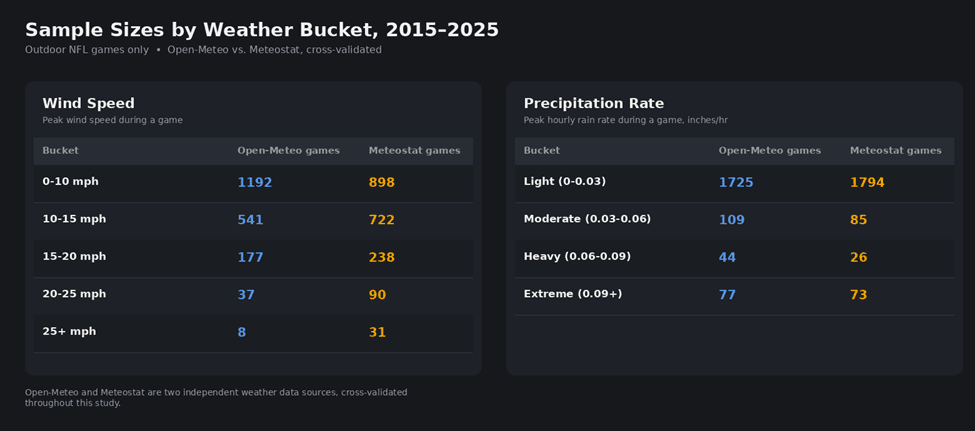
I built a dataset that merges historical play-by-play results with hourly weather observations. Because each source uses different methods (i.e., Meteostat accesses on-site stations while Open-Meteo relies more on computational tools), I pulled both as an internal check. Anyway, heavy or extreme precip rates account for about 3% of the sample. High winds come in at about half of that, making it hard for us to derive any heuristics from what we saw. But small samples have never stopped us before.
The meteorologist is calling for wind (or rain). That means QBs won’t throw as far.
I can see how folks would think playcallers and their operators would have a conservative attitude toward the elements. We don’t want to work when the wind is blowing, or there’s a downpour. Why would they? But then again, they’ve trained for these conditions.
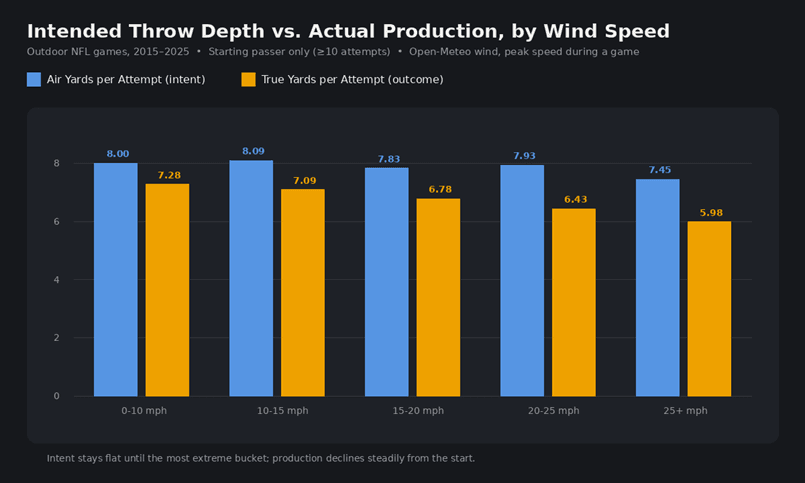
I screened my database for QB performance to see how things change as a function of wind speed. If you’ve seen more work before, the trend across the orange bars should look familiar. Anyway, there are two key takeaways here.
First, as the “Yards per Attempt” portion of the chart indicates, how fast the wind is blowing does matter. QB YPA craters by 17.9% once you get to 25 mph and above. So, on one side of the coin, the haters are right. A sustained heavy draft will reduce a passer’s output. However, the other side of that coin shows up in the other half of the chart.
Air yards per attempt (or passing aDOT) is a better measure of intent. Essentially, the metric points to what the signal-caller wants to do. And by all accounts, they still want to sling it! We’ve only got a 6.9% drop at the extreme. But the delta between intent and outcome brings us to the next typical narrative.
Don’t expect anybody to complete any passes with the wind blowing.
The analogy I’ve always used is playing golf. It’s not that there’s a gust or two in the area, but its direction. I can correct for a headwind or tailwind. But I might as well toss a sleeve of balls in the trees if the wind is going side-to-side. Surprisingly, QBs feel my pain.
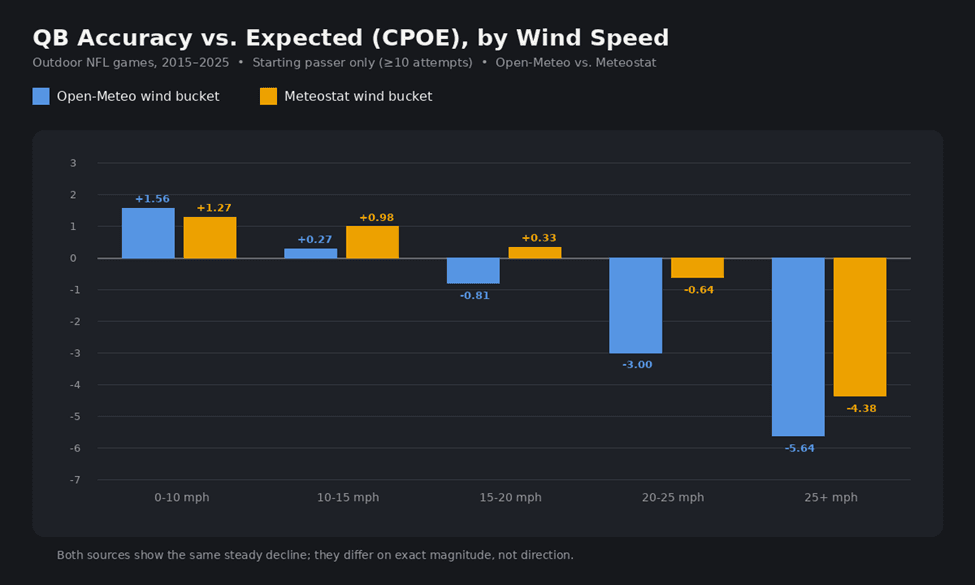
To be clear, I didn’t dig into wind vectors (not yet, at least). My focus was the magnitude. But accuracy does take a hit as speed increases, independent of the data source. And I chose the metric of interest for a reason.
Completion percentage over expected (CPOE) grades a throw on a curve. We consider short passes to be high-percentage attempts because they’re more likely to turn into a reception. Whereas lobs to the boundary or downfield increase in difficulty. Completing them gives QBs “bonus points” on the harder throws, but equally dings them on misfires in easier situations. So, since the intent on the last chart highlights a similar approach to high winds and we’ve got a negative CPOE, extreme conditions win here. Rain gives us a comparable conclusion, too.
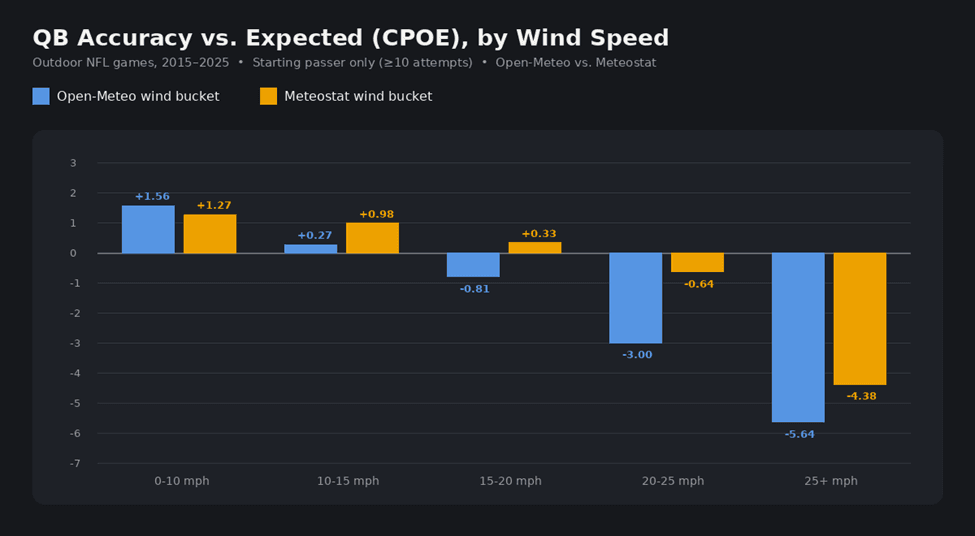
The thresholds are arbitrary bounds I’ve used after years of studying precip rates. Coincidentally, the data gives us the same story. The worse it gets outside, the tougher it is for passers. But go all the way back to the sample chart before you start to worry. These game environments don’t happen too often. Not every hoofbeat comes from a zebra. Again, the extremes are the scenarios of concern. Regardless, there’s one more narrative to address.
It’s going to be a slog. Start your RBs!
Expecting rushers to take over a game is the natural extension of our QB concerns. An offense has to move somewhere. If not through the air, then by land. But again, each chart that’s given us hints at what an offense WANTS to do has suggested everything’s (mostly) normal. Let’s see if the playcalling data agrees.
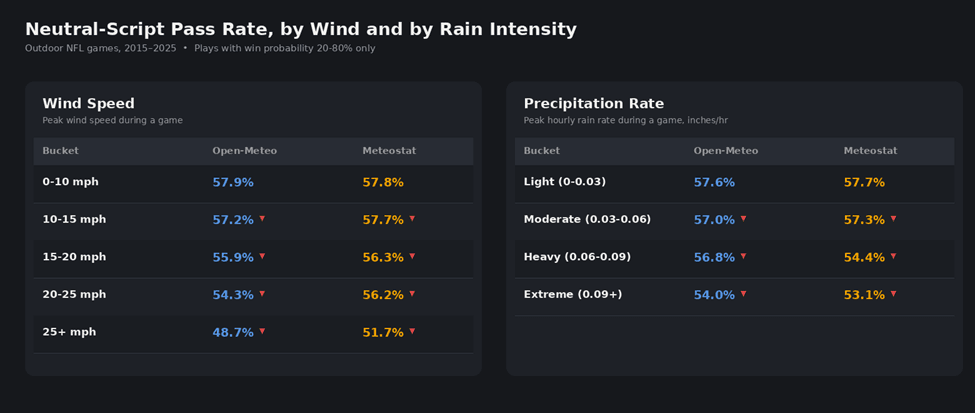
I used neutral-script passing to avoid any scenario where running would be the optimal play (i.e, when ahead and trying to run out the clock). Again, there’s no massive shift until we get past 25 mph. Pass rates fall by 6.2% up until then. So, if quarterbacks want to throw the same and playcallers are trying to stress defenses as if they were in a dome, let’s dig into what changes for fantasy managers when the forecast is undesirable.
What Actually Matters With Weather For Fantasy Football
The instant reaction to weather reports on Sundays is the adjustment to rankings. It’s not uncommon to use the playing environment as a tiebreaker. But let’s not go overboard. I’ll use an example from last year.
Sure, it’s one data point, but it helps me set up the larger conclusion.
Models for Chicago showed 20 mph winds ahead of kickoff. With Caleb Williams’ (at times) erratic play, starting Rome Odunze felt like a coin toss. Volume wasn’t the issue. His 14.2-yard aDOT was. But 10 targets and a TD later, anybody who banked on Odunze’s talent left that game satisfied with the result.
Simply put, projectable targets and touches are what matter. Volume is king. We’ve heard that saying for years. And there’s no asterisk. No caveat that a player who earns looks is only startable in the best environment. In either case, if that were a problem, we’d see a shift in their workload.
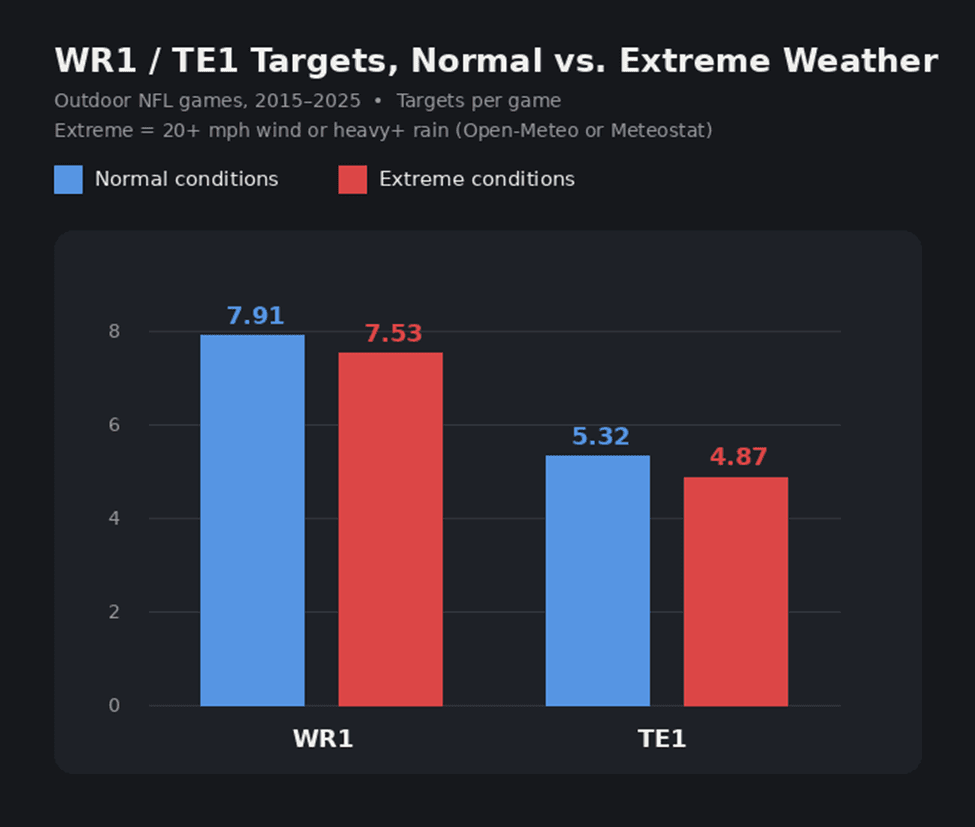
Start your studs! I don’t know about you, but if I’m not sitting Ja'Marr Chase on the chance he sees a HALF of a target less than normal. Now, I presented the data to you this one because of the practical application. However, the decline signifies a real loss across the 11-year sample. Said another way, we may just get a median outcome from our receiver instead of a true top-12 result. Let’s go back to the Bears’ game I just brought up.
- (Odunze) Targets: 10
- Receptions: 6
- Yards: 86
- Touchdowns: 1
Without the two-yard score, Odunze turns in 13.6 PPR points on the day on a 25.7% target share. That second number is great! However, the point total looks pedestrian relative to expectations. It’s why I focus on how players try to operate instead of results, because it changes our perception.
Regardless, a reduced number of targets (however slight) passes the sniff test. We already noted pass rates are on a downward trajectory anyway. It stands to reason even a team’s primary option would see a minimal cut. However, the more-pressing issue is if our WR1’s offense falls apart due to the weather.
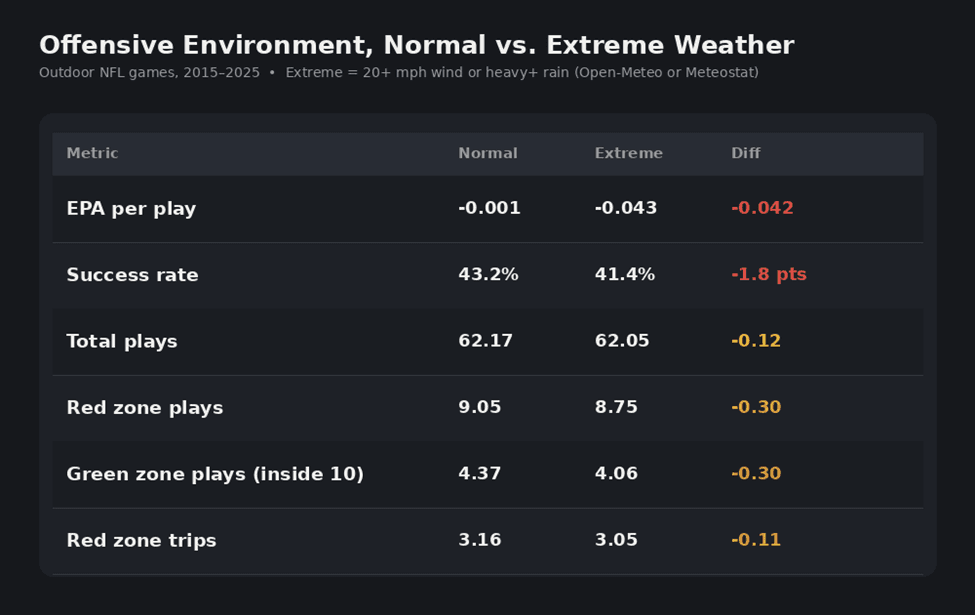
The good news is that we’re only seeing minor dips in team-level efficiency and play volume. But the decrease in scoring situations should force us to reset expectations. Like the Odunze example, the continuation of his role as the WR1 gave us a top-10 result. But he goes as the offense does. Especially given his downfield usage. So if there are red flags surrounding a player in normal conditions, adjusting our expectations and even adding upside elsewhere on our rosters can mitigate the risk of a bad-weather game.
So Where Does All This Leave Us?
If you ignored the Sunday morning news cycle, missed the live broadcast, and just looked at the boxscores, well, two things there. First, you’d miss out on the highs and lows of being a fantasy manager! The agony of a last-minute information dump altering the worldview of your lineup is a core part of our “job.” But more importantly, the boxscore (likely) wouldn’t look any different.
As we’ve established, the stat sheets on a bad weather day won’t look much different than any other game. QBs don’t turn into checkdown merchants. You don’t see the Sean McVays and Kyle Shanahans of the world scrambling for a new set of plays. Like the postal service, neither rain nor heat nor gloom of night will alter the operation. Sure, the worst conditions (e.g., +25 mph winds, heavy precipitation) should give us pause. But otherwise, arguing about the weather is, coincidentally, like the Simpsons’ meme of the old man yelling at the clouds.
However, when the forecast does point to an abnormal scenario, look at the profile of your skill players impacted. Check to see if their role is secure. Save the bench-worthy panic for the Sundays that actually earn it, because most of them won't.

Unlock Our Tools!
Stop hitting the paywall. FL+ gives you access to our premium in-depth content, expert rankings & projections, mock draft simulator, and all the tools you need – all personalized to your league.
Players Mentioned in this Article
Presented by

 CalebWilliamsQBCHI
- PPG
- 9.2
- Proj
- 16.9
 RomeOdunzeQWRCHI
 Ja'MarrChaseWRCIN
Published