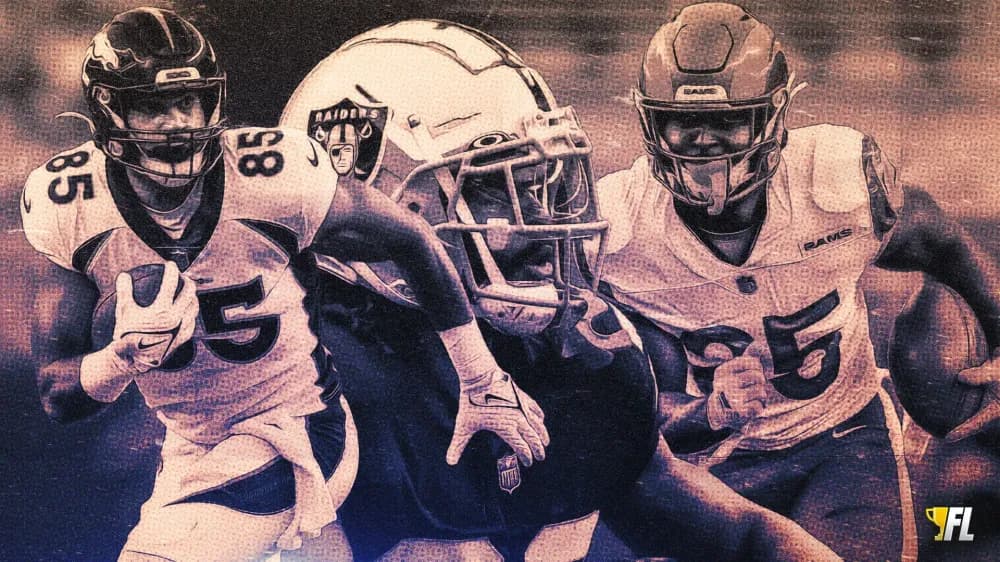
Building A Dynasty Team From Wasted Potential: Lessons From Shoulda-Been All-Stars
Jake Trowbridge takes a ... cathartic ... trip down memory lane to highlight lessons we've learned from dynasty shoulda-been all-stars of our past.
If you’ve been playing dynasty long enough, you’ve experienced the pure joy of acquiring a rising star. You’ve also experienced the distinct sorrow of watching that star vaporize in the night sky.
In the spirit of self-reflection and healing, I’ve decided to build an effigy to the players from my dynasty past that lured me in with tantalizing promise … and then broke my heart. These players all had stretches of fantasy brilliance, or elite traits, or a golden opportunity on a thin depth chart. But it just didn’t work out.
I’m not here to brood. On the contrary. I want to show my appreciation for everything this group of fantasy disappointments taught me.
Let’s take a stroll down memory lane …

Join Our Newsletter
Trusted by 400,000+ fantasy football players. Get access to Fantasy Life's free award winning newsletter and tools, all in one step.
By registering or logging in, you agree to our Terms of Use and Privacy Policy.
QB: Trey Lance
If you were on social media before the 2021 draft, you’ll probably recall that people were losing their freaking minds about which QB from that draft class would have the best career.
The third overall pick in 2021, Lance was equal parts thrilling and terrifying. The dude only played one full season of college football, but it was a doozy. Lance threw 28 touchdowns without a single interception at North Dakota State, setting an NCAA record for most pass attempts without a pick. More exciting for fantasy purposes, he rushed for 1,100 yards and 14 touchdowns.
That, right there, is the waking embodiment of upside. And a lot of us were so blinded by his ceiling that we couldn’t see the floor was covered in shards of glass.
The 49ers sat Lance in his rookie year behind Jimmy Garoppolo. That’s a pretty strong indictment already. Lance got the nod in his second season, but suffered a season-ending ankle injury almost immediately. Brock Purdy took over, and Lance now spends his days bouncing around the NFL as a backup.
Maybe he would’ve succeeded if not for the injury, but it’s clear he was a developmental prospect and never had the juice to really demand a starting role. I’ve since steered clear of similar (limited) profiles like Anthony Richardson and Ty Simpson.
Lesson(s): Chasing the upside of a raw prospect is a dangerous game. Also, college experience is invaluable for a quarterback.
RB1: Sony Michel
Analyzing rookies is hard. That’s not the lesson; it’s just a fact. Perhaps the trickiest thing is assessing how much each individual injury history really matters.
I’m not a doctor. Hell, I don’t even dress up as one for Halloween because those long white jackets look really unflattering on me. But when a player’s injury history reads like the grocery list of a very hungry cannibal, we should probably start consulting some legitimate medical experts on the matter.
Enter: Sony Michel, whose pre-draft red flags caused some teams to scoot him down or off their draft boards. But not the Patriots. They took Michel at the end of the first round despite the concern of a degenerative “bone-on-bone” condition in his knee due to multiple serious injuries he’d sustained throughout high school and college. Dynasty managers, myself included, let that draft capital mask some genuine concerns.
Because at Georgia, Michel was an explosive, elusive back that just needed more touches to really knock your socks off in fantasy. And if New England felt comfortable taking him in the first round, then he was clearly going to get a big workload.
… And he did. He just didn’t produce much with it. Granted, it’s not like Michel was a complete bust. He put together a few solid seasons as a flex-worthy player. But he wasn’t the same guy we saw in college. And he certainly wasn’t worth taking over DJ Moore, Nick Chubb, Calvin Ridley or Courtland Sutton in your rookie drafts.
Lesson(s): Don’t let draft capital override injury concerns.
RB2: Ameer Abdullah
As a casual Wisconsin Badger fan, I watched Abdullah tear up the Big Ten with Nebraska for years. He even broke the NCAA record for single-game rushing yards. So I fully expected Abdullah to run roughshod over defenses for a good long time at the NFL level.
And although he kicked off his career with a bang—94 scrimmage yards and a TD in his first game—the former Husker never clicked as an offensive weapon. His career longevity is owed mostly to his skills as a kick returner. And that didn’t make sense to this casual Badger fan.
But folks who watched ALL the tape on Abdullah probably could’ve guessed that fumbles would be part of his undoing. Abdullah fumbled the ball 24 times at Nebraska. Unfortunately, he brought that part of his game with him to the Lions, fumbling five times in his rookie year. That, along with an untimely foot injury, kept him out of the starting running back picture.
Don’t get me wrong, I think it’s pretty damn cool that Abdullah is still playing. It’s just … he looked like such a damn good dynasty asset on paper! We deserved better!
Lesson(s): Grind the rookie tape HARD. Or find someone who does that you can trust.
WR1: Travis Fulgham
You ever see a name that just ruins your day …?
No rug has ever been pulled faster than the one beneath the feet of this sixth-round pick out of Old Dominion. Fulgham truly appeared out of nowhere, brought into the fantasy landscape with a puff of smoke.
He stepped into a starting role for the Eagles in Week 4 of the 2020 season and immediately started producing. Through five games, the little-known receiver had 44 targets, 435 yards and four touchdowns. It was a hot streak that sent dynasty managers scrambling to the waiver wire to deplete their FAAB on Howie Roseman’s next great diamond in the rough.
And then … poof. He disappeared. Fulgham played another eight games with the Eagles that season, but totaled just nine catches, 104 yards and no touchdowns over that span. In the offseason, Fulgham was waived by Philadelphia. He played in just one more game in his NFL career.
So what the hell happened?? In short, the Eagles' first-round rookie Jalen Reagor came back from injury and booted Fulgham back to the sideline. That’s right, Fulgham was edged out by one of the most notorious fantasy busts of the last decade. Oof.
Lesson(s): Opportunity only gets you so far. Talent is much more important, especially at WR.
WR2: Terrelle Pryor
When a player has a middling start to their NFL career, they have a couple of choices: 1) They can work harder to improve, or 2) They can try switching positions to see if that does anything. Terrelle Pryor chose the latter. And for one glorious season, it looked like the best choice anyone has ever made.
Pryor came into the league via the Supplemental Draft as a hyper-mobile quarterback. But after failing to do much in his first few years, he made the bold decision to transition to wide receiver.
And holy horse nuts did that pay off! In his second year playing the position full-time, Pryor posted a 1,000-yard season, leading the Browns in targets by a mile. And he was only 27! He still had plenty of time to grow and become an even better dynasty asset. Clearly, it made sense to get in on the second floor of Pryor’s career.
But no. His career fizzled out after that season. Pryor would never again top 40 targets or 300 yards. To be fair, he dealt with minor injuries that could be partly to blame. But part of me wonders if there’d been some “beginner’s luck” in the mix, as well.
I’d love to say that I completely learned my lesson with players like this, but my brief dalliance with Antonio Gibson (who converted from WR to RB) says otherwise.
Lesson(s): Don’t be tempted by the siren song of the position switch.
TE: Albert Okwuegbunam
[Longest sigh of my life] So … here’s the thing …
Yes, I drafted Albert O. in the third round of my rookie draft. But everyone else on the board sucked, AND Okwuegbunam was a “traits darling.” He posted a 99th-percentile speed score for his position at the NFL Combine. He was tall. He had a wide frame. He was a dynamo in the end zone. But he was also extremely raw.
So when the Broncos drafted him in the fourth round, I don’t think anyone expected immediate dominance. But surely we’d get a little taste of what he could blossom into? With a third-year breakout on the horizon? WRONG.
He was stuck behind Noah Fant. And Greg Dulcich. And Eric Saubert. NONE OF WHICH DID MUCH OF ANYTHING. Now, he’s clinging to the Raiders roster behind much, much better tight ends.
Okwuegbunam entered dynasty leagues doing cartwheels and left them through the back door on his tiptoes.
Lesson(s): Not every super athletic TE will become a star. Or even fantasy relevant.
FLEX: Gary Barnidge
I’m sorry, but this man … this man stomped on our dreams until they were piles of sad little goo and we must talk about it!
Barnidge had that super common eighth-year breakout that everyone in the biz knows is a real thing. At 30 years old, the Browns tight end enjoyed his first 1,000-yard season … which also happened to be his first 250-yard season.
But it’s easy to talk yourself into a player like this as a dynasty value. If you didn’t scrape him off the waiver wire, you could reasonably expect to get a trade discount because, hey, he’s really old. But also, plenty of tight ends enjoy fantasy relevance well into their 30s, right? So there’s still room for growth.
Not with Barnidge. This guy played just one more NFL season that yielded a disappointing TE19 finish. So no, he did not take my team to a championship, thanks for asking.
Lesson(s): Super late breakouts are fun, but rarely lasting. Also, maybe don’t trust the Cleveland Browns.
Join Our Newsletter
Trusted by 400,000+ fantasy football players. Get access to Fantasy Life's free award winning newsletter and tools, all in one step.
By registering or logging in, you agree to our Terms of Use and Privacy Policy.
Published