
Dynasty Fantasy Football Trade Strategy: The Benefits of Losing a Trade on Purpose
Jake Trowbridge takes an unconventional approach to walking you through dynasty fantasy football trade strategy — why losing a trade on purpose can reap longer-term rewards.
Like so many men in their late 30s, I was a big fan of the movie Fight Club growing up. All these years later, there’s one scene from the psychological thriller that’s really stuck with me. It’s even informed how I navigate my dynasty leagues.
No, not the tutorial on how to make soap out of human fat. No, not the part about punching yourself in the face to get your boss fired, either. The scene I’m talking about features Brad Pitt’s character, the leader of the titular … uh … let’s call it ”social group”, giving his brawling devotees a homework assignment:
“You’re gonna start a fight … and you’re gonna lose.”
For the characters in the movie, this was meant to chip away at their pride and help them embrace the inevitability of failure. And to realize that giving up control can be very freeing. But when translating this same idea to your dynasty leagues, the takeaways are a little different …

Join Our Newsletter
Trusted by 400,000+ fantasy football players. Get access to Fantasy Life's free award winning newsletter and tools, all in one step.
By registering or logging in, you agree to our Terms of Use and Privacy Policy.
Losing a Dynasty Trade On Purpose for the Good Vibes
Now, before I dive into the merits of this strategy, let me be clear that in most of your trading endeavors, I want you to get the best value possible. It’s why we talk so much about players to “buy low” or “sell high” on this very website. We only want the best for you and your team. But every once in a while, the best thing to do for your team is to “lose” a trade.
One of the most underrated aspects of playing in dynasty leagues is developing good relationships with your leaguemates. That, by itself, is often more important than any specific strategy you employ.
So although constantly sniffing out value like a truffle pig obviously has its benefits, sometimes it catches up to us. Over time, all that value hunting builds a reputation that can turn into a bit of a hindrance. It makes others in the league fearful when our snout gets too close to their mushrooms, causing them to recoil rather than engage. And that can limit our opportunities.
More bluntly: No one wants to trade with the person who always has to “win” trades, whether in reality or in their own mind. That person sucks. We should boo that person and throw tomatoes at them. Plus, no one wants to feel like they’re being taken advantage of.
Therefore, “losing” the occasional trade makes you a safe and friendly trade partner in the eyes of your leaguemates. It’s like how your dad would occasionally “lose” a game of H.O.R.S.E. when you were a little kid so that you wouldn’t pout and/or throw the basketball at his crotch. This strategy is as much about self-preservation as anything else. It’s about protecting your crotch.
Losing a Dynasty Trade for the Long-Term Good
Losing a trade doesn’t have to be a permanent thing, either. Losing one trade could be the impetus for you to make another trade that you wouldn’t have otherwise, and THAT trade could put you in a much better spot overall.
Let’s say that, for whatever reason, you just weren’t going to get fair value (or better) for Player A. So you trade Player A for Player G, at what most would perceive as “a loss.” But Player G eventually nets you way more than fair market value in a future trade. Now let me ask you: Did you really “lose” that initial trade?
Alternatively, sometimes a trade that feels bad for you in the moment looks like a masterstroke of genius a few months down the road. The dynasty streets are littered with the ashes of “lopsided” trades that evened themselves out sooner or later, or even overcorrected to favor the opposite side. Dynasty is a fickle beast that way.
I’m not saying you should go into a trade purposely trying to wreck your team. Or that every trade offer should look like a four-year-old got ahold of your phone and figured out your password. But there’s real merit in extending some olive branches, especially to leaguemates who rarely trade.
See, some folks in your league are deathly afraid of looking stupid. They think any trade they make will eventually lead to them lying in bed with the curtains drawn, listening to the entire Elliott Smith catalogue. So they never trade. Often to the detriment of multiple teams, including their own.
You can help those people while helping yourself. By busting through the dam that is their roster with a very gracious offer, you’ve allowed more players to flow freely into the river. By overpaying, you’ve given yourself more downstream opportunities.
Find Your Own Emeka Egbuka
Of course, everyone has to determine what “overpaying” means to them. But generally, it’s more than just tossing an extra 4th rounder onto the side of what you think is an even trade.
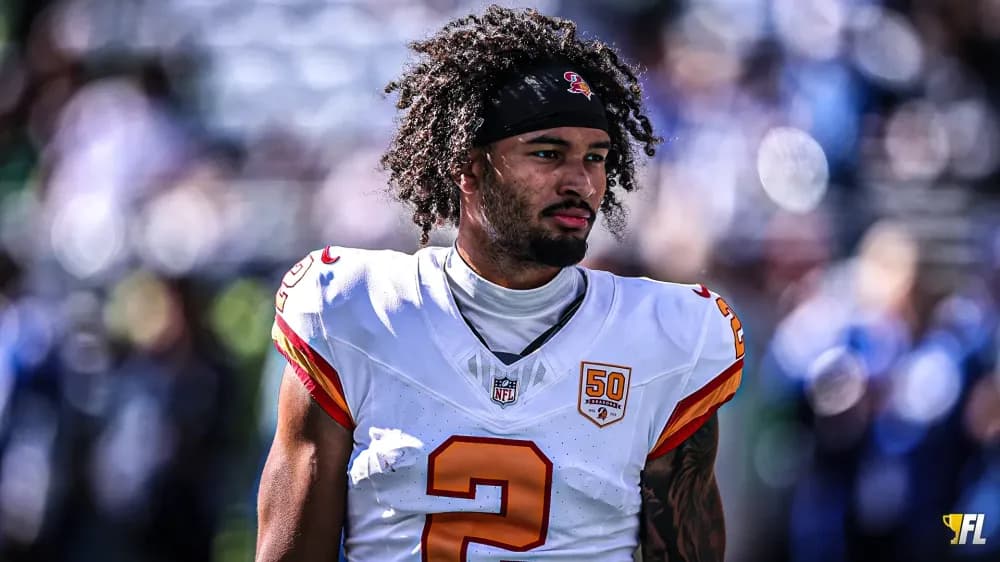
I’ll give you an example. A couple of months ago, amid all the hype of Ted Hurst taking over “the Mike Evans role,” I traded away two first-round rookie picks and an ascending Seahawks wideout, Tory Horton, to get Emeka Egbuka on my roster. This is in a league where depth is vital, as we start three WRs and also have three FLEX spots to fill. So giving up three potentially solid-or-better pieces for a player who’s only flashed some upside is more of a gambit than it would be in standard leagues.
How do I know this was an overpay? Well, for starters, the offer was accepted with lightning speed. That’s rarely the sign of a perfectly fair trade.
But ya know what? I would’ve gladly given up even more. Because I fully believe in Egbuka’s talent. I believe that the version of the Bucs’ receiver we saw in the first five weeks of last season, when he was the WR3 and averaging an outrageous 11.7 yards per target, is the version we’ll see a lot more of in the coming years.
In fact, I think Egbuka could be on that Jaxon Smith-Njigba type of trajectory. So hell no, I’m not going to let a couple of random first-round rookie picks blind me to the value that’s sitting right in front of my face.
Also, I didn’t want to experience the ramifications of NOT overpaying for a player I love …
Don’t Regret What Could Have Been
Here’s an opposite example. I’m about to get really vulnerable with you all, so please be gentle with me.
About a year ago, in a TE-Premium league, I was offered Tucker Kraft and a couple of throwaway rookie picks in exchange for Bucky Irving and T.J. Hockenson. Bucky was coming off a phenomenal rookie season, and I felt the other person was trying to take advantage of my Packers fandom. I liked Kraft a lot, but didn’t want to fork over such a high-value asset to get the deal done (going against my own wisdom that says not to overvalue young running backs).
A deal involving Kraft was eventually made, but I wasn’t a part of it. And now? The manager who has Kraft has latched onto him with a kung fu grip. As they should. So what felt like an overpay back then would now be a drop in the bucket, especially given the questions surrounding Bucky’s role alongside Kenneth Gainwell.
I lost that trade by not making it. Don’t be like me. Learn from me. Or else, as Tyler Durden might put it, the players you own will end up owning you.
You have your homework assignment. Now go out and lose a trade.
Join Our Newsletter
Trusted by 400,000+ fantasy football players. Get access to Fantasy Life's free award winning newsletter and tools, all in one step.
By registering or logging in, you agree to our Terms of Use and Privacy Policy.
Published