Fantasy Football Rankings For 2026: Drake London and More Expert Rankings vs. Consensus Differences
Joe Metz breaks down the consensus fantasy football rankings at Fantasy Life and highlights a trio of players that an expert is way higher on, or way lower on.
For this week’s fantasy football rankings update, instead of focusing on the changes made by one of our individual experts, I wanted to take a step back and evaluate the consensus half-PPR rankings as a whole.
Our experts are mostly in line with each other from player to player, but not every player. Below are two groups of players—a trio that some of our experts are noticeably higher on than the consensus ranking, and a trio that they are lower on relative to consensus.

Unlock Our Tools!
Stop hitting the paywall. FL+ gives you access to our premium in-depth content, expert rankings & projections, mock draft simulator, and all the tools you need – all personalized to your league.
Higher Than The Consensus Fantasy Football Rankings
 Trey McBride | TE | ARI
- FL Consensus: 23 (TE2)
- Freedman’s Ranking: 16 (TE1)
One of the most widely debated topics of the 2026 fantasy season is whether Trey McBride or Brock Bowers deserves the title of TE1 throughout the preseason. With Klint Kubiak in town and a new-look offense in Vegas, the consensus belief at Fantasy Life is that we’re in store for a big enough Bowers bounce back to vault him into the TE1 spot, while additional competition for touches in Arizona may be enough of a knock on McBride to knock him down to TE2.
Not for Freedman, though.
McBride’s role is simply something we haven’t seen before at the tight end position. His 694 routes run in 2025 not only led the tight end position, but all positions—65 more routes than Ja’Marr Chase, and 121 more routes than Travis Kelce, the TE2 on a total routes run basis.
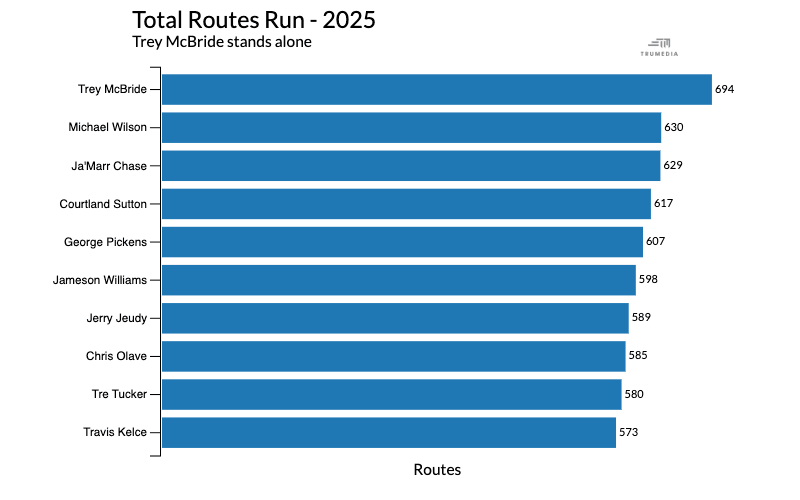
And just how elite was McBride on those routes? His 23% targets per route run ranks second at the position (Harold Fannin, 24%), and his 27% target share ranks first. Expecting some regression is warranted. We don’t know how many games we’ll see out of Jacoby Brissett, and it’s hard to imagine he’ll be slinging the ball 40+ times per game with the team investing so much in their new RB1.
That said, it’s impossible to argue that McBride belongs outside of the top two tight ends this season, and while I’m drafting more Colston Loveland than both McBride and Bowers, it’s simply due to the multi-round discount with similar upside (TE1 overall). There isn’t really a more bulletproof pick at tight end this season than McBride.
 Rome Odunze | WR | CHI
- FL Consensus: 68 (WR31)
- Kendall’s Ranking: 57 (WR28)
While Kendall is only three WR spots higher on Rome Odunze than our consensus, she’s nearly a full round ahead on him from an overall rankings standpoint.
The discourse around Odunze has been far from positive this offseason. It’s been centered around one of two things—the assumed breakout of Luther Burden, and comments Odunze recently made about adjusting to a ‘new normal’ after rehabbing his foot injury.
But what if Odunze really is the WR1 in Chicago?
Through the first eight weeks last season, Odunze averaged 13.3 0.5-PPR points per game, good for WR1 status (WR11). He operated with a 26% target share, 23% TPRR, a Utilization Score of 76 and a 93% route participation rate—WR1 numbers across the board.
From Week 9 onward, he found himself on the injury report, in at least some capacity, in 8 of 10 weeks, missing four of the 10 games. Because of the sour taste left in drafters’ mouths, Odunze is the cheapest pass catcher of the main Bears options, carrying a WR3 price tag.
Could Ben Johnson have had a plan for Odunze, and it was simply injuries that derailed that plan? It’s quite possible. It’s also quite possible that the late-season breakouts of both Burden and Loveland will deprioritize Odunze in the offense. But it’s also possible that, with the removal of DJ Moore and an offseason to get healthy, Odunze could assume a similar role that we saw at the beginning of last season.
At his current price, there’s virtually no downside relative to just how much upside Odunze comes with; it just might not feel as fun as clicking on his pass-catching teammates.
 Josh Downs | WR | IND
- FL Consensus: 100 (WR43)
- Dwain’s Ranking: 73 (WR35)
I’ve already written about the rise of Josh Downs’ stock in a recent Fantasy Life Newsletter, so I’ll keep this brief with a recap of what I said:
“Recent camp quotes point to a larger role for Downs in 2026, with him lining up outside and being used all over the formation and giving him ‘ample opportunities to play on the outside and exploit mismatches against opposing defenses.’
With Downs rocking a 29% targets per route run rate against man coverage last season, that points to a ton of fantasy upside.
This news got Dwain to up his route share to 84% (73% over the last three years) and move him into pole position in the Colts’ pass-catching room, leading the team with a projected 109 targets—he was projected for 98 before the news, third behind Pierce (101) and Warren (105).”
As Dwain’s WR35 now, Downs is 8 spots ahead of consensus in the WR rankings, and a whopping 27 spots ahead of his consensus ranking in our overall half-PPR rankings. He’s a screaming buy in your home leagues, where he’s bound to go multiple rounds later than he’s going in sharper best ball drafts right now.
Lower Than Consensus Fantasy Football Rankings
 Drake London | WR | ATL
- FL Consensus: 12 (WR7)
- Dwain’s Ranking: 17 (WR8)
London’s ranking difference between our consensus and Dwain’s ranking is far less about the positional difference (WR7 vs. WR8) and more about the five-spot drop from the No. 12 overall player to the No. 17 overall player. Going from a Round 1-2 turn player to a mid-Round 2 player is a significant difference early in drafts.
Despite Kyle Pitts getting paid, there really isn’t much target competition behind London. The bigger question mark is what we’re going to get out of his quarterback play, but honestly? It might not matter a ton. He was catching passes from Kirk Cousins and Michael Penix last season, and going from Cousins to Tua Tagovailoa feels like a lateral move at worst, considering Tagovailoa’s history of supporting multiple fantasy-relevant wideouts.
London is currently the WR7 in our half-PPR projections for 2026 (259.6 total points) with a projected stat line of 93 catches on 140 targets, 1,204 yards and nearly 8 receiving touchdowns (7.7). That equates to 5.8 catches and 75.3 yards per game on 8.8 targets. That projection, assuming the quarterback play can maintain itself as league-average, feels more than attainable given his target-earning ability (27% TPRR, 30% target share in 2025). I’m all-in on London in 2026.
 De'Von Achane | RB | MIA
- FL Consensus: 15 (RB8)
- Ian’s Ranking: 20 (RB12)
I’m surprised more of our rankers aren’t as low as Ian is on De’Von Achane this season, because there isn’t a player who I have a harder time clicking in Round 2 than Achane right now.
His utilization in 2025 was downright elite—75% snap share, 62% of the rushing attempts, 23% TPRR, 20% target share, 92 Utilization Score. He was the definition of a do-it-all back, even logging 42% of the inside-the-five attempts despite his lack of size at the goal line.
There are simply too many red flags ahead of 2026 to get me to trust him at this price.
He has a new quarterback in Malik Willis, who posted a 19% scramble rate in his limited action last season (and 8% designed rush attempt rate).
He has a new head coach in Jeff Hafley, who is far-fetched to feed a back of Achane’s size (5-foot-9, 191 pounds) as many touches as Mike McDaniel did, given the latter’s creativity with schemed touches for Achane.
And he’s the sole playmaker in the Dolphins offense, with the most barren room of pass catchers in the league. While this could be spun as a position in full-PPR formats, defensive game plans are going to be crystal clear in 2026—take away De’Von Achane, and you’ve taken away the Dolphins’ offense.
Achane could very well prove me (and Ian) wrong and go scorched-Earth this season, but I’m taking the safe bet and betting against that and leaning into the systemic failure I expect out of this offense.
 Breece Hall | RB | NYJ
- FL Consensus: 33 (RB14)
- Freedman’s Ranking: 45 (RB17)
Similarly to how Kendall’s Odunze ranking contrasts with the consensus, Freedman’s Breece Hall ranking is less about the positional ranking difference (3 RB spots) and more about how he is a full round behind consensus from an overall ranking standpoint.
Hall just got a ringing endorsement from the Jets with a three-year, $45.7M contract extension, and when he’s been on the field and healthy, he’s been great. In the three years since his rookie year, Hall has averaged 1,453 yards and over 7 touchdowns per season, and he’s only 25!
So why the concern?
The god damn Jets.
Not only did the Jets bring in Frank Reich as their new offensive coordinator—a questionable decision considering that the last two times we saw Reich command an offense, they finished bottom-three in scoring—but also because of HC Aaron Glenn’s recent comments about wanting to get all three running backs involved in 2026. While I don’t expect a full three-headed committee, it’s going to be annoying when we see Breece Hall get the Jets to the goal line, only to be subbed out for bruising backup Braelon Allen.
Talent could ultimately win out here, though. Hall oozes it, and it’s obvious when he’s on the field. The Jets offense could theoretically be better than last season, despite the Reich hiring, too, considering that Geno Smith proved capable of running a functional and often competitive offense in 2024 with the Seahawks.
Hall’s range of outcomes is wide. At his current third-round ADP, I don’t feel strongly one way or another about clicking on Hall, but my preference would be to have him as my RB2 on a roster rather than the running back I anchor a team around when I’m prioritizing pass catchers.

Join Our Newsletter
Trusted by 400,000+ fantasy football players. Get access to Fantasy Life's free award winning newsletter and tools, all in one step.
By registering or logging in, you agree to our Terms of Use and Privacy Policy.
Players Mentioned in this Article




Published Updated