Forced Missed Tackles: Using Them To Identify A Potential Top-12 RB
Chris Allen breaks down the nuances of Forced Missed Tackles and how we can use them to further our conviction in fantasy football.
Sometimes the most direct solution is the best one.
I’ve often mentioned I’m an engineer by trade. I just cosplay as a writer every now and then. Anyway, writing code to automate data analysis or signal interpretation is a common part of the job.
On the surface, it’s easy. The formulas are already well known. My only task is to combine the information with the algorithms to spit out something I can use to evaluate. The code I write works. But then I’ll show my brother.
For context, he has a background in computer science. Programming has an elegance to it, in his eyes. And I have to hand it to him. His scripts make mine look like a code-by-numbers exercise. However, at the same time, the reliability of my brute-force tactics is just as valuable.
In football, we praise the creativity and gracefulness of some players. Route-running or blazing speed is highlight-worthy. But sometimes, being able to take a hit and keep going or weaving around it altogether is just as good.
The Definition of Forced Missed Tackles
“A forced missed tackle is when a player successfully avoids a tackle by fighting through or maneuvering around it.”
A tackle, or getting tackled, is a natural part of the game. An offensive player has the ball. The defenders have to bring them down. And in some cases, there’s little a ball carrier can do to avoid getting stopped.
A receiver draped by a corner and safety in a contested catch situation likely isn’t going anywhere after they make the catch. RBs plowing into stacked boxes have a similar outlook. But we’ve seen plenty of players with the ability to use their strength or agility to make the defense miss and pick up a few extra yards. The Ravens’ RB1 is the poster child for the first half of the definition of a forced missed tackle.
Nate Hobbs tried to trip up Derrick Henry’s feet, forcing him to re-establish his balance and maintain forward momentum. Then Charles Snowden attempts to take Henry down by his shoulder pads. Big mistake, as a stiff arm not only sent the Raiders’ LB to the sideline, but allowed the former Titan to pick up another ten yards.
It’s easier to highlight rushers as examples of “fighting through” attempts to stop their progress because of the constant contact. Receivers can get the same treatment, though.
We need a stat to measure how demoralizing a play is for the opposition. It’s probably EPA, but the nerds have already claimed it. In either case, A.J. Brown being able to leverage his 227-lb. frame would make the proposition of limiting his progress all the more difficult for a slight-framed safety or corner. Brown posting the highest forced missed tackle rate amongst WRs in neutral situations (26.2%) reflects his athletic power. However, power comes in many forms.
First off, there was a brief period where I thought the Bengals were going to lose to the Panthers. Second, Chase pinballing off defenders is still a marvel. Contact balance and ball control are traits we value, but can’t measure until they’re right in front of our eyes. Forced missed tackles, in part, capture those attributes. And coincidentally, examples like the ones provided by some of our top draft picks highlight why the metric can be so important to our game.
Why Do Forced Missed Tackles Matter?
Well, unfortunately, they don’t.

With a 0.04 R-squared value (0.02 for WRs), the connection between forced missed tackles and fantasy points is non-existent. Metrics gauging volume (carries, targets) or efficiency (success rate, EPA) would be better direct indicators of on-field production. But look at those plays again. Actually, I won’t make you scroll up. I’ll let Garrett Wilson do some of the work here.
Pause the video at 0:02. I count four Dolphins within five yards. Wilson took a 14-yard pass and turned it into a 36-yard gain. He added 2.2 expected points to his offense. That matters! But to see how much it matters, let’s reframe our approach.
- How often does any player avoid or break a tackle?
Since 2020, running backs with more than 50.0% of their team’s carries (i.e., the team RB1) have averaged a forced missed tackle rate of 20.0%. At roughly 17 carries per game, that’s only three missed tackles a week. For WR1s, the per-week total is even less. Receivers boasting a target share north of 25.0% only broke tackles on 10.0% of their receptions. That’s maybe one each week (0.9 for my nerds).
Put another way: because forced missed tackles don’t happen every play, they shouldn’t correlate to overall fantasy points.
- OK, so then what metric(s) should forced missed tackles influence?
Now, scroll up and look at the previous clips. See if you can spot the commonality across them all. And, to help, I’ll give you one more from the reigning OPoY.
The answer? Explosive plays.
Over the last five seasons, of the 1572 carries to gain at least ten yards, there were 991 missed tackles (63.0% forced missed tackle rate). For the rushing plays that generated 15 yards or more (665), RBs avoided 535 tackles (80.5% FMT rate). Or, said another way, it’s harder to pick up chunk yardage without making the defense miss at least once. So, to test my theory, I tried to connect missed tackles to explosive play rate.

There’s not a strong tie because, again, big plays or even missed tackles don’t happen on every snap. But having the ability to power through or stay upright after a collision is at least an indicator of being able to create an explosive. And for players with those traits, they have access to a ceiling in fantasy that should warrant them being on our rosters.
How Can You Use Forced Missed Tackles?
Qualitatively, we can use forced missed tackles as a way to separate the source of a player’s production into two buckets: talent and situation. An ideal instance gives us the best of both worlds, like Bucky Irving’s rookie campaign.
On top of accruing the ninth-most forced missed tackles of any RB (min. 100 attempts), the former Duck earned a 9.2% target share in an offense that ranked top-five in every efficiency metric. There’s a reason Irving was able to force a timeshare between him and Rachaad White. Actually, now that I think about it, there’s a baseball analogy here.
I was just in Chicago the other week and caught a Cubs game with some friends. They taught me about barrel rate. Essentially, how often a batter is making optimal contact with the ball. Sometimes they fly out. Other times, it’s a home run. I’ll liken forced missed tackles to it in the sense that you won’t always get an explosive play or touchdown. But the ingredients are there. And the more often a player puts those skills on tape, the greater the chance for an outlier performance. In either case, quantitatively, we can use the metric to find underrated players during the draft.

Unsurprisingly, breaking a tackle or finessing your way around one isn’t an ability that instantly goes away. From a year-to-year standpoint, historical data at least indicates we can expect a similar outlook for RBs. Accordingly, if we look at the rushers with strong workloads and the capacity to regularly elude defenders, one guy sticks out from the crowd.
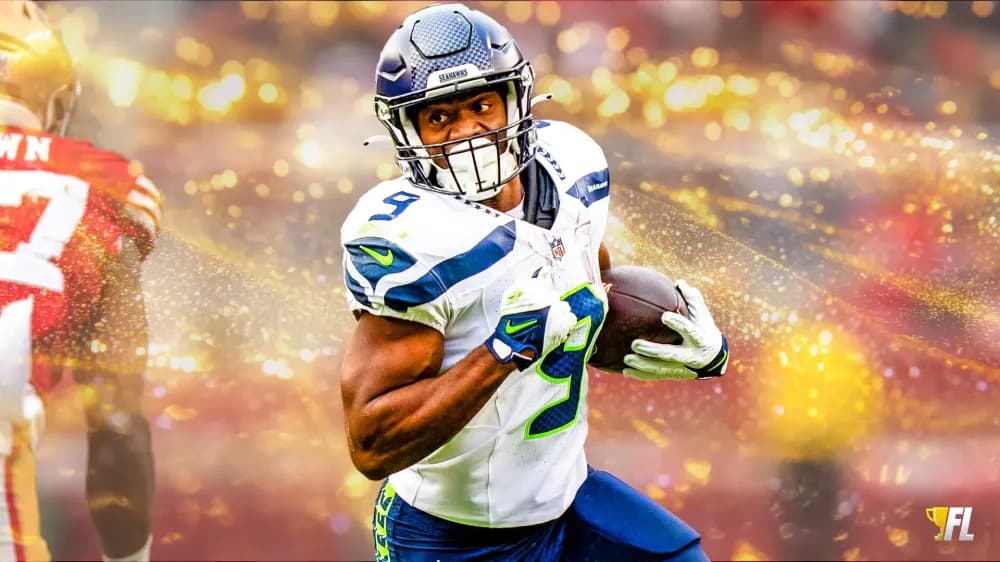
Kenneth Walker III had the eighth-most forced missed tackles in 2024. He was just behind Saquon Barkley at 61. However, Barkley had over twice as many carries during last year’s regular season. Walker’s absurd 39.9% forced missed tackle rate is the highest of any RB with more than 150 carries since 2015. His innate talent should have him in the conversation for one of the best pure runners in the league. But his situation clouds the issue.
- Zach Charbonnet matched or exceeded nearly all of Walker’s metrics as the starter.
- The offensive line is still a work in progress.
- Sam Darnold is now the QB.
However, the OC switch to Klint Kubiak has been a footnote in the story of Seattle’s offseason. Kubiak’s use of outside zone-run concepts was a staple of the Saints’ offense in ’24 (46.3% OZ run rate, third-highest). A shift to this style of rushing would be a benefit to a one-cut runner like Walker, while keeping the pressure off Darnold. So while most might want to fade a seemingly potential down year from the Seahawks, their RB1’s penchant for hitting homeruns has the potential to boost him back into the top 12.
Unlock Our Tools!
Stop hitting the paywall. FL+ gives you access to our premium in-depth content, expert rankings & projections, mock draft simulator, and all the tools you need – all personalized to your league.
Players Mentioned in this Article
Presented by





Published Updated