How To Leverage Explosive Play Rate For Fantasy Football
Chris Allen breaks down the ins and outs of explosive plays and explosive play rate, breaking down how we can leverage the metric for fantasy football in 2025.
You could sell me on any thriller movie in one sentence.
A man is trying to track down his wife’s killer, but he suffers from memory loss? Say no more.
Two detectives realize that the string of murders they’re trying to solve represents the seven deadly sins? I’ve got 30 minutes.
A good tag line is my kryptonite. I know what I’m getting. Multiple intriguing storylines will ratchet up the tension. A few action sequences or jump scares will keep the plot moving. But I’m waiting for the big reveal that will flip the whole movie on its head.
Explosive plays are like the revelation in a movie. We know (or hope) they’re coming. More importantly, a big gain can swing the story of an entire game. Or, if enough of them happen in a single contest, they’re the only thing we’re talking about the next day.
The Definition of Explosive Plays in Football
“An explosive play is any attempt that gains more than 15 yards (rushing) or 20 yards (passing).”
Honestly, I considered skipping the definition. We know what explosive plays are! They’re the replays we look for during a game. The highlights we’re happy to scroll past after a day of watching football. To be fair, the yardage thresholds can change depending on the source. But it’s easy to spot a big play when it happens in real time.
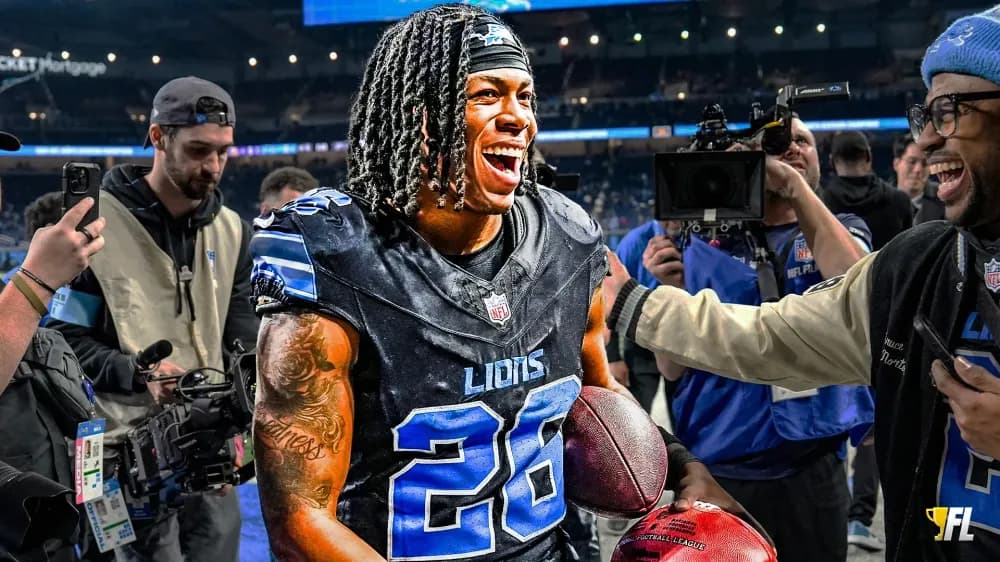
If there was any wager worth placing on a weekly basis last year, it was betting the over on Jahmyr Gibbs’ longest rushing attempt. Detroit’s RB1B (?) accrued 25 runs of 15 yards or more. Derrick Henry and Saquon Barkley had the same amount. However, the sophomore’s ability to pick up chunk gains should stick out amongst the older guys based on play volume alone.
- Gibbs: 25 (explosive plays), 250 (total carries), 10.0% (explosive rush rate)
- Henry: 25, 325, 7.7%
- Barkley: 25, 345, 7.2%
The question isn’t just “if you can” inject volatility into a game, but “how often.” Without considering explosive play rate, Gibbs looks like the other guys. The Lions, Ravens, and Eagles can all claim strong offensive line play. Their play-calling tendencies are all more run-focused. But his place in a timeshare with David Montgomery puts him at a disadvantage. Peripherals like ranking first in explosive play rate amongst all RBs, plus posting a success rate above 50.0% with a target share over 10.0% are why he’s a first-round staple. Despite the lesser workload, Gibbs has (weekly) access to a ceiling. We can apply a similar concept to receivers.
Take a guy like Rashod Bateman, for example.
The fourth-year vet averaged over two fewer looks per game than teammate Zay Flowers (4.2 vs 6.8). Of course, we’d rather draft and start Flowers. But Bateman’s 13.5-yard aDOT, with Lamar Jackson throwing him the ball, mind you, warrants reconsideration. As Jackson still notched a top-six deep-ball rate, having the WR he targeted the most downfield in your FLEX doesn’t sound so bad.
Regardless, we see these types of plays every game. Even better, we usually know they’re coming. A.J. Brown against the Commanders’ secondary. Henry facing Cincinnati’s run defense. Fantasy managers can take advantage of certain situations simply by comparing offensive strengths against defensive weaknesses. But there’s more to explosive plays than finding a potential outlier for a single game.

Why Does Explosive Play Rate Matter?
I haven’t used this bit in a while, but let’s do some mythbusting to highlight the importance of explosive plays.
- Explosive plays are a volume stat.
I get the sentiment. Agnostic of position or role, the more you’re out there on the field, the greater the chance of breaking a long run. However, in this case, we’re conflating two ideas.

Yes, an extra throw, target, or tote is another shot to pick up more yards. But it doesn’t guarantee an explosive play. Derrick Henry and Saquon Barkley emphasized this point last year. Their workloads (i.e., being RB1s with little to no competition for touches) set the floor for production expectations. Talent and situation helped us visualize their ceiling outcomes. The other positions are no different.
Joe Burrow threw the ball 652 times in ’24. Nobody else crossed 600 attempts. And yet, he only had the 11th-most completions to go for more than 20 yards. However, bringing him up dovetails into the next myth.
- Explosive plays are luck-based events.
That’s fair.
Explosive plays are like forced missed tackles in that they don’t happen often relative to normal plays. The average explosive passing rate was only 13.3% in 2024 (min. 200 dropbacks). Going back to the Burrow example, that meant maybe three per game. For RBs, their explosive play rate dropped to 8.2%. I’d understand chalking up the low frequency to randomness. However, there’s a reason these things keep happening with the same players.

There’s always a stat we seem to ignore that influences something we care about. For passers, the ability to process defenses and get the ball out on time would help when the coverage allows for a shot downfield. There are related traits for RBs.
Rushers who can plow through defenders (or run around them) also have the talent to turn a short gain into a long one. It’s like trying to hit a pitch in baseball. As long as you’re making contact, eventually, you’ll put one over the fence. Accordingly, an R-squared of 0.19 between historical forced missed tackle rate and explosive rushing rate points us in the same direction. There’s some skill behind momentum-shifting plays.
Ultimately, “busting” these two myths underscores the importance of explosive play rate. It can indicate who’s good beyond their great plays. We knew Gibbs could challenge for the overall RB1 spot if given a larger workload. And it wasn’t just because he was racking up 10-plus-yard runs faster than any other ball carrier. He had the underlying metrics to complement the home runs. Similarly, explosives can also force us to challenge our priors.
We left Darnell Mooney for dead after two disappointing seasons in Chicago. I didn’t have him posting the third-highest explosive play rate amongst WRs on my bingo card. And again, his resurrection didn’t hinge on contested catches. He earned more targets (100) than A.J. Brown (95). But the big catches worked exactly as intended. They got our attention.
How Can You Use Explosive Play Rate?
Unfortunately, explosive play rate doesn’t exhibit any year-to-year stickiness that we can trust.

Intuitively, this makes sense. We can look at play-calling philosophies and preferred styles to gauge attempts. Even player-specific stats such as completion percentage over expectation or yards after the catch might help us build a case for their ceiling potential. But we still have to account for defensive adjustments. And personnel changes between seasons can shift how each offense operates. Therefore, during our drafts, we can’t assume a team or player’s explosive play rate will repeat from the previous year.
Instead, let’s focus on what we learn during the season.
I wasn’t surprised seeing Russell Wilson dunk on the Bengals in real time. Hurt? Absolutely. However, by comparing his explosive pass rate to his down-to-down efficiency, I could cope with the outlier performance.
- Explosive Passing Rate (Weeks 7-13): 5th (out of 33 qualifiers – min. 100 dropbacks)
- EPA per Dropback: 5th
- Passing Success Rate: 19th
Remember, EPA awards big plays. It’s like grading with extra credit. Success rate only asks if the result was positive or not. Ideally, the two would align. But in Wilson’s case, he was (still) living off the deep shots. Consequently, there was a half-life on his time as a productive starter. J.K. Dobbins had a similar year.
I mean, don’t get me wrong. Seeing a player return from injury is always a compelling story. But we need to fully contextualize their production before translating it into actionable fantasy advice. Folks saw his back-to-back 100-yard games and declared him the value-pick of the season. But again, once you get under the hood, you can see how his weekly output wasn’t sustainable.
- Explosive Rushing Rate (Weeks 1-6): 1st (out of 14 qualifiers – min. 50.0% team rushing rate)
- Forced Missed Tackle Rate: 8th
- Rushing Success Rate: 12th
It’s not to say Dobbins was incapable of being useful for our purposes. However, he was as efficient as D’Andre Swift and Breece Hall on a down-to-down basis. It just so happened Dobbins was cranking out homers as often as Derrick Henry with the same workload. We were right to focus on the (recovered) talent, but by using explosive play rate in conjunction with other stats, we can get a true sense of a player’s range of outcomes.

Join Our Newsletter
Trusted by 400,000+ fantasy football players. Get access to Fantasy Life's free award winning newsletter and tools, all in one step.
By registering or logging in, you agree to our Terms of Use and Privacy Policy.
Players Mentioned in this Article
Presented by





Published