Tight End Tiers For 2026 Fantasy Football: Can Colston Loveland Challenge Tier 1?
Dwain McFarland breaks down his TE tiers for 2026 fantasy football drafts, going player-by-player through his top 10 tiers, guiding you through draft strategy at the position.
One of my favorite exercises in fantasy football is creating tiers because it forces us to think in buckets rather than strictly in individual rankings. Finding values and fades relative to fantasy football ADP becomes easier with this approach, too.
It also helps frame players through the lens of floor and ceiling. That’s critical when building a roster. If you pass on an early-round TE, you need ceiling options to catch early-round TE drafters, but might also need an option that can hold the line early.
Ultimately, identifying the small group of players with league-winning upside is the priority, and that remains the focus here. The approach blends data-driven insights with context around how offenses and roles could evolve in 2026.
Because of that, these tiers won’t perfectly align with my fantasy football rankings or fantasy football projections. Players are grouped based on talent, age, role certainty, and team environment. Please note, these TE Tiers were updated on Aug. 26 for the latest news, injuries and other reports
For more on the data and concepts referenced throughout, check out What Matters for Tight Ends in Fantasy Football, which lays the foundation for this analysis.
My QB Tiers and RB Tiers are already LIVE, y'all:
Before we start, here are a few housekeeping items:
- Historical points = PPR scoring.
- This is mostly re-draft focused, where upside matters even more, but I have included some bestball notes.
- References to personnel groupings refer to plays between the 20s because of this.
New Additions (7/27): Hunter Henry and Dalton Schultz have been added to the Tier 8 Tight Ends.

Join Our Newsletter
Trusted by 400,000+ fantasy football players. Get access to Fantasy Life's free award winning newsletter and tools, all in one step.
By registering or logging in, you agree to our Terms of Use and Privacy Policy.
Tier 1 Fantasy Football TEs for 2026
- Brock Bowers | Raiders
- Trey McBride | Cardinals
This tier of TEs comprises our proven high-end talent options who are in their prime.
 Brock Bowers | Raiders
- Age: 23.8 (Prime)
- Fantasy PPG (23-25): 15.5, 14.7
Bowers has secured TE3 finishes in PPG in each of his first two seasons. In Year 2, he picked up a PCL injury in Week 1 that impacted his performance. He averaged 16.6 PPG after returning from injury, finishing in the top 12 in six of eight contests.
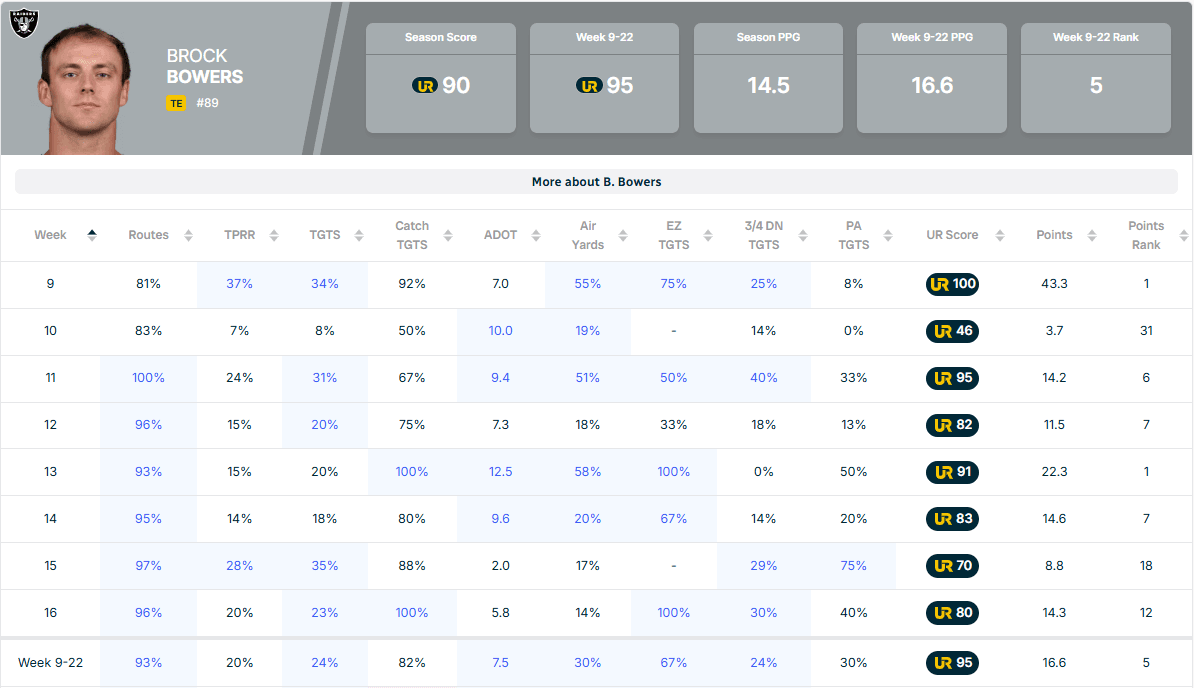
At tight end, receiving yards per game (YPG) is one of the stickiest metrics, and Bowers ranks third in the NFL at 64.6 over the last two seasons. He posted 70.2 YPG as a healthy rookie before dipping to 56.7 last year.
He is the No. 2 TE prospect all-time in the Rookie Super Model, and his early-career underlying data backs it up: Bowers ranks fourth in yards per route run (YPRR) at 1.89 over that span.
Year 3 sets up well with Klint Kubiak taking over as head coach and playcaller. Kubiak has leaned into heavier personnel between the 20s:
- 12 Personnel (1 RB, 2 TE, 2 WR): 30% (+8 vs NFL average)
- 21 Personnel (2 RB, 1 TE, 2 WR): 16% (+10)
- 22 Personnel (2 RB, 2 TE, 1 WR): 7% (+5)
Those looks boost TE production relative to 11 personnel:
- 11 Personnel: 0.34 fantasy points per route for TEs
- 13 Personnel: 0.55 → 62% boost
- 22 Personnel: 0.53 → 56% boost
- 21 Personnel: 0.42 → 24% boost
- 12 Personnel: 0.36 → 6% boost
Fewer WRs on the field generally means a higher target probability. While 12 personnel isn’t a huge efficiency spike, it’s a path to more routes—top-100 ADP TEs have posted an 85% route rate since 2019.
TEs can get squeezed in 21 personnel due to blocking demands, but Kubiak called Bowers a “football robot from heaven,” and his versatility should keep him on the field.
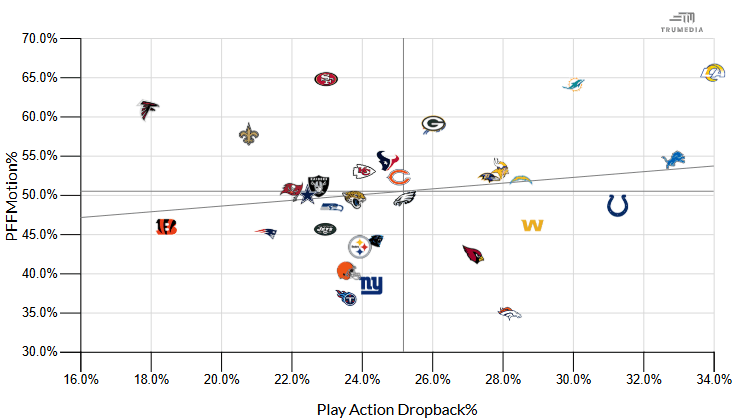
Kubiak has also been a plus pass-game schemer. TEs have seen a 69% boost in fantasy points per route on play action and 21% when in motion. His 2025 Seahawks ranked 7th in play action (28%) and 7th in motion (58%) on dropbacks.
With no proven target earner at WR, this offense should run through Bowers—he has a real shot to lead the NFL in receptions.
The swing factor is overall passing efficiency. Kirk Cousins showed late last year that he can support a TE1, but Fernando Mendoza will likely start at some point, adding volatility.
I have the Raiders projected for 218 passing yards per game (vs. 225 league average). Top-three TE seasons can still happen in that range, but a surprise passing season from Las Vegas would be a bonus.
Bowers projects for 15.7 PPG, with a consensus average draft position (ADP) of 20. That projection would deliver +1 PPG higher than historical TEs taken from mid-Round 2 to early-Round 3 and provide 1.8 wins above replacement (WAR).
- Superpower: Talent + scheme + lack of target competition.
- Kryptonite: Passing offense upside.
Bottom Line: Bowers is a difference-making option worthy of a late Round 2 to early Round 3 pick in drafts as the TE1 off the board.
 Trey McBride | Cardinals
- Age: 26.8 (Prime)
- Fantasy PPG (23-25): 10.7, 15.6, 18.6
McBride has posted TE2 and TE1 finishes over the last two seasons, averaging 71.6 and 72.9 YPG. Historically, he fits the archetype of TEs that keep on keeping on.
His TDs jumped from 0.13 and 0.18 per game to 0.65 in 2025. There is a risk of negative regression in 2026, but I do not believe it will return to prior levels. The truth probably lies somewhere in between.
The reason? He is a premium-talent TE in his prime who was due for positive regression last year. McBride ranks third in YPRR (1.94) over the last two years among TEs with at least 250 routes, backing up his PPG and YPG.
The bigger questions center on the offense. Arizona could turn to Round 3 rookie Carson Beck at some point, and oddsmakers have them at 3.5 wins.
I am projecting a dip in both pace and pass rate under new head coach Mike LaFleur. Arizona should remain pass-leaning due to game scripts, but more balanced than 2025.
Team 2025 numbers vs 2026 projections:
- Plays per game: 62.4 vs 61.3
- Pass rate: 69.5% vs 63.5%
Target competition is also worth noting. Marvin Harrison Jr. missed time last season, and Michael Wilson flashed late. McBride averaged 14 PPG over the first six games with Harrison healthy, then 21.1 from Week 7-18 with Harrison out or limited.
The good news: LaFleur is comfortable with TE-heavy concepts, similar to Drew Petzing. Under Sean McVay with the Rams, his offense leaned into heavy personnel—Los Angeles led the NFL in 13 personnel (30%).
That level is unlikely, but enough multi-TE usage should remain to support strong route participation. McBride ranked second in slot snaps (54%) last year, and the addition of Kendrick Bourne isn’t enough to materially threaten his role.
LaFleur also brings a heavy play-action and motion-at-the-snap background from McVay, where the Rams have been among the league’s best in both areas over the last two seasons.
- Superpower: Elite TE talent in his prime.
- Kryptonite: QB uncertainty
Bottom Line: McBride is my TE2 and is worthy of targeting in Round 3, but is less appealing in the middle of Round 2.
Tier 2 Fantasy Football TEs for 2026
- Colston Loveland | Bears
- Tyler Warren | Colts
In this tier, we have young talents in above-average to good offenses that must prove they can take the next step. If they do, they could challenge the Tier 1 options.
 Colston Loveland | Bears
- Age: 22.4 (Early Prime)
- Fantasy PPG (25): 10.3
Loveland didn’t step into a full-time role until Week 16, but he exploded once given the keys. He posted a 99 Utilization Score with 16.8 PPG over a five-game stretch through the divisional round, averaging 72.3 YPG with a 29% target share.
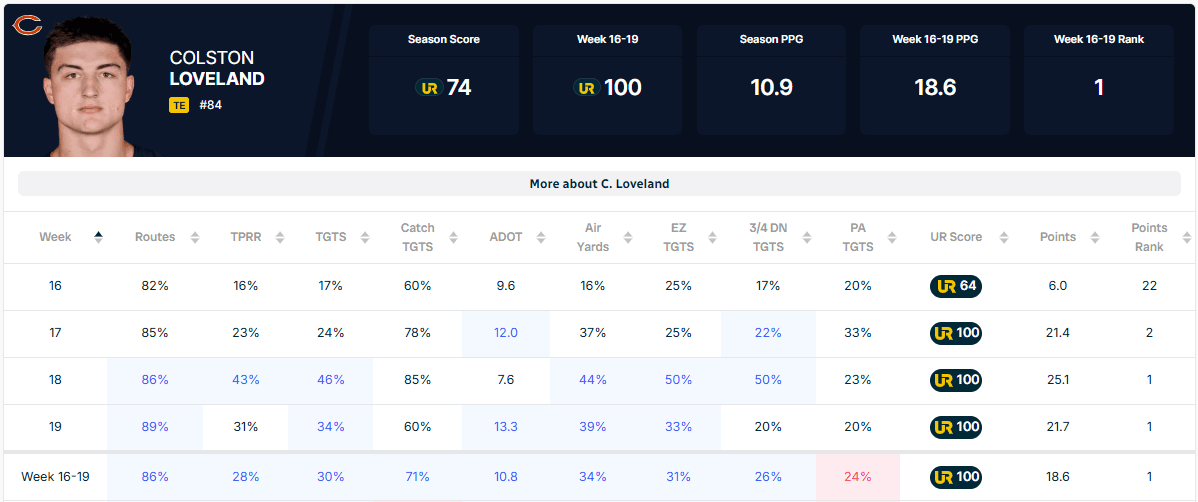
It’s a small sample, but the profile backs it up. Loveland was the No. 4 all-time prospect in the Rookie Super Model (89/100), and his 1.98 YPRR ranks as the third-best rookie TE mark since 2011, behind only Brock Bowers and Kyle Pitts.
He brings a rare combo of target-earning and vertical usage (10.0 aDOT), the same traits that have driven ceiling seasons from Rob Gronkowski, Jimmy Graham and Mark Andrews.
With DJ Moore gone, the Bears’ WR room thins out, setting Loveland up for a full-time role. Ben Johnson leaned into TE-friendly personnel last season, using 12 personnel on 33% of plays (5th) and 13 personnel at 9% (5th)—both strong signals for TE route volume and production.
Johnson also creates high-efficiency looks for his pass catchers. Chicago ranked 6th in play action (33%) and 6th in motion at the snap (59%), two areas that consistently boost TE efficiency.
There will be target competition. Rome Odunze was heavily involved before injuries piled up, and Luther Burden is expected to play a full-time role. Still, this projects as a consolidated offense with plenty of Year 2 upside under Johnson.
- Superpower: Ascending TE with a rare blend of target-earning and field-stretching ability.
- Kryptonite: Could struggle with target competition if Caleb Williams doesn't progress.
Bottom Line: Loveland is my favorite TE bet to surprise as the No. 1 option in 2026, making him my most drafted option. He goes 20 picks later than Bowers/McBride.
 Tyler Warren | Colts
- Age: 24.3 (Prime)
- Fantasy PPG (25): 11.1
Before Daniel Jones was lost to a season-ending Achilles injury in Week 14, Warren averaged 12.9 PPG with a 21% target share.
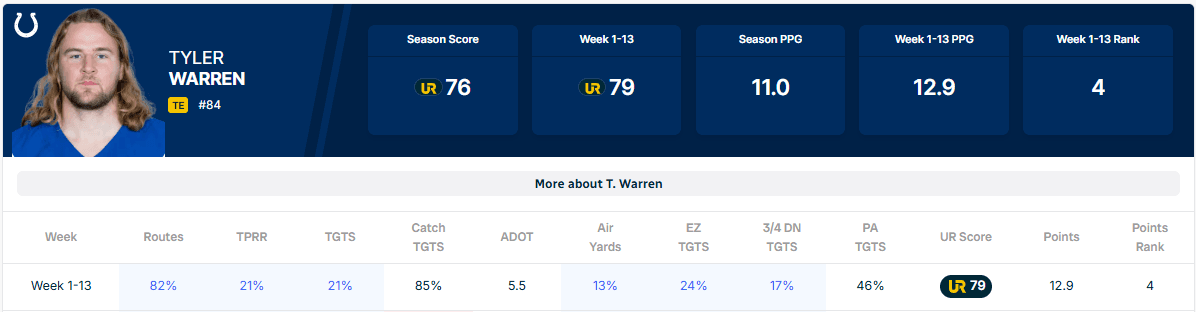
Over those 12 games, he averaged 57 YPG with a 1.95 YPRR. That's not too shabby for the No. 5 prospect all-time in the Rookie Super Model with an 84 rating. He was a focal point against zone coverage with 25% targets per route run (TPRR) and 2.20 YPRR.
Warren is an ideal catch-and-run TE who can turn short targets underneath (5.9 aDOT) into big plays. He ranked second in the NFL in yards after the catch (YAC) at 6.2 yards per reception among TEs with at least 250 routes.
With Michael Pittman traded to the Steelers, we could see a leap in targets in Year 2 from Warren. Last season, he had a 24% target share on 48 routes without Pittman.
Shane Steichen's offense ranked 13th in 12-personnel (25%) and 4th in 13-personnel (9%). It would make sense for the Colts to be in the market for a WR3, but they have three other TE options they like, who are all of the blocking variety—a plus for Warren when they are on the field.
Steichen also leaned into play action (32%, 3rd) and motion at the snap (57%, 8th).
Update (8/26): Warren is dealing with a Grade 2 groin strain that he picked up on Aug. 19. The team is playing it smart with him, and he is reportedly on track for Week 1. He also picked up some new target competition in Keenan Allen. He remains in Tier 2, but is a tad shakier with these developments.
- Superpower: Ascending YAC talent who could dominate targets.
- Kryptonite: Can Daniel Jones succeed again in 2026?
Bottom Line: Warren offers the type of profile that could position him as a high-end TE1 next season. I prefer Loveland, but Warren goes later in fantasy drafts.
Tier 3 Fantasy Football TEs for 2026
- Tucker Kraft | Packers
- Kyle Pitts | Falcons
Tier 3 boasts another group of prime TEs, each with risk but also the potential for a boom. They have a clear path to a big-time role in decent offenses. Think ceiling.
 Tucker Kraft | Packers
- Age: 25.9 (Prime)
- Fantasy PPG (23-25): 6.8, 9.6, 14.7
Kraft averaged 16.2 PPG over the first seven weeks before tearing his ACL, ranking as the TE2. Over that span, he averaged 67 YPG and 0.86 TDs.
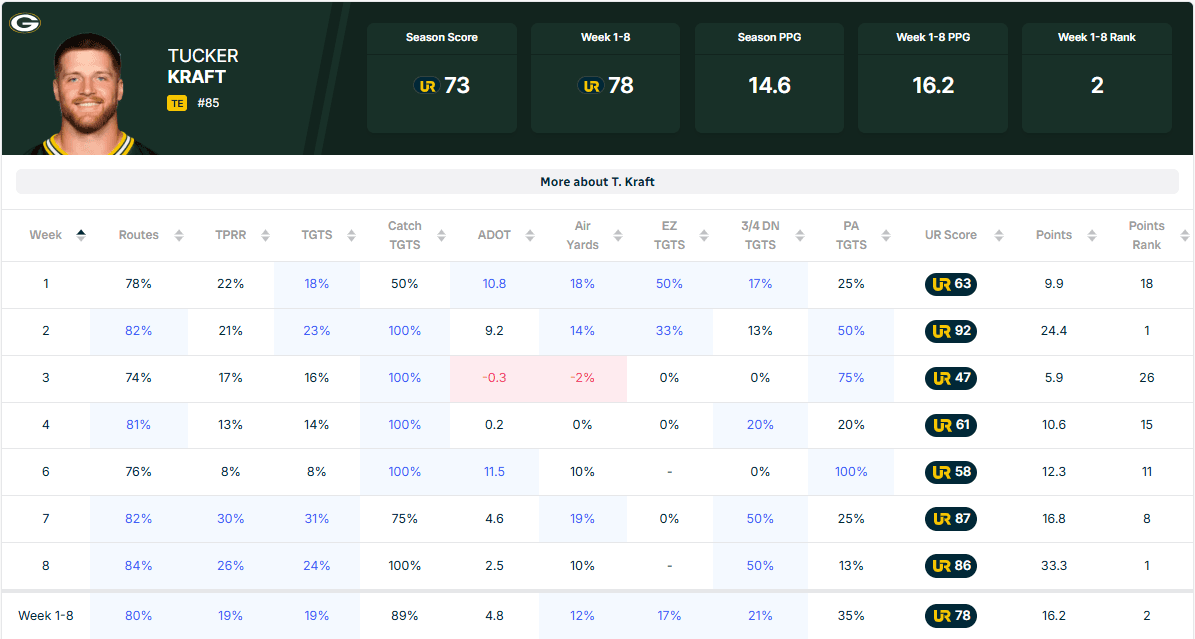
Kraft is the ultimate YAC monster. Over the last two seasons, he has primarily operated under the defense (5.0 aDOT) and escaped would-be tacklers to the tune of 9.8 YAC per reception. That ranks No. 1 in the NFL.
If there weren't health concerns, Kraft would be in Tier 2. But he is recovering from ACL surgery in November and could start training camp on PUP. Kraft's goal is Week 1, and he is ahead of schedule, according to Matt LaFleur. He recently clocked in at 21.5 MPH on the treadmill.
That is all positive news, but Tier 3 provides us with some room for error if he suffers a setback or starts the season slowly.
The other concern with Kraft is his reliance on big plays, given his lower-than-average target share (19%) for a high-end TE1 option. But the Packers are down two WRs in Romeo Doubs and Dontayvion Wicks, which could open up more opportunities. And it just makes sense to get this guy the damn ball.
From a scheme and personnel perspective, Matt LaFleur has been a plus playcaller over the last two seasons.
- 12 Personnel: 28% (7th)
- Play action: 26% (12th)
- Motion at snap: 59% (5th)
The Packers project as my No. 16 passing offense, with 229 YPG, and rank No. 9 in TD passes at 2.6 per game.
Update (8/26): Kraft is working in full team drills and looks fantastic. He is on track for Week 1, but could be on a snap count early in the year. Kraft might be the TE3 in fantasy this year if healthy. So, I am pushing him into Tier 2. Wheels up.
- Superpower: The No. 1 YAC option in the NFL, who is in his prime window.
- Kryptonite: Recovering from ACL surgery.
Bottom Line: Kraft is a HIGH PRIORITY target. He is the most talented TE available at his ADP and could SMASH fantasy leagues, offering high-end TE1 upside.
 Kyle Pitts | Falcons
- Age: 26 (Prime)
- Fantasy PPG (23-25): 12.4
Pitts collected his best fantasy finish (TE5) since his rookie season and was a league-winner late in the year. With Drake London out or playing injured from Week 12 to 18, Pitts averaged 16.3 PPG, hogging 27% of the targets. Over that timeframe, he averaged 70.6 YPG.
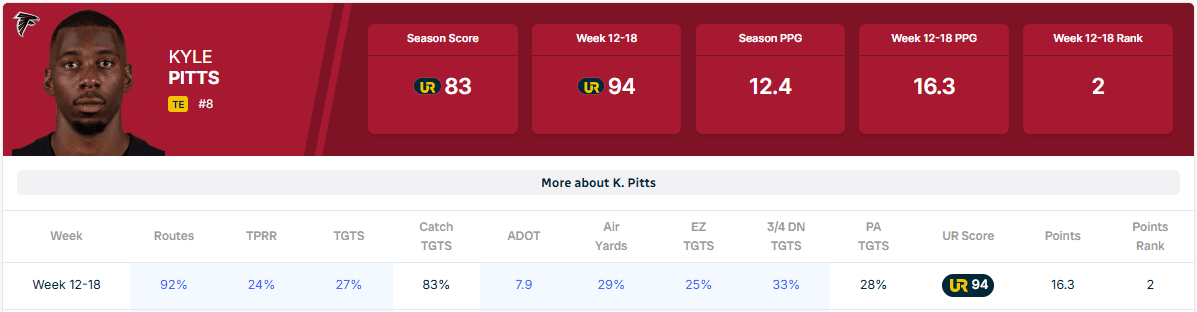
That also coincided with Kirk Cousins as the starter, with Michael Penix injured.
Pitts clearly demonstrated the upside we once thought he had as the No. 1 TE prospect all-time in the Rookie Super Model. There is a part of me that wants to believe Pitts is finally right after his 2022 torn MCL and PCL. It was his best season against man coverage since his rookie season, with a 2.09 YPRR.
But it also took an injury to London for him to get going. Before that, Pitts averaged 9.6 PPG as the TE17 with 43 YPG.
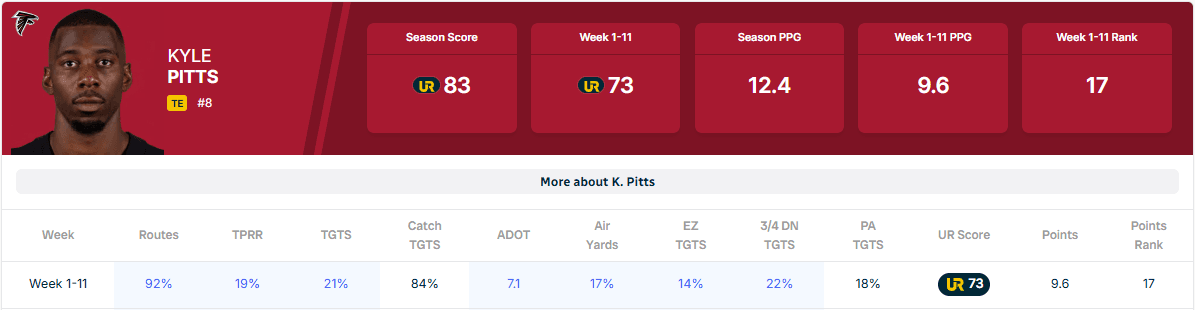
The targets (21%) were solid, but the production wasn't there. It's worth noting that Pitts battled a foot strain and a toe issue during training camp, which may have contributed to the slow start.
Over the last two seasons, Pitts has shifted into a lower aDOT role (8.7 and 7.5), but historically, he has shown field-stretching ability. His average aDOT was 12.3 over his first three years.
Kevin Stefanski has hovered around the league average in play action (24%) and slightly below the league average in motion at the snap (40%) over the last two years. He has deployed 12 personnel, the eighth-most (28%) over that time frame, and they added Austin Hooper in the offseason.
The routes feel very safe for Pitts, especially considering the weak depth chart behind London at WR. But they could come down. He was in outlier territory last year at 93%. Still, this should be a highly consolidated offense across London, Pitts and Bijan Robinson.
The question is whether the team can take a step forward as a passing unit. With Penix recovering from November ACL surgery, they added Tua Tagovailoa. Tagovailoa isn't a team-raiser, but historically, he has done a good job playing point guard. He can get the ball to his best weapons.
- Superpower: Amazing prospect who flashed a rare high-end ceiling in 2025.
- Kryptonite: It took an injury to unlock his upside.
Bottom Line: Pitts is a mid-range to low-end TE1 option with considerable upside but a low floor.
Tier 4 Fantasy Football TEs for 2026
- Sam LaPorta | Lions
- Harold Fannin Jr. | Browns
Tier 4 provides us with more prime-age TEs, but they need more help beyond their control to reach ceiling outcomes. But they have solid floors.
 Sam LaPorta | Lions
- Age: 25.7 (Prime)
- Fantasy PPG (23-25): 14.1, 10.9, 11.9
LaPorta burst onto the scene as the TE3 as a rookie, but has settled into TE9 and TE7 finishes in PPG over the last two seasons. He has averaged 52.3, 45.4, and 54.3 YPG. LaPorta ranks sixth in YPRR (1.75) since 2023.
He remains one of the top young TEs, but the Lions’ passing game runs through Amon-Ra St. Brown. LaPorta then competes with Jameson Williams in more of a 2A/2B setup, while Jahmyr Gibbs adds another high-end target earner underneath.
The saving grace is the offensive environment. Detroit projects as my No. 2 passing offense (261 YPG) and No. 2 in TDs per game (2.9). If St. Brown or Williams were to miss time, LaPorta’s ceiling would spike.
Drew Petzing takes over at OC and brings some of the same levers we look for in top playcallers. While not heavy on motion, his offenses have posted a 27% play action rate (10th) over the last two seasons.
He has also leaned into heavier personnel, ranking fifth in 12-personnel (29%) and second in 13-personnel. Brock Wright handles blocking duties, and Tyler Conklin was added in free agency, leaving Isaac TeSlaa competing with the TEs for the No. 4 option in the passing game.
It’s not a lock Detroit increases heavy personnel usage, but it’s in play. That would help LaPorta’s route volume.
However, don’t expect a major efficiency boost from those looks. St. Brown, Williams and Gibbs will still command targets, even when the Lions deploy 12 personnel.
- Superpower: Plus talent in a high-voltage offense.
- Kryptonite: Target competition.
Bottom Line: LaPorta is a mid-range TE1 with a strong floor and offers high-end TE1 contingency upside.
 Harold Fannin Jr. | Browns
- Age: 22.2 (Early Prime)
- Fantasy PPG (25): 11.7
An injury to David Njoku opened the door for Fannin to step into a full-time role starting in Week 7 as a rookie. From Week 7 to 16—before a groin injury in Week 17—he averaged 12.8 PPG, as the TE6.
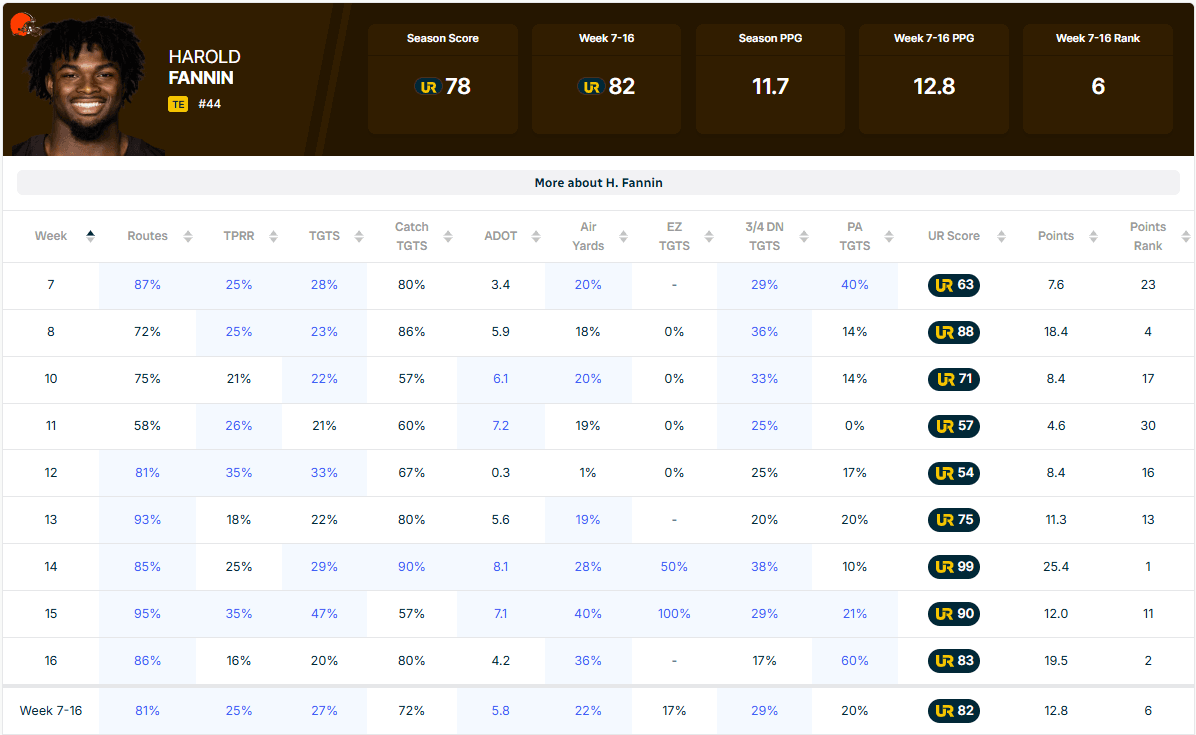
Over that stretch, he led the Browns in targets (27%) and receiving YPG (49.7), impressive on an offense that averaged just 179 passing YPG.
His 1.68 YPRR trailed Loveland and Warren, but context matters given the QB play and environment. The talent profile is strong—Fannin ranks No. 7 all-time in the Rookie Super Model (80) and owns the No. 1 Production Rating (100).
The challenge is the 2026 outlook. Cleveland could again struggle through inconsistent QB play with Deshaun Watson and Shedeur Sanders. I have the Browns projected for 206 passing YPG (30th).
Target competition also increases after the additions of KC Concepcion and Denzel Boston in Rounds 1 and 2.
Todd Monken could improve the scheme, but usage is the key question. His Ravens ranked third in 21 personnel (19%) over the last two seasons.
- How 21 personnel helps: 2.41 YPRR, 0.42 fantasy points per dropback (+24% vs 11 personnel)
- How 21 personnel hurts: 64% route participation rate (-16 percentage points vs 11 personnel)
That creates a trade-off—higher efficiency for TEs on the field, but fewer routes overall if the team prefers a different TE for blocking.
Monken also used the second-most 12 personnel (34%), though that was with Mark Andrews, Isaiah Likely and Charlie Kolar. Cleveland did add Joe Royer in Round 5, but WR is the strength of this roster, making heavy 12 usage harder to project.
The cleanest path for Fannin is a shift to 11 personnel where he handles a full route load. That outcome is possible, but far from certain.
- Superpower: Uber-talented ascending tight end who can gobble up targets.
- Kryptonite: The offensive environment is one of the worst in the NFL.
Bottom Line: Fannin is a strong TE1 option, but slightly overpriced on sites where he is a borderline Round 5 pick.
Tier 5 Fantasy Football TEs for 2026
- George Kittle | 49ers
It's the George Kittle tier. He is the older model of Kraft—but he's a classic—and would be in Tier 3 if not for age and a late-season injury. Similar upside with more risk.
 George Kittle | 49ers
- Age: 33.0 (Post Prime)
- Fantasy PPG (23-25): 12.7, 15.8, 14.7
Kittle played 11 games last season, including the playoffs. In 10 where he didn’t leave early, he averaged 14.9 PPG with 60 receiving YPG on a 23% target share.
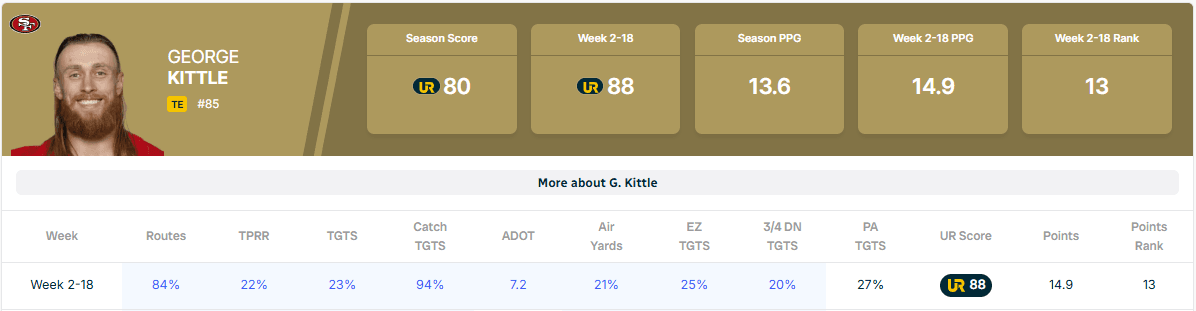
In the two years prior, he averaged 63.8 and 73.7 YPG.
He remains elite on a per-route basis. Kittle led all TEs in YPRR last year (2.18) among players with 250+ routes and ranks No. 1 over the last two seasons (2.46). He has also dominated zone coverage, posting 3.15 and 2.56 YPRR marks over that span.
The concerns are age and injury. Kittle turns 33 this season and is coming off a torn right Achilles tendon suffered in January. Per Dr. Neal ElAttrache, it was a “best-case scenario” repair with a clean tear in a high-blood-flow area. He is expected to open camp on the PUP but has a chance to be ready for Week 1.
The target tree is deeper in 2026. The 49ers added Mike Evans and drafted De’Zhaun Stribing in Round 2, while Christian McCaffrey remains heavily involved. That lowers Kittle’s median projected target share, though he should still operate as the No. 2 or 3 option in Kyle Shanahan’s offense when healthy.
Despite the risks, the impact has been steady—Kittle has produced +1.5 WAR in every season with 14+ games. Drafters are baking in the downside, with Kittle going in Rounds 8-9, depending on site—about a four-round discount from last year.
Update (8/26): Kittle is ahead of schedule in his recovery and is aiming for a Week 1 return. But Week 2 might be in play, given the team's international travel in Week 1.
- Superpower: One of the best TEs of the last decade on a Shanahan offense.
- Kryptonite: Age + coming off injury.
Bottom Line: Kittle could fade due to age and injuries, but offers significant upside if he holds off Father Time one more season. He is a fantastic target if you get boxed out of early TE options.
Tier 6 Fantasy Football TEs for 2026
- Mark Andrews | Ravens
- Dallas Goedert | Eagles
- Travis Kelce | Chiefs
This tier represents post-prime TEs on quality offenses without a shot for decent target shares.
 Mark Andrews | Ravens
- Age: 31.7 (Post-Prime)
- Fantasy PPG (23-25): 13.5, 11.1, 7.7
Andrews has seen a steady decline in PPG (TE5, TE8, TE28) and YPG (54.4, 39.6, 24.8), alongside a drop in YPRR (1.96, 1.89, 1.23).
The downturn aligns with his late-2023 cracked fibula and ankle injury that required a tightrope procedure—one that hasn’t aged well for some veterans:
- Chris Godwin: 19.4 PPG → 9.0 PPG
- Tony Pollard: 15.5 PPG → 12.7 PPG
- Cooper Kupp: 13.5 PPG → 14.4 PPG
On one hand, decline is a real concern.
On the other hand, Year 9 sets up for a rebound in usage with Isaiah Likely gone. Andrews’ route participation has dipped:
- 2023: 79%
- 2024: 66%
- 2025: 68%
The Ravens also lack a locked-in No. 2 behind Zay Flowers. Rashod Bateman enters camp as the favorite, competing with Ja'Kobi Lane (Round 3) and Elijah Sarratt (Round 4).
At TE, the depth chart is unproven. With Likely and Charlie Kolar gone, Andrews faces Durham Smythe (blocker) and rookies Matthew Hibner (Round 4) and Josh Cuevas (Round 5)—neither of whom is a strong college producer.
Declan Doyle takes over as playcaller under Jesse Minter. A Ben Johnson disciple who also spent time under Sean Payton.
The positive: Doyle's offense used 12 personnel 33% (5th) and 13 personnel 9% (5th). With Likely gone, those looks should help stabilize Andrews’ route participation, even if weekly usage varies. The Bears also used play action 33% (2nd) and motion at the snap 59% (6th).
The negative: Payton-style systems often rotate TEs. Last year, Evan Engram led that offense but managed only a 56% route rate.
Still, Andrews projects as one of the top three receiving options on a Ravens team I have as the No. 16 passing offense (229 YPG) and the No. 3 offense in total TDs per game (2.9).
Update (8/26): The word out of training camp is that Andrews does not look good. He still belongs in this tier, but I have moved him down to borderline TE1 territory.
Bottom Line: Andrews is a descending talent, but the removal of Likely and a weak depth chart give him a shot to produce in a solid environment. He is a high-end TE2.
 Dallas Goedert | Eagles
- Age: 31.7 (Post Prime)
- Fantasy PPG (23-25): 9.7, 10.4, 12.3
Goedert has settled in as a mid-to-low TE1 the last three seasons (TE12, TE11, TE6), averaging 42.3, 49.6, and 39.4 YPG.
Last year, he ran hot in the TD department—a red flag for lower-YPG TEs historically:
- 2023: 0.21
- 2024: 0.20
- 2025: 0.73
That’s especially concerning for an aging profile.
The counter is a major offensive shift. A.J. Brown is gone, and Sean Mannion takes over as playcaller after two years under Matt LaFleur. That opens the door for redistribution, even with Makai Lemon (Round 1) and Eli Stowers (Round 2) entering the mix. They could collectively absorb Brown’s 30% target share, but Goedert should claim a portion.
These developments make me bullish on Goedert despite the arrivals of Makai Lemon (Round 1) and Eli Stowers (Round 2), who could blossom but are unproven. Maybe collectively they replace Brown's 30% target share, but part of those opportunities are also available to Goedert.
We’ve already seen the ceiling without Brown. Over the last two seasons in those splits, Goedert commanded a 32% target share with a 2.69 YPRR on 140 routes.
The scheme also works in his favor. The Packers used 12 personnel at a 28% rate (6th) under LaFleur, and that should carry over with Mannion. It’s a natural way to keep Goedert’s routes intact while integrating Stowers.
The addition of FB Carson Steele also points to the potential of more 21 personnel, where Goedert would remain on the field. The key question is how much 11 personnel work Stowers takes, but the veteran has the edge.
Mannion should also bring more under-center looks, play action, and motion:
- Play action: 26% (12th)
- Motion at snap: 59% (5th)
I have the Eagles projected for 212 passing YPG (28th), with upside under Mannion. Even with a 4% route participation hit baked in for Stowers, Goedert still projects as the TE11.
Bottom Line: Goedert has been in decline, but he is a strong low-end TE1 option with sneaky upside due to a changing offensive environment. With a TE13 ADP, going after pick 100, he is my most-drafted veteran TE.
 Travis Kelce | Chiefs
- Age: 37 (Post Prime)
- Fantasy PPG (23-25): 14.6, 12.2, 11.4
Kelce has posted TE1, TE7 and TE9 finishes over the last three seasons, averaging 65.5, 51.4 and 50.1 YPG. His YPRR has also declined (1.92, 1.45, 1.49), aligning more with borderline TE1 production recently.
He is operating at the extreme edge of the age curve, but players like Kelce are the reason that curve has an edge—outlier talents who sustain relevance longer than expected.
The positives for Kelce:
- Plays with Patrick Mahomes.
- Plays with Patrick Mahomes.
- Plays with Patrick Mahomes.
Mahomes hasn’t been quite the same recently, but the Chiefs still project for 244 passing YPG (5th), well above league average.
Beyond Rashee Rice—who carries off-field risk—the Chiefs lack a proven, high-volume target earner. That keeps Kelce firmly in the mix as a top option in the passing game.
Kansas City also reunites with Eric Bieniemy and has signaled a shift toward more balance with added schematic boosts. KC over the last two seasons:
- Play action: 24% (18th)
- Motion at snap: 53% (11th)
Bottom Line: Kelce is trending down, but should still be the No. 2 or No. 3 option for Mahomes. He is a low-end TE1.
Tier 7 Fantasy Football TEs for 2026
- Jake Ferguson | Cowboys
- Dalton Kincaid | Bills
- Isaiah Likely | Giants
- Terrance Ferguson | Rams
- Chig Okonkwo | Commanders
- Kenyon Sadiq | Jets
- Oronde Gadsden II | Chargers
All the TEs in this group have a path to outperform their ADP, but their role is uncertain. This includes players with shakeups to their offensive environment that could dramatically impact their performance.
 Jake Ferguson | Cowboys
- Age: 27.7 (Prime)
- Fantasy PPG (23-25): 10.4, 7.5, 11.1
Ferguson delivered his best fantasy season in 2025 (TE11), setting career highs in YPG (44.8) and TDs (0.47 per game).
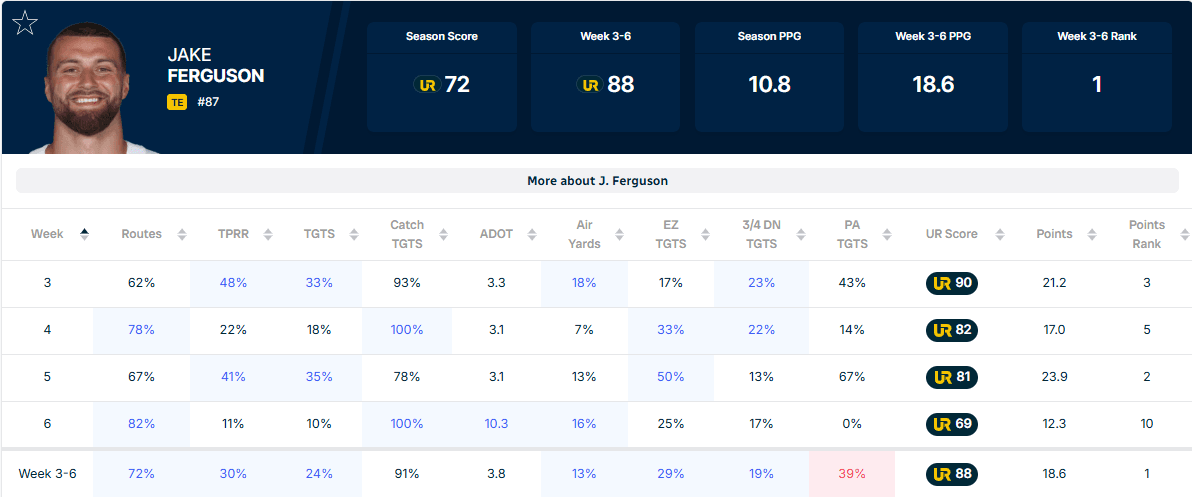
Like Pitts, his spike was TD-driven and tied to a teammate's absence. From Week 3 to 6, with CeeDee Lamb out, Ferguson averaged 18.6 PPG on a 24% target share.
From Week 7 to 16 in nine games with Ferguson and Lamb both active, he averaged 8.5 PPG with a 15% target share.
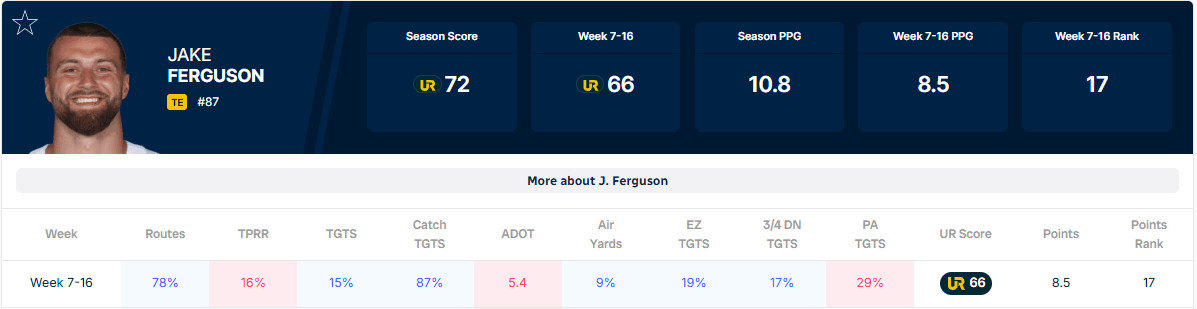
Unlike Pitts, Ferguson lacks the elite prospect profile (No. 56 in the Rookie Super Model) and doesn’t bring strong underlying efficiency. Over the last two seasons, he ranks 36th in YPRR (1.24).
This is ultimately a bet on the environment. Dallas projects as the No. 1 passing offense (263 YPG), giving Ferguson access to scoring opportunities. However, he is likely the third option behind Lamb and George Pickens, making it difficult to count on consistent volume without injuries shifting the target tree.
Bottom Line: Ferguson is a borderline TE1 who needs to score TDs to be relevant, but offers mid-range TE1 upside should Lamb or Pickens miss time. He is slightly overpriced as the TE11.
 Dalton Kincaid | Bills
- Age: 26.9 (Prime)
- Fantasy PPG (23-25): 9.4, 7.8, 10.5
Kincaid finished as the TE14 in his third season, but injuries were a major factor. Over the first five games, he averaged 12.9 PPG and 57.4 YPG before landing on the injury report in Week 6—all while operating in a part-time role (60% route participation).
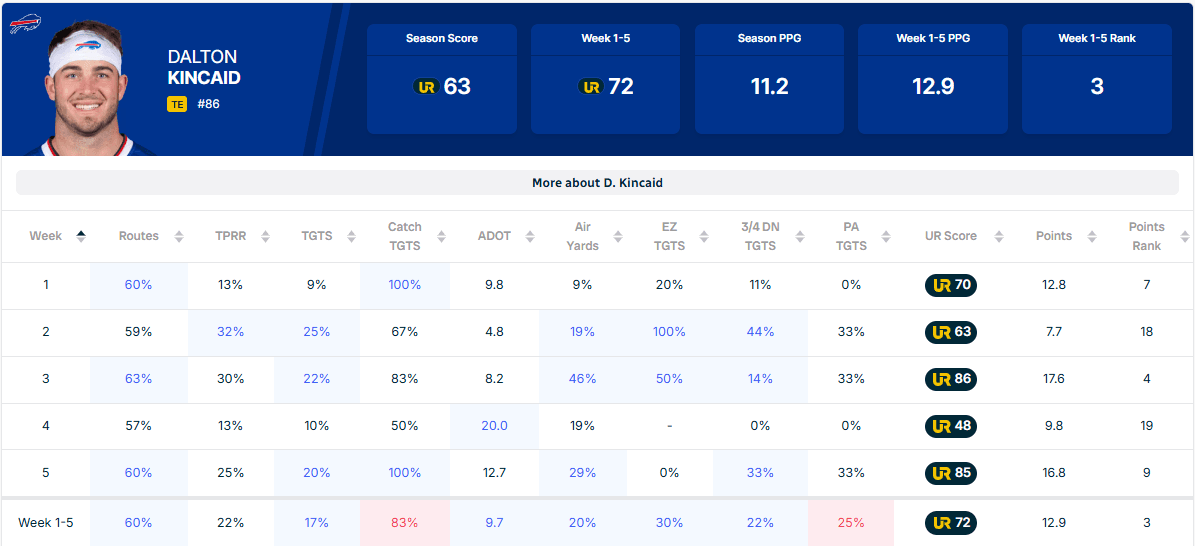
He benefited from a TD spike (0.42 per game) after posting 0.13 and 0.15 in his first two seasons—a potential red flag.
Still, the breakout case is strong. Kincaid ranks No. 10 in the Rookie Super Model (80) and is second among TEs in YPRR (2.13) over the last two seasons (250+ routes).
The Bills added DJ Moore, but the target hierarchy remains open in an offense projected for the most TDs per game (3.1). They rank 19th in passing YPG (227).
Personnel usage could also tilt in Kincaid’s favor. Buffalo lost FB Reggie Gilliam, potentially shifting away from 21 and 22 personnel—areas where they ranked No. 8 (8%) and No. 3 (8%) under Joe Brady. If Ben VanSumeren (UDFA, limited NFL usage) fills that role, more 12 personnel could follow (Bills rank 28th under Brady at 13%).
Brady also leans into efficiency boosters:
- Play action: 26% (11th)
- Motion at the snap: 59% (6th)
A massive jump in routes isn’t a lock, but 70–75% participation is attainable. As a healthy Round 1 talent in a high-scoring offense, the setup remains favorable.
Bottom Line: Kincaid offers borderline TE1 potential as a part-time player, but if playing time breaks his way, he would catapult into top-six territory. That isn't an easy profile to find outside the top 110 picks.
 Isaiah Likely | Giants
- Age: 26.4 (Prime)
- Fantasy PPG (23-25): 5.9, 7.7, 4.4
Likely has a chance to step into a full-time role with the Giants after escaping a rotation with Andrews in Baltimore. New York backed that with a three-year, $40M deal.
He ranks No. 31 in the Rookie Super Model with the No. 5 production rating all-time, but the NFL efficiency hasn’t fully matched. Over the last two seasons, his 1.44 YPRR aligns more with high-end TE2s.
Opportunity is the draw. With Wan’Dale Robinson gone, Malik Nabers is the only proven target earner—and he could open on the PUP. That leaves a path for Likely to emerge as the No. 2 option, but he’ll need to earn it.
Usage is the swing factor. Theo Johnson is expected to handle traditional Y duties, especially in 21 and 22 personnel. Likely played in those groupings in Baltimore, but only logged a 40% snap share.
Those looks could remain prevalent. Baltimore ranked third in 21 personnel (19%) and second in 22 (10%) over the last two seasons after adding FB Patrick Ricard.
The coaching staff adds more context. Matt Nagy takes over as OC, with Greg Roman as a key assistant. Both offenses have leaned into TE usage—Baltimore ranked second in 12 personnel (34%), while Nagy ranked third (30%).
The path is clear but fragile. Likely can become the No. 2 option behind Nabers, but if the offense leans into RB/FB-heavy sets, his route participation may struggle to reach 70%.
Bottom Line: Likely offers TE1 upside tied to role growth, but personnel usage could keep him in mid-range TE2 territory.
 Terrance Ferguson | Rams
Update (8/26): Ferguson is having an amazing camp, and his ability as a field stretcher and red-zone threat could separate him from the pack in the Rams TE room. He has a chance to be the No. 3 option in the offense and has significant contingency upside if Puka Nacua or Davante Adams miss time.
Bottom Line: If you didn't get a high-end TE that you like, pair Ferguson with a floor option. He is a HIGH PRIORITY TARGET in that setup. If he surprises with an 80% route share in Week 1, he will immediately move into TE1 territory.
 Chig Okonkwo | Commanders
- Age: 27 (Prime)
- Fantasy PPG (23-25): 6.7, 6.7, 7.3
Okonkwo signed a three-year, $27M deal ($16.7M guaranteed) to operate as Washington’s No. 1 TE.
With only Terry McLaurin established, there’s a clear path for Okonkwo to become the No. 2 option for Jayden Daniels. The concern is efficiency—he ranks 31st in YPRR (1.30) over the last two seasons and wasn’t a high-end college producer.
That profile aligns with low-end TE2s, and he has already played in offenses lacking target competition. To his credit, QB play has been poor—Daniels alone could lift his efficiency.
New OC David Blough plans to lean into under-center looks, play action, and motion, and has called out Okonkwo as a movable chess piece. Whether that fully materializes is unclear, but under Kliff Kingsbury, the team ranked fifth in play action (29%) and 22nd in motion at the snap (46%).
The structural setup helps. Washington doesn’t have a fullback, giving Okonkwo a clear role in 11 personnel and a path to stay on the field in 12. That said, Tennessee rarely used a fullback, and Okonkwo’s career-high route participation was just 66%.
I lean toward a career year, given the opportunity and expected usage, but he still has to earn it.
Bottom Line: Okonkwo is a volume-based bet on a roster without a strong No. 2 option, but the talent profile points more toward TE2 than a true high-end TE1.
 Juwan Johnson | Saints
Update (8/26): Johnson ranked seventh in YPG (52) in 2025, and Jordyn Tyson will now miss an extended period of time. Johnson offers TE1 potential, like he did much of last season, until Tyson returns.
Bottom Line: Johnson is a high-end TE2 option until Tyson is back.
Tier 8 Fantasy Football TEs for 2026
This group of TEs will most likely be waiver-wire options unless you play in TE premium or deep formats. They also fit as TE2/3 options in best ball.
- Dalton Schultz | Texans: With Jayden Higgins out for the season and the Texans planning to implement heavy TE packages, Schultz is positioned as a strong floor play.
- Greg Dulcich | Dolphins: Dulcich could be one of the top options on a bad offense, but he has not been on the field in 21 personnel in the preseason. I like him more if the team doesn't keep a fullback.
- Pat Freiermuth | Steelers: Freiermuth appears to be in a heavy rotation with Darnell Washington. I'm out, dog.
- Evan Engram | Broncos: Engram has a relationship with Davis Webb from their time together at the Giants, and his role has been much larger in camp and in preseason. You could do worse things with your last-round pick in TE premium formats.
- Hunter Henry | Patriots: Could still be the No. 2 or No. 3 target for Drake Maye.
- Brenton Strange | Jaguars: Received a contract extension and plays in a high-upside offense, but it's crowded—possible Jake Ferguson arbitrage.
- AJ Barner | Seahawks: Ceiling is the No. 2 option in the passing game, but splitting time with Elijah Arroyo.
- T.J. Hockenson | Vikings: Declining profile with high target competition, but the Vikings could surprise.
- Cade Otton | Buccaneers: The contingency king, but rarely does much when the WRs are healthy.
Tier 9 Fantasy Football TEs for 2026
This is your sleeper tier. High-upside swings for late in your redraft league. The chances of them hitting aren't high, but you could imagine what it would be like if they did.
- Kenyon Sadiq | Jets: Sadiq falls from Tier 7 due to missing most of camp with a hernia procedure setback. He still offers immense upside, but will likely start the season slow. He remains a target in deeper leagues, but is tougher to roster in small formats.
- Oronde Gadsden II | Chargers: Our concerns about a part-time role in McDaniel's scheme that prioritizes blocking have come to fruition. Gadsden has played behind Charlie Kolar and even David Njoku at times. He is also playing late into preseason games. Gadsden is talented but needs a lot to break his way to make fantasy noise.
- Eli Stowers | Eagles: Probably stuck behind Goedert in Year 1, but they spent a Round 2 pick on Stowers. His last two collegiate seasons (after switching from QB) were electric.
- Erick All | Bengals: Injuries have derailed All's career, but the Bengals use plenty of multi-TE sets, and none are great. They also don't have an ideal WR3.
Tier 10 Fantasy Football TEs for 2026
This sicko tier consists of part-timers with a late-round best-ball focus (aka scroll down).
- Mike Gesicki | Bengals: Will Tee Higgins be hurt? He might be good in those games.
- Michael Mayer | Raiders: High-end prospect stuck behind Bowers, but might be the second-best receiver on the team, and Kubiak will use 12 personnel.
- Colby Parkinson | Rams: If Ferguson misses, it is partially due to Parkinson hanging onto his role, which gave us usable fantasy games in 2025.
- Darnell Washington | Steelers: Got the contract extension and offers a unique blend of size and tackle-breaking ability. Who doesn't want to root for the NFL's version of The Mountain?
- Eli Stowers | Eagles: Stowers has struggled throughout camp and might not contribute much in 2026. He falls from Tier 9 to Tier 10.
- Mason Taylor | Jets: With Sadiq struggling through injuries, Taylor is set up as the Week 1 starter. The 2025 Round 2 Draft pick has a chance to carve out a larger role early.
- Darren Waller | Panthers: We don't know for sure if Waller will make the team.
- Jonnu Smith | Packers
Join Our Newsletter
Trusted by 400,000+ fantasy football players. Get access to Fantasy Life's free award winning newsletter and tools, all in one step.
By registering or logging in, you agree to our Terms of Use and Privacy Policy.
Players Mentioned in this Article
Presented by




Published Updated