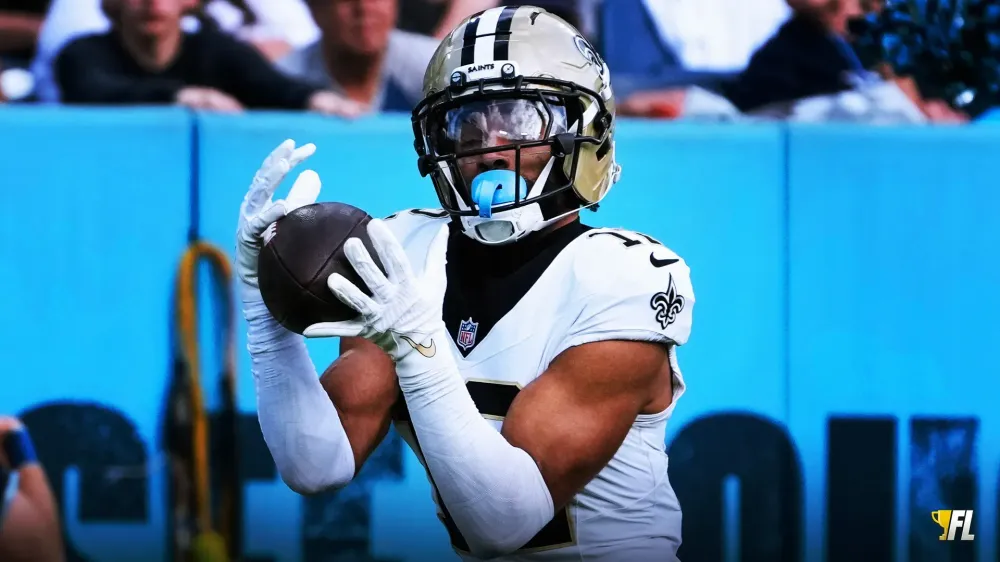
Week 1 Matchup Advantages For Fantasy Football: Chris Olave And Juwan Johnson Take On The Lions
Zain Dhanani identified scheme matchup advantages and disadvantages to attack in fantasy football for Week 1.
After watching many hours of film last season and throughout the summer and crunching as many stats as possible, I wanted to bring the fantasy community something deeper. Something where I could explain why some matchups should lead to fantasy success.
We get a full slate in Week 1 with updated fantasy football projections, and it’s easy to know you should be playing players you drafted in the first few rounds, so I’m hoping to give clarity and reasoning to some of the more questionable choices through schematics, film, and analytics.
Week 1 Fantasy Football Matchups To Target
Juwan Johnson and Chris Olave at Detroit
Juwan Johnson and Chris Olave stand out this week because of some significant mismatches with the Detroit Lions secondary that is ravaged with injuries to Brian Branch and Kerby Joseph. With Jordyn Tyson out and limited proven WR depth behind Olave, I expect Moore to lean further into the two-TE sets the Saints were already planning to use.
Noah Fant or Oscar Delp will likely play in-line while Johnson moves into the slot in those two-TE sets. Detroit likes to be in base personnel on defense, especially when the opposing team is in 12 personnel, which can create a mismatch in the slot with Johnson.
Johnson ran 55.4% of his routes from the slot last season, and Olave was there for 42.0% of his, so I expect both of them to get some healthy looks from the slot. Detroit allowed the sixth-most EPA per target to slot receivers while being fourth-stingiest against targets to players aligned in-line, per PFF.
When Moore senses man coverage coming, I expect him to use bunches and stacks to give Olave cleaner releases into his slants and crossing routes, which forces the defense to follow receivers in traffic or communicate a switch. That’s difficult for any secondary, let alone one that has to play with backups. The Lions allowed 0.520 EPA per slot target against man last season compared with a 0.230 league average.
Against zone, Moore will likely have route combos that make the defense decide between Johnson's hitches and flats with Olave's deeper crossing routes so Tyler Shough can work above or below the underneath coverage. If a defender gains depth with Olave, Johnson can settle into the space below him, while a defender driving on Johnson can open a window behind him.
Olave's 27.3% target share from 2025 shows that he’s capable of being an elite target earner and the focal point of this offense, especially with Tyson on IR, but Johnson also performed well with Shough, averaging 1.97 YPRR. This should be a consolidated pass offense around these two players against a bad secondary. In reality, you were already starting Olave, but Johnson is a good player to start in this matchup and someone you may hold on to for future weeks.
Chuba Hubbard Against Chicago
I like the way Carolina's zone running game fits against Chicago’s defense, which should benefit Chuba Hubbard in this matchup. Outside zone accounted for 30.4% of the Panthers' RB carries last season, and the Bears allowed 1.50 yards before contact on those runs against a 1.18 league average, per PFF.
Hubbard displays good feel for zone blocking with the ability to press the line of scrimmage and find cutback lanes despite poor metrics in 2025 (likely due to injury). The Bears were favorable to opposing rushers on inside zone as well—allowing 1.72 yards before contact, 0.45 yards above league average.
The Panthers will likely utilize two-TE sets, which adds another gap for the Bears defense to account for, and Chicago struggled against those formations even when they put at least eight defenders into the box. The Bears allowed 1.46 yards before contact against a 0.85 league average in that situation, while Carolina used two TEs on 30.4% of its RB carries.
Hubbard's disappointing efficiency last season and Jonathon Brooks' role keep me from assuming a huge fantasy day. The Panthers were more run-heavy than the league in neutral situations, though, and the room Chicago allowed before contact against Carolina's main zone concept seems fruitful. The Panthers run scheme against this Bears front seven should create good space for him to run, so he’s worth putting in lineups as a flex or RB2 in a pinch.
Rico Dowdle and Pittsburgh's running game against Atlanta
Pittsburgh is the other rushing offense I like this week, and I lean Rico Dowdle within the committee. Dan Graziano reports that Dowdle is likelier to handle the early-down work, and that is the role I want if the Steelers play from ahead.
Mike McCarthy ran inside zone on 36.6% of his RB carries in his final season in Dallas. Atlanta allowed 2.12 yards before contact on those runs last year—substantially higher than the 1.27 league average, per PFF—giving McCarthy a strong advantage to create space in the run game for Dowdle. This gives Dowdle a chance to build momentum before he has to make someone miss or run through a tackle. And we know, through my offseason research, that explosive plays come off higher yards before contact.
While the Falcons have some personnel turnover within their defensive front seven, Jeff Ulbrich remains the defensive playcaller, and there weren’t meaningful defensive upgrades, so the same schematic advantages should still exist.
The Steelers are favored by 3.5 points, so they have a chance to learn into the ground game, where Dowdle should see a majority of the work. I like both RBs in this matchup, but if the reports are correct, Dowdle should get the early-down work, which leans favorable in a victory.
Where To Be More Cautious in Week 1
Washington's backfield at Philadelphia
Even though I was pounding the table for Jacory Croskey-Merritt this offseason, I would sit him this week based on the matchup and game script. This is not the defense to use Bill against, especially without Laremy Tunsil and a questionable offensive line that’s learning a new scheme. Against Philadelphia, that group has to deal with Jordan Davis, Jalen Carter and Moro Ojomo inside, with Zack Baun and Jihaad Campbell behind them, which is probably the best front seven in the NFL.
Blough's stretch and cutback runs offer a way to move that front, and Philadelphia did allow just over 5.0 YPC on runs designed around either end last season. But those runs still require the tackles and TEs to secure the edge and cut off pursuit, while attempts aimed at either tackle averaged below 3.3 YPC against the Eagles. If they had Tunsil, they could have had a chance to do some perimeter runs, but without him I don’t trust schematics to defeat the talent disparity.
Falling behind would put Croskey-Merritt in a worse position because the carries he needs could give way to passing downs. I prefer Rachaad White between the two in PPR for that reason, and Philadelphia's slightly below-average RB target rate doesn't erase the benefit of Washington potentially throwing more often. More dropbacks can still produce more receiving opportunities, even against a defense that allows a smaller share of them.
White gives Blough an option on screens and quick releases out of the backfield, but I would still lean toward sitting both. If Washington needs White to help protect Jayden Daniels, he loses routes, and Baun's coverage ability is another reason to temper expectations for easy receiving yards. White has the more useful role if Washington is chasing the game, while neither back gives me a combination of workload and matchup that I want to prioritize. I would sit both backs this week and try to find other options with more upside.
Green Bay's offense at Minnesota
I am downgrading Green Bay's offense because Minnesota can test both the communication and the individual blocking along an unsettled offensive line. Jordan Morgan at LT, Sean Rhyan at center and Jacob Monk at RG are being asked to establish that coordination against Brian Flores, with Aaron Banks and Zach Bako-Bewele also carrying availability questions into the week.
Flores can walk linebackers into the gaps on either side of the center and force the offense to decide where the protection needs help. If Green Bay commits the line or RB toward one threat, it can leave a harder individual block elsewhere, and the Packers have to get those decisions right before they worry about winning the block. Minnesota sent at least five rushers on 47.5% of opposing dropbacks last season against a 25.8% league average and generated pressure on 44.1% of dropbacks, per PFF.
Keeping a TE or RB in protection can help Jordan Love, but it also gives him fewer receivers to attack the coverage. Matt LaFleur can use quick slants, hitches and crossing routes to shorten the time Love needs, and Minnesota was slightly more generous than average on throws traveling within nine yards of the line of scrimmage. The Vikings were third-stingiest in EPA per target on throws behind the line of scrimmage, though, so I would rather see Green Bay work those short routes downfield than assume screens will solve the problem.
There are opportunities deeper, where Minnesota allowed the most EPA per target last season on throws traveling at least 20 yards, but those attempts accounted for only 9.0% of targets against the Vikings. Christian Watson remains one of my season-long flag plants, and he or Matthew Golden can change a fantasy result with a big catch. I still want to lower expectations for this offense because those deeper routes need protection that is going to be tested throughout the game.
The running game gives me even less confidence with Josh Jacobs unavailable, and MarShawn Lloyd, Chris Brooks and Kaleb Johnson (or Pierre Strong) sorting out the work. Minnesota held RBs to 3.94 YPC and 0.93 yards before contact last season, so it is a difficult place to assume the lead back can compensate for a smaller share through efficiency. I am moving Love down in close QB decisions and would avoid relying on this backfield until the rotation gives us something firmer to work with.
Players Mentioned in this Article
Presented by




Published