What Matters For QBs In Fantasy Football 2026: The Importance of Scheme, Supporting Cast & More
Dwain McFarland breaks down just what goes into the makings of the elite fantasy QBs to target in 2026 drafts.
In fantasy football, our goal is to win. To achieve this, we need to target the right players. To put it even more clearly, we need to target the right types of players. I have dedicated thousands of hours researching which data points matter for future fantasy performance.
That doesn't mean we will get everything right. There will be misses. Football is a cruel game played with an elongated sphere that can bounce in the most unpredictable ways. The critical thing to remember is that we are playing a game of probabilities.

Unlock Our Tools!
Stop hitting the paywall. FL+ gives you access to our premium in-depth content, expert rankings & projections, mock draft simulator, and all the tools you need – all personalized to your league.
In this article, we will dive into which data points matter most for QBs in fantasy football. This piece is the backbone for my 2026 QB Tiers article, which is to follow.
One final thought before we move forward: It is a great time to be a fantasy football enthusiast. We have some of the brightest minds in the industry's history using data-driven methodologies to deliver league-winning insights. It is a really cool thing.
Ryan Heath from Fantasy Points is a great example—he was the first person I saw using ESPN playoff rostership to dissect league winners. It is a really cool angle, which I have now looked into deeper and added it to my research. Additionally, I have added WAR (wins above replacement) and historical fantasy football ADP analysis.
Which Stats Matter Most For QBs In Fantasy Football?
No other data point correlates more strongly with next-season production than fantasy points per game (PPG). In fact, it is just as strong as current-season ADP over the last five years. That is kind of wild when you stop to think about it. Theoretically, current-season ADP is baking in team changes and the latest news.
When we dig a level deeper than PPG, one thing becomes immediately clear: rushing matters. Of the top 15 data points, nine (60%) relate to rushing. For simplicity, I have pared down that list. The table below shows the correlation between next-season fantasy points and the top three rushing and passing stats, compared to ADP and PPG from 2021 to 2025.
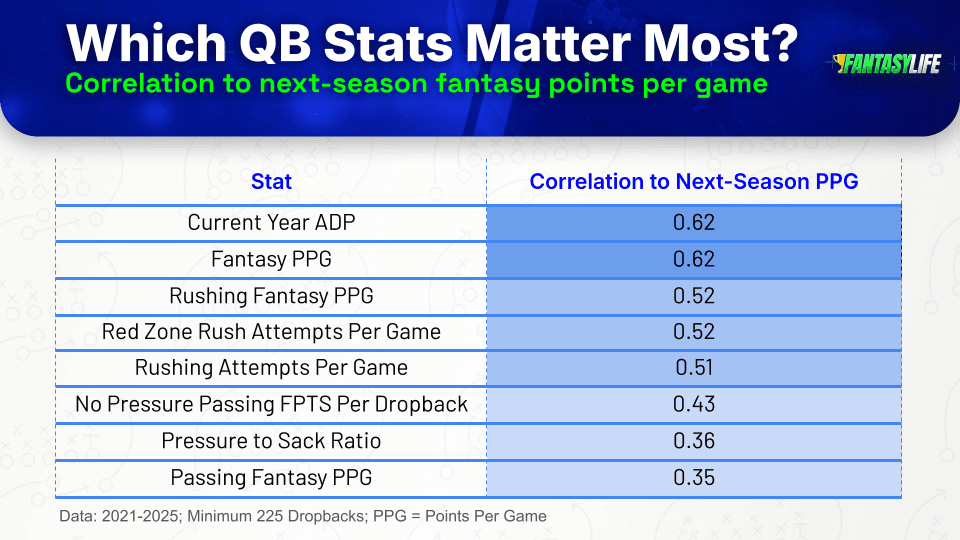
From a macro perspective, this makes sense. First, we have more quality dual-threat QBs. Second, passing yards per game are down over the last four years. In 2025, teams averaged 225 passing yards per game—the lowest mark since 2008 (224). The result: the correlation of rushing fantasy PPG (0.52) to next-season performance is 49% stronger than passing fantasy PPG (0.35).
Historically, for this piece, I have gone back much further in my database (to 2011). However, the downturn in passing yards per game over the last three years prompted me to focus on a tighter five-year window.
NFL Gross Passing Yards Per Game:
- 2011: 245
- 2012: 246
- 2013: 252
- 2014: 252
- 2015: 259
- 2016: 240
- 2017: 240
- 2018: 254
- 2019: 252
- 2020: 255
- 2021: 244
- 2022: 234
- 2023: 236
- 2024: 234
- 2025: 225
At this point, we need a prove-it counter-punch season from offenses, with passing yards rebounding, to feel comfortable referencing seasons where teams averaged 250-plus yards per game.
 Nerd Note: If you are looking for a sneaky edge in the passing department, evaluating fantasy points per dropback when the QB wasn't pressured ranks first. Isolating non-pressure dropbacks provides us a more apples-to-apples comparison of performance.
To further illustrate the impact of the dual-threats and a downturn in passing, we can look at how much fantasy passing and rushing PPG have changed from 2016-2020 vs. 2021 to 2025, based on QB finishes.
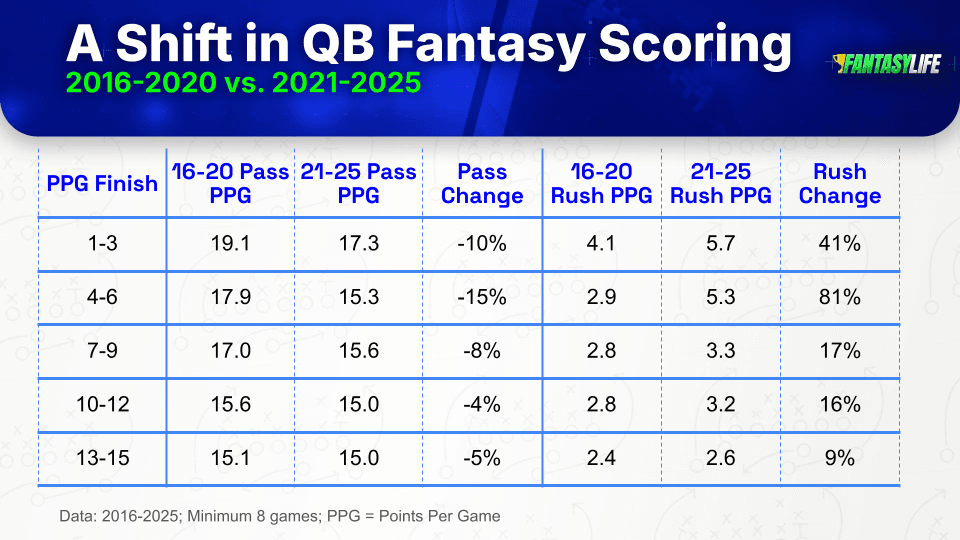
Passing fantasy PPGs are down across the board, and rushing PPGs are up. And the top fantasy producers are adding significant value on the ground. On the one hand, this data is heavily influenced by elite dual-threat options like Josh Allen, Lamar Jackson and Jalen Hurts over the last five seasons. Admittedly, this is one of the drawbacks to using a five-year window. On the other hand, with passing numbers falling, we need additional outs for difference-making fantasy production and want to be proactive in targeting QBs that can add value on the ground.
Of course, this can vary to some degree. Not every QB has an elite dual-threat skill set, but we can get a blend of those traits from players like Drake Maye. We also have a handful of pocket passers who have proven over multiple seasons they can still put up significant passing numbers like Joe Burrow and Dak Prescott. We just don't have as many of those as we used to, which is also part of why passing is down.
What Do League-Winning QBs Look Like In Fantasy Football?
Another way to think about this is to look at fantasy playoff rostership and wins above replacement (WAR).
For playoff rostership, we will use ESPN data, where 4 of 10 teams make the playoffs (40%). So, we will focus on players who significantly outproduced that mark, showing up on 50% or more of rosters in the first week of the fantasy playoffs.
For this exercise, I bucketed QBs into four groups based on their rushing fantasy points per game:
- Dual Threat: 5.5+ rushing PPG
- Balanced: 2.5 to 5.49 PPG
- Pocket: 1 to 2.49 PPG
- Statue: Less than 1 PPG
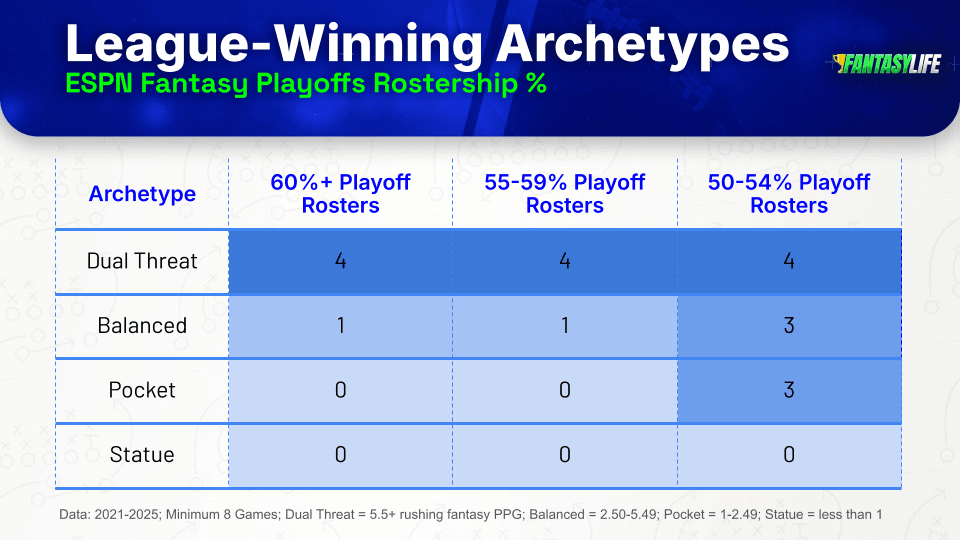
Of the 20 QBs who were on 50% or more of ESPN playoff rosters, 60% were dual threats. And 80% of the QBs rostered 55% or more were dual threats. Balanced QBs were the next best group. Pocket passers had a small showing, and mostly belonged to one-season spike players, which are hard to predict.
For WAR, we will look at QBs who added at least one win to rosters over a 14-game season (the length of most fantasy seasons before the fantasy playoffs). This approach expands our sample to 28 QBs over the last five seasons.
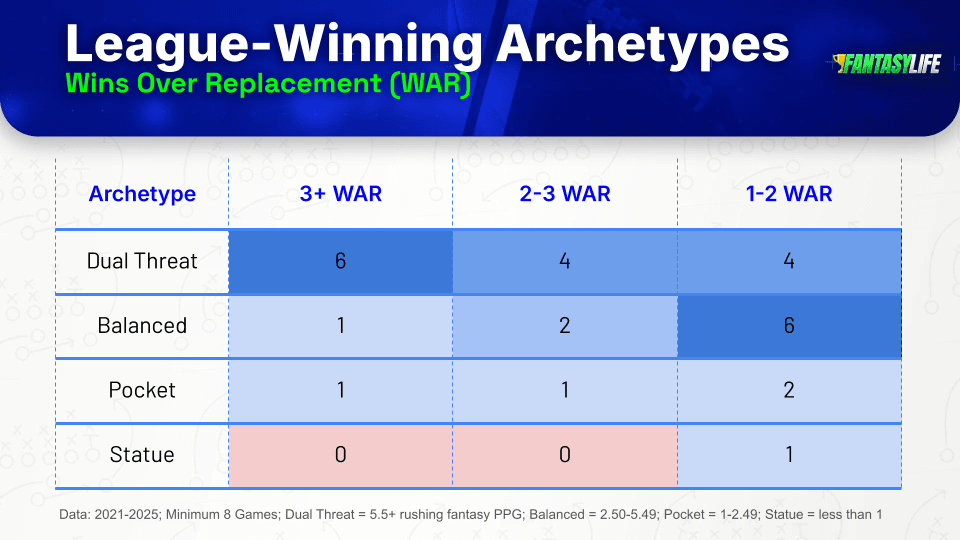
Of the 28 QBs who added at least one win to fantasy teams, 50% were dual threats. It is worth noting that Josh Allen is a complete alien. He accounts for four of the six 3-plus WAR seasons for dual threats. Lamar Jackson and Jalen Hurts accounted for two. Balanced QB options had the second-strongest showing. Pocket passers posting a +1.0 WAR was a rarity.
When we look at QBs through the league-winner lens, the data aligns closely with the most important stats from section one. We have a pretty clear picture emerging: We want to target dual-threat and balanced QBs to unlock league-winning upside in fantasy football.
How Much Does Age Matter For QBs In Fantasy Football?
The QB position enjoys the longest career span in the NFL. But when do they peak, and when do they start to decline? To get our arms around this question, we can compare performance across age buckets relative to a player's peak three-year window. I call this prime production. It is my preferred methodology over a career comparison because rookie season and late-career numbers can muddy the picture.
Rather than using age, I prefer to use experience (years in the NFL) to help normalize for outlier rookies (e.g., those aged 21), given that our sample is extremely small. Plus, acclimation to the NFL is real, and regardless of age, there is a learning curve.
The data breaks down into five buckets.
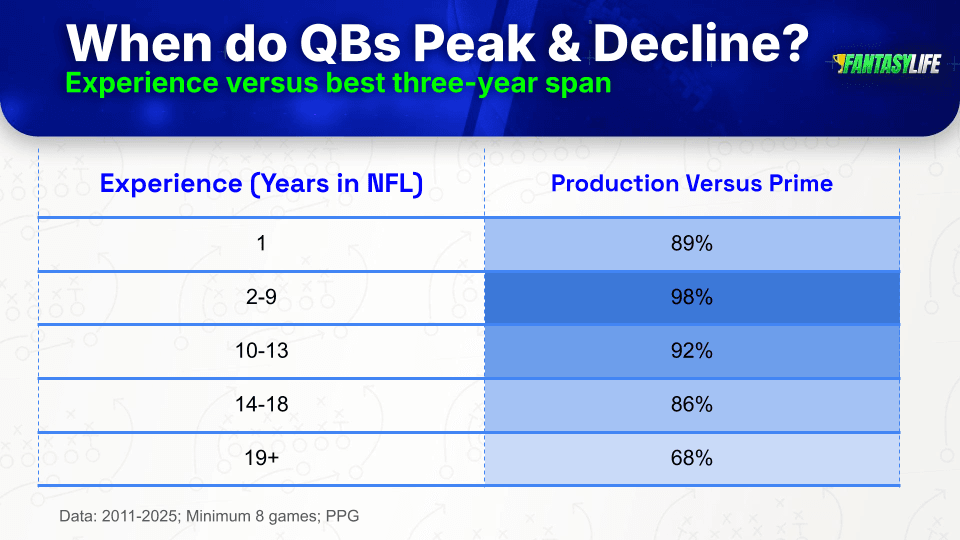
Year 2 through Year 9 is the sweet spot for QBs. During that range, they perform at 98% of the best three-year window. In Years 10-13, we start to see a decline, with performance approaching levels slightly above Year 1.
While the sample size for Years 14-18 is smaller, these survivors tend to produce just below their rookie levels, with an extreme drop-off occurring from Year 19 onward. Remember, it is best to think of these as guidelines rather than hard-and-fast rules. We have seen high-end aging pocket passers boom in the right environment like Tom Brady, Peyton Manning and Matthew Stafford. Plus, our sample size for Years 14+ is very small.
It is worth noting that dual-threat QBs acclimated slightly more quickly, reaching 92% of their three-year prime in Year 1 and 100% by Year 2. Ultimately, their averages level out, similar to those of other QBs in the middle ranges. For late-career dual threats, it is hard to say whether their production declines more quickly due to a small historical sample size. However, we do have a decent sample for Year 7, where they performed at 94% of their best three-year span.
This year we have a couple of high-end dual-threat QBs entering Year 9:
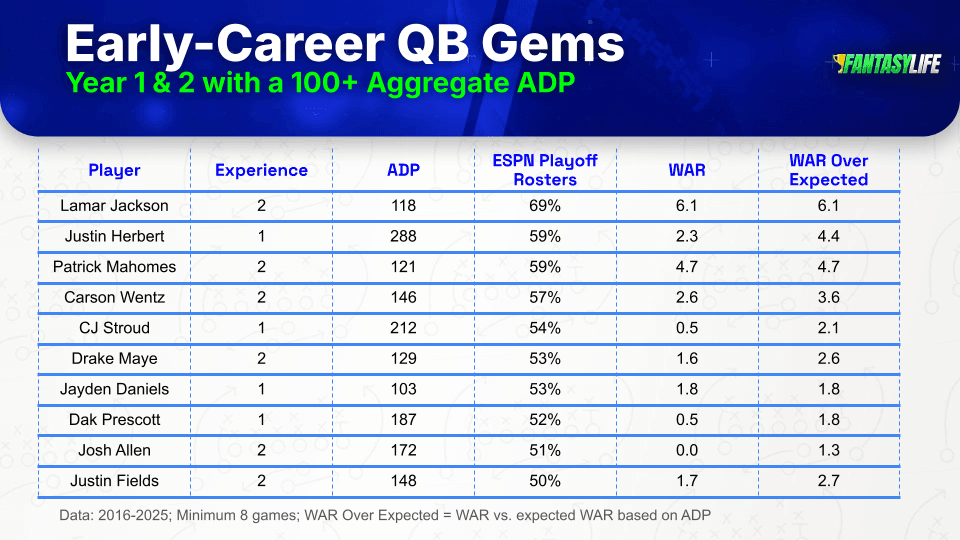
If we are looking for a cheat code versus ADP, look no further than Year 1 and Year 2 QBs. Of the 14 QBs since 2016 to show up on at least 50% of ESPN playoff rosters with an ADP of 100 or later, 11 (79%) have been in Year 1 or Year 2. Note: For ADP, we used an aggregate across multiple sites to help with years when our database is missing ESPN data.
Also, you will see WAR over expected. Based on historical WAR and ADP, we have baseline expectations against which we can compare actual WAR.
Over the last five years, we have seen 20 offenses improve their yards per game by 35-plus yards. Of those, seven were associated with rookie or Year 2 QBs.
Our crop of options for Year 1 and 2 signal callers in 2026:
- Jaxson Dart | Giants: Year 2
- Cam Ward | Titans: Year 2
- Tyler Shough | Saints: Year 2
- Shedeur Sanders | Browns: Year 2
- Fernando Mendoza | Raiders: Year 1
- Carson Beck | Cardinals: Year 1
I will break these down further in my tiers article, but Dart is a dual-threat who could ascend in Year 2. Ward wasn't good in Year 1, but the team made multiple WR upgrades. Shough was a strong performer once taking over as the starter as a rookie, and the team added Jordyn Tyson in Round 1 of the NFL Draft.
Nerd Note: Notice there are QBs with 0.5 or lower WAR who were on 50%-plus of ESPN playoff teams. That tells us there are multiple ways to construct winning fantasy rosters. Sometimes getting a late-round steal or waiver wire pickup that breaks even is enough if the rest of your roster is loaded because you waited on QB.
Is Supporting Cast And Scheme Important For QBs In Fantasy?
While QB talent is a primary driver of performance, the right supporting cast and scheme can transform mediocre talent into a viable fantasy option. In contrast, a bad cast and scheme can limit the upside of good QBs—especially those who don't add much on the ground. In just the last few seasons, we have some excellent examples:
- Caleb Williams scored 15.6 PPG as a rookie, then improved to 18.6 PPG in Year 2 with the arrival of Ben Johnson, Colston Loveland and Luther Burden.
- Matthew Stafford jumped from 14.2 PPG in 2024 to 21.4 in 2025 when healthier, plus a green zone maven in Davante Adams.
- Sam Darnold's best season before 2024 was 15.6 points per game, but he improved to 19.3 points with Kevin O'Connell and a supporting cast that included Justin Jefferson, Jordan Addison and T.J. Hockenson.
- Tua Tagovailoa jumped from 14.7 PPG to 18.5 after the additions of Tyreek Hill and Mike McDaniel.
- Jared Goff fell from 17.3 PPG with the Rams to 14.8 in his first season with the Lions. Then the team added Amon-Ra St. Brown, Sam LaPorta and Jameson Williams, charging Goff back up to 17.3, 17.9, 19.2 and 18.5-point campaigns.
Of the 20 NFL offenses to improve by 35-plus yards year over year since 2021, 16 (80%) of them added noteworthy weapons to the offense. This doesn't mean all of them will be smashes, but it is logical: improving your supporting cast creates opportunities for QBs to increase their fantasy PPG.
This offseason, we have several QBs who have received notable upgrades to their weapons. We will delve deeper into the quality in the tiers article, but for now, here is a quick summary:
- Drake Maye | Patriots: A.J. Brown and Romeo Doubs
- Bo Nix | Broncos: Jaylen Waddle
- Brock Purdy | 49ers: Mike Evans
- Josh Allen | Bills: DJ Moore
- Cam Ward | Titans: Carnell Tate and Wan'Dale Robinson
- Tyler Shough | Saints: Jordyn Tyson
- Jaxson Dart | Giants: Isaiah Likely (but lost Robinson and Malik Nabers recovering)
- Geno Smith | Jets: Kenyon Sadiq, Omar Cooper
- Aaron Rodgers | Steelers: Michael Pittman, Germie Bernard
- Jayden Daniels | Commanders: Chig Okonkwo, Antonio Williams
- Browns QB | Cleveland: KC Concepcion, Denzel Boston
We also have several teams, like the Bears, with young weapons (Loveland, Burden, Rome Odunze) who could take a significant step forward in 2026.
We prefer the offenses with at least a mid-level signal-caller and a good-to-great surrounding cast. The mid-level part of that sentence is important. There is a level of QB incompetence that can't be overcome.
Of course, the scheme also matters, and some coaches just know how to dial up the cheat codes, which leads to more fantasy points. For QBs, play action and motion show to boost QB performance on a per-dropback basis over the last three seasons.
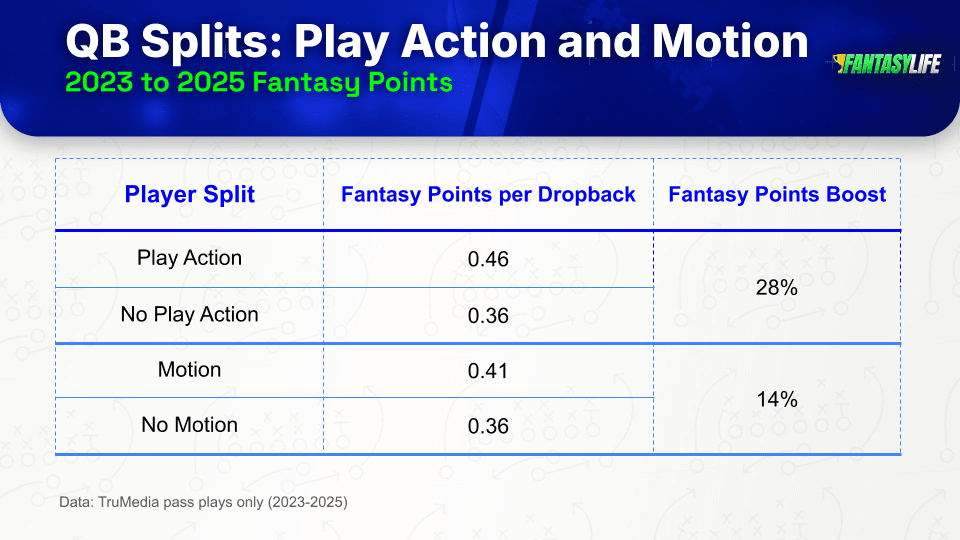
Below is a summary of the top play callers for 2026 in the categories above. If the play caller didn't call plays in the last three years, the numbers represent the team he coached on. An asterisk indicates a new play caller for the team.
Play action
- Declan Doyle* | Ravens: 33%
- Ben Johnson | Lions: 32%
- Shane Steichen | Colts: 29%
- Kevin O'Connell | Vikings: 29%
- Sean McVay | Rams: 28%
- Mike McDaniel* | Chargers: 28%
- Mike LaFleur* | Cardinals: 27%
- Drew Petzing* | Lions: 27%
Motion at the snap
- Kyle Shanahan | 49ers: 70%
- Mike McDaniel* | Chargers: 69%
- Sean McVay | Rams: 66%
- Mike LaFleur* | Cardinals: 66%
- Zac Robinson* | Buccaneers: 61%
- Declan Doyle* | Ravens: 57%
- Matt LaFleur | Packers: 57%
Of the 20 offenses to improve by 35-plus yards per game year over year from 2021 to 2025, 12 (60%) of them had a play caller change.
Of the play callers with new teams, Mike McDaniel (Justin Herbert) and Declan Doyle (Lamar Jackson) have my attention.

Join Our Newsletter
Trusted by 400,000+ fantasy football players. Get access to Fantasy Life's free award winning newsletter and tools, all in one step.
By registering or logging in, you agree to our Terms of Use and Privacy Policy.
Players Mentioned in this Article
 JoshAllenQBBUF
- PPG
- 31.8
- Proj
- 21.3
 LamarJacksonQBBAL
- PPG
- 20.4
- Proj
- 18.2
 JalenHurtsQBPHI
- PPG
- 18.8
- Proj
- 19.1
 DrakeMayeQBNE
- PPG
- 9.2
- Proj
- 16.9
Published Updated