Fantasy Football Stacks To Target For 2026: Target Ravens For Ease & Upside
Anthony Rodriguez highlights his four favorite three-man stacks to target in 2026 fantasy football drafts.
Fantasy football stacks from the same offense are a common practice across formats like DFS and Best Ball for one simple reason: it concentrates your bet.
When you’re drafting a team, you’re essentially making a bunch of different bets. You’re betting on different players, different coaching staffs, different offensive systems and different pieces of the production pie. The more unrelated offenses you rely on, the more individual things you need to go right for your team to hit its ceiling.
With stacking, instead of spreading every bet across the league, you’re making one larger bet that a single offense will outperform expectations, allowing multiple players on your roster to benefit together when it does.
If that offense takes off, your team rises with it.
Stacking should be an integral part of your fantasy strategy this season, so I wanted to answer a question I don’t think gets asked enough:
Which three-man stacks give you the best combination of projected production, draft cost and the ability to actually build a good roster around them?

Join Our Newsletter
Trusted by 400,000+ fantasy football players. Get access to Fantasy Life's free award winning newsletter and tools, all in one step.
By registering or logging in, you agree to our Terms of Use and Privacy Policy.
Stacking Strategy For 2026 Fantasy Football
To answer that question, I loaded up Draft Champion, our fantasy football mock draft simulator, and started ripping ESPN mock drafts.
For this exercise, every mock was a standard 12-team PPR league starting one quarterback, two running backs, two wide receivers, one tight end and one FLEX.
Evaluating The Stacks
My goal was to identify three players from the same offense who function as the major engines for that team.
These are the players I expect to be among the most productive fantasy assets within their offenses and, ideally, players whose production can feed off one another.
On top of the projected points, I wanted to know whether you could actually draft all three without destroying the rest of your roster in the process.
So I evaluated every stack using three categories:
- Projected Fantasy Points: The combined FL fantasy football projections for the three players.
- Average ESPN ADP: The average overall draft position of the three players.
- Stacking Difficulty: How difficult it was to realistically complete the stack while still constructing a roster I actually liked.
Stacking difficulty isn’t based solely on ADP.
Some stacks look completely realistic when you stare at three ADP numbers on a screen, but once the draft starts moving, the windows don’t line up, while other stacks almost fall into your lap.
After running through the possibilities, here’s where I landed.
My Top Four Stacks From The Mock Drafts
| Rank | Stack | Projection | Avg ADP | Difficulty |
|---|---|---|---|---|
| 1 | BAL - Jackson/Henry/Flowers | 770.4 | 34.2 | 4/10 |
| 2 | NO - Shough/Olave /Tyson | 630.6 | 96.4 | 2/10 |
| 3 | SF - Purdy/CMC/Kittle | 723.6 | 69.9 | 7/10 |
| 4 | CIN - Burrow/Chase/Higgins | 753.7 | 40.9 | 10/10 |
Before you immediately scroll down to the team-by-team breakdowns, there’s something else worth talking about: There are a lot of really good offenses missing from this list.
That’s intentional.
This isn'tabout naming the four best offenses in football, but rather identifying three-player stacks that I could realistically build without sacrificing the rest of my roster just to force the correlation. ADP alone eliminated several teams. Detroit was one of the easiest examples.
Amon-Ra St. Brown and Jahmyr Gibbs are both first-round selections. It’s nearly impossible to come away with both, which eliminates the possibility of creating the type of three-player stack I was looking for.
Atlanta ran into a similar problem. Bijan Robinson is generally coming off the board at either 1.01 or 1.02, while Drake London is consistently gone by the middle of the second round. Unless something unusual happens in your draft room, London simply isn’t making it back to you.
Other offenses were technically stackable, but I consistently hated what forcing the stack did to my roster.
Buffalo is the perfect example. Could you start with James Cook and eventually add Josh Allen? Absolutely.
But based on where Cook is typically selected, you’re often picking him in the second half of Round 1. That means if you’re determined to complete the stack, you may have to take Allen at the 1-2 turn because the chances of him making it all the way back to your third-round pick are slim.
When you use two of your first three picks on a running back and quarterback, you immediately create positional holes elsewhere and can spend the rest of the draft chasing the players you passed on.
Dallas presented a different problem. It wasn’t impossible to build the stack. I just consistently liked other players better at every decision point.
CeeDee Lamb’s ADP puts him around the middle of Round 1. If you start there and then try to come back for George Pickens, you’re often staring at a group of players like Derrick Henry, Kenneth Walker, Saquon Barkley or Drake London.
Personally, I prefer those players to Pickens in that range.
Javonte Williams creates a similar issue. Unless he falls deeper into the third round, the draft window becomes uncomfortable. Even trying to build Dallas backward gets tricky because Pickens and Javonte are close enough in ADP that completing the stack can force you into reaches.
And the Giants were another team that initially made this exercise before updated ADPs pushed them out. That’s actually an important part of this entire concept. These stacks are not static. As ADPs move throughout draft season, some teams will become easier to build, and others will become nearly impossible.
That’s why I care so much about the difficulty of the build.
A theoretically great stack doesn’t matter much if you can never actually draft it. With that out of the way, let’s get into the four that survived.
Fantasy Football Stacks To Target In 2026
 Cincinnati Bengals
There’s no denying the upside here.
Joe Burrow, Ja’Marr Chase and Tee Higgins form one of the highest-projected three-player stacks in fantasy football.
Their combined Fantasy Life projection sits at 753.7 points, second only to Baltimore among the stacks in this exercise.
The problem isn’t production; it's actually getting the stack. If you’re not sitting somewhere around the 1.03 or 1.04, you have almost no realistic chance of landing Chase. Even when I was drafting fourth overall, Chase frequently disappeared one pick before me. Sometimes he went even earlier. It ultimately took me seven mock drafts to successfully complete the Bengals stack.
Then you get to the Tee Higgins part of the equation.
Personally, I don’t love opening drafts WR-WR this season.
My preferred build is to come away with two running backs within the first three rounds, so I wanted to avoid automatically pairing Chase with Higgins on my second selection.
That meant trying to grab a running back first and then get Higgins around the Round 2-3 turn.
It worked eventually, but it dramatically reduced my flexibility.
Transparently, there were also drafts where Higgins was sitting there, and I simply liked another player more. The goal of stacking shouldn’t be to blindly draft someone because he happens to play on the same team as your first-round pick.
When everything finally came together, I ended up with:
- QB: Joe Burrow
- RB: Derrick Henry
- RB: Javonte Williams
- WR: Ja’Marr Chase
- WR: Tee Higgins
- TE: Colston Loveland
- FLEX: Parker Washington
That’s a good team.
There’s no question about it.
And with a healthy Burrow, Higgins has already proven he can be a high-scoring WR2 while Chase gives you legitimate overall WR1 upside.
But among these four stacks, Cincinnati consistently demanded the most from me:
- You need the right draft slot.
- You need Chase to actually make it to that slot.
- You need Higgins to survive long enough for the build to work.
- And you need to be comfortable passing on other players in his range.
The Bengals stack is awesome when it hits, I just don’t love everything you have to do to get there.
 San Francisco 49ers
The 49ers are probably the most interesting stack in this entire exercise.
The only true hurdle is Christian McCaffrey. Unfortunately, it’s a pretty massive hurdle.
If you’re not sitting somewhere in the top six picks, this stack is basically dead before your draft even starts.
Even from the 1.07, you’re hoping CMC falls one spot beyond his typical draft range.
So why do I still have San Francisco third? Once you get McCaffrey, the rest becomes incredibly manageable.
George Kittle is typically available around the seventh round. Brock Purdy is sitting there around the eighth or ninth. That creates a really interesting combination of production and flexibility. The Purdy-McCaffrey-Kittle trio is projected for 723.6 fantasy points. That’s just 46.8 points behind Baltimore’s league-leading projection among the stacks I tested. Put another way, San Francisco is projected to produce 93.9% of Baltimore’s three-player fantasy output, despite carrying an average ADP more than 30 picks later.
That’s wild.
More importantly, the way you acquire those points gives you enormous flexibility throughout the middle of your draft.
You can comfortably skip the Round 2-3 elite tight end chase because Kittle is waiting later.
You don’t have to reach for an elite quarterback in Rounds 4 or 5 because Purdy fits naturally, only several rounds later.
That allows you to use those picks on wide receivers, running backs or whatever value falls to you. Once you clear the CMC hurdle, the rest of the build almost falls into place.
There is obviously some injury uncertainty attached to this group given the recent histories of McCaffrey, Kittle and Purdy, but I don’t think that needs its own rating system. That uncertainty is already baked into the cost.
What matters to me is the roster you can build around them. And if I’m sitting in the right part of Round 1, this is one of my favorite ways to attack a draft.
 New Orleans Saints
This one might surprise people. The Saints stack offers the most flexibility of any offense I tested, and it’s not particularly close.
Chris Olave is the only piece that requires anything resembling premium draft capital.
After that, you have time.
Jordyn Tyson is going much later, and may continue to fall with his ongoing hamstring issue. Tyler Shough is going even later than that.
That means you can spend the majority of your draft building the strongest possible roster before coming back and completing the stack. That freedom is exactly what made New Orleans so appealing.
One of my favorite drafts came from this build. Drafting fifth overall, I opened with Christian McCaffrey and Derrick Henry. With that type of strength at running back, I was comfortable pushing the position for a while.
My next three selections were:
- Chris Olave.
- Davante Adams.
- Jaylen Waddle.
Now I’m five rounds into the draft, and I’ve already got two elite running backs and three wide receivers I’m extremely comfortable starting and still haven't had to force the stack.
Because Tyson tends to fall in drafts as a rookie and with his injury issues, I was able to grab Tucker Kraft and David Montgomery before finally selecting him. This gives me plenty of insurance ahead of Tyson if he does indeed end up missing significant time.
Then I took Jonathon Brooks as an upside bench swing before coming back for Tyler Shough.
That’s the beauty of this build. You aren’t chasing the stack, but letting it come to you.
Shough showed plenty of promise down the stretch last season. Over his final eight games, he averaged 18.6 fantasy points per game in four-point passing touchdown scoring. That’s already flirting with low-end QB1 production.
I’m also a huge believer in Kellen Moore as a play caller. Historically, Moore’s quarterbacks have comfortably ranked among the league leaders in pass attempts per game, according to StatMuse. The one major exception was his season in Philadelphia. But even then, Jalen Hurts attempted a career-high 538 passes and finished as the QB2 overall in fantasy. Moore simply loves to sling it. That’s important here. I’m not just betting on Shough improving. I’m betting on an offensive environment that should give him opportunities to produce.
Then there’s Jordyn Tyson.
Tyson was my WR1 in this past rookie class, and because he’s still an unknown NFL commodity, you don’t have to pay anywhere near the price you would for a more established receiver. If Tyson hits and Shough takes another step forward, this stack has a chance to absolutely smash its current draft cost. That’s also why I couldn’t quite put it first. There’s more uncertainty here than Baltimore, but the combination of cost, upside and roster flexibility is incredibly difficult for me to ignore.
In fact, this was probably my favorite actual roster that I drafted throughout the entire exercise.
 Baltimore Ravens
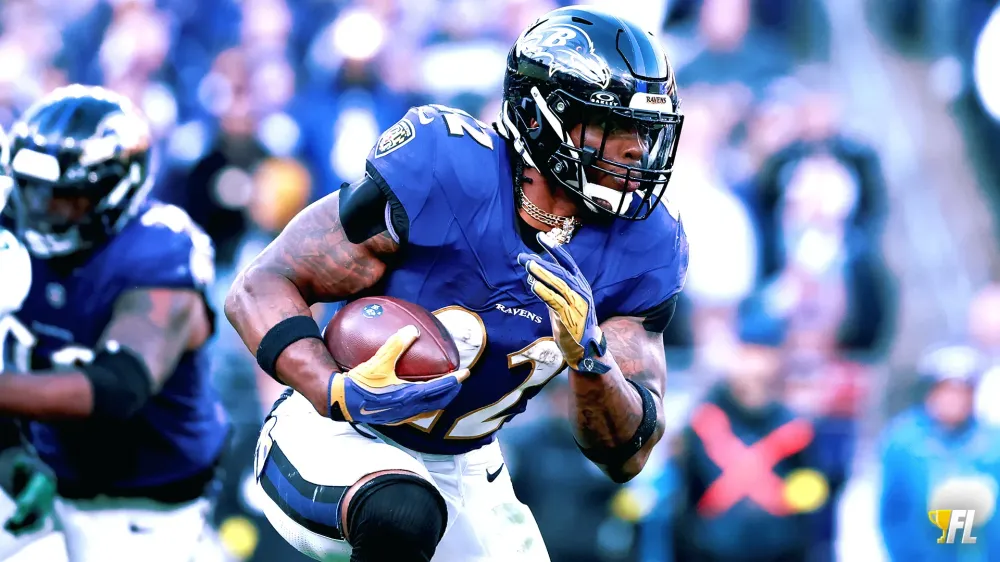
So why did Baltimore ultimately win? Simple: Dependable offensive production, an easy path to completing the stack and, most importantly, flexibility.
On paper, the Ravens have the highest average ADP of the four stacks at 30.7. Normally that would be a red flag, but in the mock drafts, it never felt restrictive. That’s what separates Baltimore from Cincinnati. You can comfortably start RB-RB, or WR-RB. You can grab an elite wide receiver first and then come back for Derrick Henry in Round 2.
There are multiple paths to the same destination.
In my favorite Ravens build, I was drafting from the 1.07
I opened with Amon-Ra St. Brown in Round 1 and then grabbed Derrick Henry in Round 2. From there, I never felt like I had to reach to complete the stack. The finished starting lineup looked like this:
- QB: Lamar Jackson
- RB: Derrick Henry
- RB: Bhayshul Tuten
- WR: Amon-Ra St. Brown
- WR: Zay Flowers
- TE: Tucker Kraft
- FLEX: David Montgomery
That’s the exact kind of roster I’m trying to build.
The Ravens stack gives me exposure to an elite offense without requiring me to sacrifice the rest of my team to do it. And unlike New Orleans, there isn’t nearly as much projection involved.
We know Lamar Jackson can be an elite fantasy quarterback.
We know Derrick Henry can be a league-winning fantasy running back.
We know Zay Flowers can produce when given opportunity, and there’s reason to believe his role can expand even further within this offense.
Baltimore also carries the highest projected total of the group at 770.4 fantasy points, so you’re combining the highest projection with one of the easier real-world builds. That’s why Baltimore finishes first for me, and ultimately, that’s the entire point of this exercise.
Join Our Newsletter
Trusted by 400,000+ fantasy football players. Get access to Fantasy Life's free award winning newsletter and tools, all in one step.
By registering or logging in, you agree to our Terms of Use and Privacy Policy.
Players Mentioned in this Article
 LamarJacksonQBBAL
- PPG
- 20.4
- Proj
- 18.9
 DerrickHenryRBBAL
 ZayFlowersQWRBAL
 TylerShoughQBNO
- PPG
- 24.1
- Proj
- 18.0
Published Updated