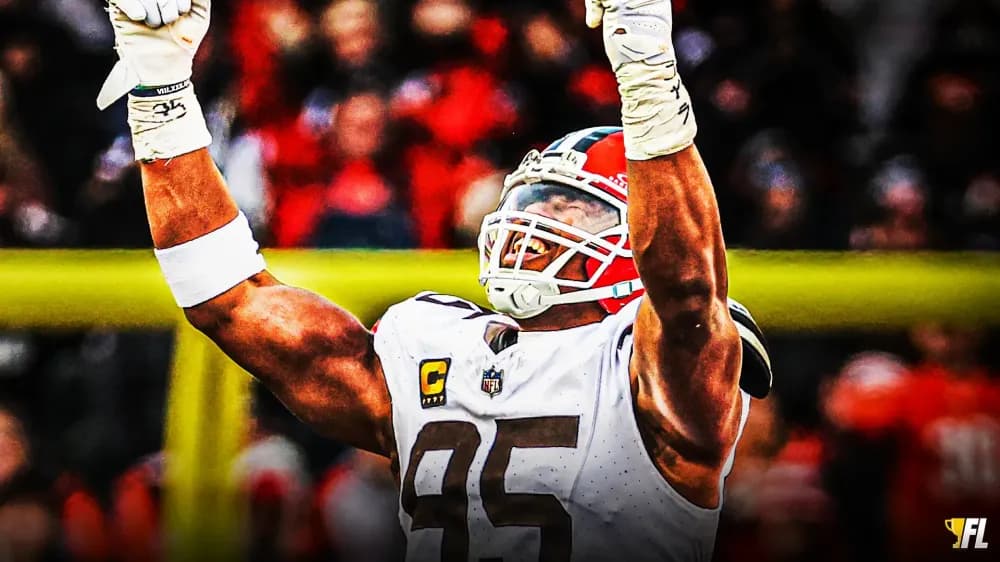
IDP Fantasy Football 2026 Strategy Guide: Lineup Construction, Draft Targets and More
Interested in joining your first IDP fantasy football league? Walk through the nuances of the scoring settings, roster formats and when to target your defensive players in this 2026 IDP draft guide.
You’ve been on the fence about joining an IDP fantasy football league and are considering trying it out in 2026.
You’ve seen IDP bantered about and have seen the acronym. No, it doesn’t mean Incredibly Delicious Pancakes. So, just what is IDP? It’s individual defensive players. Instead of drafting the Cleveland Browns defense, you can draft Myles Garrett, and he accrues points like the other positions in fantasy, except you’re scoring tackles, sacks, interceptions and forced fumbles (among other stats).
As someone who’s played IDP fantasy football for a while, like enjoying a grilled cheese sandwich for lunch, sometimes it’s good to get back to basics.
Different scoring systems and lineup structures matter. They shape how you build your lineup, how you attack drafts, and where value actually lives. Tim Duncan was “The Big Fundamental,” and sometimes IDP needs a little Duncan energy. Not flashy. Not cute. Just a smart, clean, disciplined process. Whether this is your 500th IDP league or your first, getting back to the fundamentals will help keep your IDP game sharp.

Join Our Newsletter
Trusted by 400,000+ fantasy football players. Get access to Fantasy Life's free award winning newsletter and tools, all in one step.
By registering or logging in, you agree to our Terms of Use and Privacy Policy.
IDP Fantasy Football Tips For 2026
Know Your Scoring
This is as basic as you can get, and even I’m guilty of looking past scoring rules. We preach this for drafting offensive players, and I’m doing the same for IDP. You value positional players differently in a PPR and half-PPR—it’s the same with different IDP scoring formats.
IDP has matured a lot over the last few seasons, but scoring still hasn’t reached a true standard. You’re going to see terms like “Big Play”, “Balanced” and “Tackle Heavy” mentioned as scoring formats. The first stop in your fantasy manager should be the scoring rules or setup. However, here are some of the scoring systems you might see:
- ESPN
- FantasyPros
- Big3
- Sleeper
- Footballguys
So, what do the scoring systems mean?
Big/Splash Play Scoring (Big3 Scoring)
In this scoring format, the emphasis is on the big/splash plays. So, you’re targeting the sack and interception leaders. Because you’re focusing on the big plays, you’re prone to volatile weeks where your guys could get you 20 pts one week and three pts the next. Here’s an example of what a big-play scoring league might look like:
| Sacks | 8 pts (4 pts for a half-sack) |
| QB Hits | 2 pts |
| Interceptions | 5 pts |
| Fumble Recoveries | 4 pts |
| Forced Fumbles | 4 pts |
| Defended Pass | 2 pts |
| Tackles for Loss | 2 pts |
| Solo Tackle | 1 pt |
| Assisted Tackle | 0.75 pts |
This scoring keeps the tackle compilers at bay and devalues them somewhat. In this format, your sack monsters are valuable. They are getting points for the sack and the TFL. You may want to target Myles Garrett, Will Anderson and Aiden Hutchinson a little earlier than normal.
You’re probably looking at the 5th/6th round.
I want to land at least one edge rusher who can get 12+ sacks, as those guys will dry up quickly. Younger ascending rushers like Jared Verse, Nik Bonitto and Dallas Turner also fit nicely if you can grab them in the right round.
Go FantasyLife+
Your league is unique. Your advice should be too. Get personalized tools, rankings, and projections tailored to your fantasy football league settings.
Tackle Heavy (Sleeper)
This is my favorite format because I love linebackers and tackles. This format puts less emphasis on the big plays because of their volatility and randomness. I believe tackles are a bit more sticky. Here’s what a tackle-heavy scoring format might look like:
| Sacks | 4 pts (2 pts for a half-sack) |
| Interceptions | 3 pts |
| Fumble Recoveries | 2 pts |
| Forced Fumbles | 2 pts |
| Defended Pass | 1 pt |
| Solo Tackles | 2 pts |
| Assisted Tackles | 1 pt |
Solo and assisted tackles are double compared to a big-play format. In this format, I’m targeting linebackers first. Actually, in the words of Calvin Candie from Django Unchained, linebackers should be your first, second, third, fourth and fifth concern. Tackle machines like Roquan Smith, Jack Campbell and Foyesade Oluokun are linebackers who score well in this format. Up-and-comers like Carson Schwesinger are in play, as well.
Now, you’ll have anomalies like Myles Garrett’s NFL sack record in 2025 that propelled him to a top overall finish. Only a handful of edge rushers will finish in the top-30. Off-ball linebackers and tackle-heavy safeties are the prized commodities.
Positional Scoring
Positional scoring formats spread out scoring among the positions, evening out the playing field. Each position is valued equally and is scored based on that position’s key stats. This scoring format is useful if you’re playing in position-specific leagues; defensive tackles and cornerbacks included. The scoring for balanced formats might look like this:
| Defensive Tackle | Defensive End | Linebacker | Cornerback | Safety | |
| Sacks | 8 pts (4 half) | 6 pts (3 half) | 5 pts (2.5 half) | 6 pts (3 half) | 5 pts (2.5 half) |
| Interceptions | 4 pts | 4 pts | 4 pts | 6 pts | 5 pts |
| Fumble Recoveries | 2 pts | 2 pts | 2 pts | 2 pts | 2 pts |
| Forced Fumbles | 2 pts | 2 pts | 2 pts | 2 pts | 2 pts |
| Defended Pass | 3 pts | 3 pts | 2 pts | 4 pts | 4 pts |
| Solo Tackles | 3 pts | 3 pts | 2 pts | 3 pts | 2 pts |
| Assisted Tackles | 1 pt | 1 pt | 1 pt | 2 pts | 1 pt |
A defensive tackle isn’t known for sacks, so when they get one, it should be rewarded. This format also puts value on all positions, including cornerbacks.
The best part about the lack of a standard scoring format: you can tailor and tweak formats to your league’s liking. Take a poll of your league and see what they are looking for in scoring, and design a system around that.
Lineup Construction In IDP Fantasy Football Leagues
Knowing how your roster is to be constructed is key, as well. You need to check how many at each position constitute a valid starting lineup. Is it position-specific? Do I need to draft defensive tackles (DT) and cornerbacks (CB)? You need to know how many starters/flexes you’ll be deploying each week and the position designations. Your scoring should also determine your flex spots. In a tackle-heavy format, I’m filling flexes with three-down linebackers.
“True Position” has become much closer to the default than the exception in 2026. What does that mean? True Position is built on real defensive player usage. The linebacker pool becomes true off-ball linebackers. Edge OLBs are pulled out and slotted into the DL pool. Guys like T.J. Watt, Micah Parsons and Nik Bonitto are valued for what they actually are: pass rushers. Interior defensive linemen carry real weight in formats that require a DT.
Most modern platforms, like Sleeper and ESPN in particular, handle this well. Sleeper is also known for dual eligibility. Leagues on MyFantasyLeague have customized commissioner tools that allow you to tweak the designations. On Sleeper, a player like Andrew Van Ginkel may be listed as LB/DL, and the platform will slot him into the first eligible position in your lineup (you can flip him into the right slot when you set lineups). The more granular your league’s position requirements, the more important it is to know exactly how your platform treats hybrids before draft day.
Here are some example IDP roster setups based on your knowledge of IDP.
Beginner/Casual
| Position | Number of Starters |
| DL | 1 |
| LB | 2 |
| DB | 2 |
As you can see, the positions are general. DTs are in the DL pool, LBs are LBs no matter how they’re deployed, and DBs include safeties and cornerbacks. This is a good setup to get your feet wet and become familiar with the defenders. However, your player pool is going to be shallow.
Intermediate
| Position | Number of Starters |
| DL | 2-3 |
| LB | 3-4 |
| DB | 2-3 |
With this number of starters, the linebacker pool will drain fast and the waiver wire gets a bit thin, so this format might offer a bit more of a challenge and strategy (depending on the scoring, of course). When drafting, I’m drafting as many three-down/full-time LBs as I can. I treat linebackers like bellcow running backs. I want them all (especially in tackle-heavy formats).
Advanced
| Position | Number of Starters |
| DT | 2 |
| DE/EDGE | 3 |
| LB | 4 |
| CB | 3 |
| S | 3 |
Now we’re talking. In this format, we’re introducing defensive tackles and cornerbacks, and most “advanced” leagues today split true edges off from interior DL. You can also have IDP flex spots, much like offensive players. The more granular your league gets, the more it pays to know which players carry dual eligibility on your platform.
If you’re drafting a general DL or DB, defensive tackles and cornerbacks become less valuable. So make sure you know the answers to these questions:
- How many defensive players do you have to start each week?
- How many can you roster?
- Are there limitations as to how many you can draft at each position? For example, no more than 4 LBs on a roster.
Go FantasyLife+
Your league is unique. Your advice should be too. Get personalized tools, rankings, and projections tailored to your fantasy football league settings.
Strategy For 2026 IDP Fantasy Football Leagues
Follow the Snaps (Not the Scheme)
Up until a few seasons ago, the scheme used to dictate how we target certain players. 4-3 MIKE (middle) linebackers were the prized possessions, and 4-3 WILL (weakside) linebackers were next.
That really isn’t the case these days. Most teams are running hybrid fronts with one or two off-ball linebackers and a heavy dose of defensive backs in nickel and dime. Designations like 4-3 MLB or 4-3 WILL aren’t really useful anymore. Most charts list LBs as RILB or LILB (right and left inside), and what actually matters is who’s on the field on third down. We want the linebackers who aren’t coming off the field. Pro Football Reference is a great resource for snaps. Target linebackers and safeties who are playing at least 80% of the snaps and draft at least four of those guys in a 12-team league. If you’re starting at least three linebackers, make those a priority. They get snatched up in a hurry. In deeper leagues, you might need to draft guys who are getting 70%-75% of the snaps.
Defensive linemen who are playing at least 65% of the snaps are fine targets. The DL position is, arguably, the most rotated position on the defense, and the gap between an every-down guy and a sub-package rusher only widens in tackle-heavy formats.
If you follow me on X (formerly Twitter) and read my work on The IDP Show and Substack, I put out an annual piece on the projected three-down LBs and which players are wearing the green dot.
If I had a Nickel
One of the biggest IDP shifts of the last few seasons has been the emergence of the nickel/slot corner as a legitimate draft target. With most NFL defenses now playing nickel as their base personnel, the slot corner is no longer a sub-package specialist.
Call-out: What is a nickel package? When there are five DBs on the field. Often at the expense of a linebacker.
He's a full-time defender who lines up close to the line of scrimmage, fits the run, and racks up tackles at a rate that used to be reserved for box safeties. They have big play upside, especially if they can rush the passer. Cooper DeJean and Ja’Quan McMillian are the poster children here. In 2025, both played near 100% of snaps in slot-heavy roles and produced solid tackle totals. If your league requires a CB or scores them as a separate position, the nickel/slot guys are the only corners I'm comfortable drafting. Outside corners live and die on interceptions and pass deflections, which is a brutal way to build a weekly floor.
IDP and Offense: When To Draft
If you’re playing an IDP/Offense mixed league, which most of you probably are, the age-old question is “when do I start drafting my IDPs?” At this point, it all depends on the scoring, but I still like to build my offense out first. I like to have at least two startable RBs and two or three WRs before I think about defense. If you’re looking at an elite IDP like Jack Campbell, Carson Schwesinger, Roquan Smith or Myles Garrett, in that same range, you might have a chance at a high-end offensive piece. I’ll usually take the offensive player and trust that the next tier of LBs will be there in the next couple of rounds. If the IDPs score similarly to offensive players, it might be a good idea to take the best DL or LB as opposed to a WR3 you may not be too high on.
The mistake I keep seeing in mixed leagues is reaching for the very top IDP in the fourth or fifth round and missing the back end of the WR2/RB2 pool. That’s a tough trade-off to recover from. The IDP position is deep enough, especially at LB, that the difference between the LB1 and the LB10 over a full season is rarely as wide as the difference between the WR12 and the WR30.
In a 12-team league, I typically start looking at my first IDP in the seventh round. I’m targeting an elite/full-time LB, and then I’ll attack the second tier of linebackers a round or two later. As much as I’d love to have Myles Garrett on my squad, he’s going to go earlier in drafts, and I’m confident I can find a potential double-digit sack DL in the next tier. In redraft, there’s still old-man value with guys like Maxx Crosby, Danielle Hunter and Brian Burns. Once I get my weekly DL, I’ll target more full-time LBs as those guys are becoming rarer, and they’ll get sniped—you’ll have a leg up by starting at least three full-time linebackers.
I’ll wait on the DB position. It’s the most volatile spot when it comes to scoring on a weekly basis, and the difference between drafting a “name” safety in round 10 versus a box safety with similar usage in round 15 is usually negligible.
Offensive Targets Rounds 1-6
I’m not targeting a QB (unless it’s Superflex), but I want a combination of two reliable RBs and three receivers in this range. I usually wait on a tight end, but I don’t mind taking a swing on one earlier if the value falls right. An elite IDP like Myles Garrett will probably go inside the first six rounds in some leagues. Don’t be flustered if he’s gone before you start your defense.
Target First IDPs Round 7-12
This is where I’m targeting my first IDP, and it’s usually a linebacker or two. I want to grab two three-down guys I can set and forget. Once two LBs are secured, you can target an edge rusher in round 10 or 11. If an RB or WR with tremendous value falls, don’t pass it up.
- LB Targets in Rounds 7-12: Jack Campbell, Carson Schwesinger, Jordyn Brooks, Foyesade Oluokun, Edgerrin Cooper, Ernest Jones
- DE/EDGE Targets in Rounds 9-13: Maxx Crosby, Aidan Hutchinson, Will Anderson Jr., Jared Verse, Danielle Hunter, Brian Burns, Nik Bonitto
- Target DBs Rounds 13-15: This is a good spot to target your first DB. Nick Emmanwori and Kyle Hamilton will probably get drafted earlier, and that’s fine, but I still want to use those rounds on 120-tackle LBs. As far as DBs go, target box safeties who’ll play near the line of scrimmage.
- DB Targets in Rounds 13-15: Xavier Watts, Talanoa Hufanga, Cole Bishop
Put Away The Handcuffs
You don’t need to draft an IDP’s handcuff. If you draft Jack Campbell, you don’t need to roster his backup. It’s just not necessary to spend draft capital on a backup defender. IDPs always emerge from the waiver wire, and if your defender gets hurt, his replacement should be available.
Have Fun
This is the most important aspect. We tend to get lost in the competition and minutiae of scoring and positions and forget that this is all for fun. Enjoy the process, the draft and dole out some good-natured trash talk. Don’t let someone laugh at your scoring or roster requirements and tell you you’re doing it wrong. Have fun. Watch the games. Enjoy the sweat.
Join Our Newsletter
Trusted by 400,000+ fantasy football players. Get access to Fantasy Life's free award winning newsletter and tools, all in one step.
By registering or logging in, you agree to our Terms of Use and Privacy Policy.
Published Updated