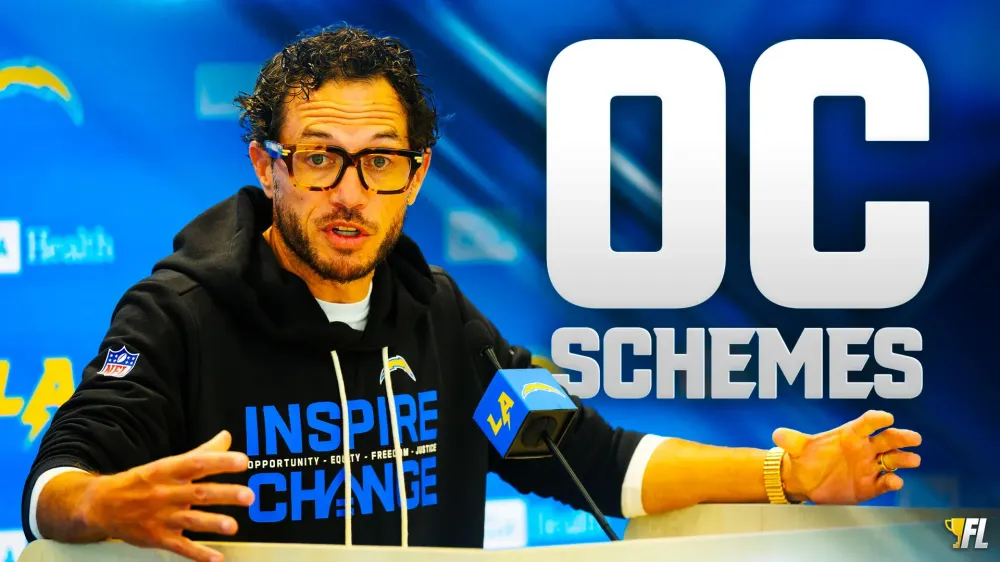
Offensive Coordinator and Scheme Changes For Fantasy Football: The Chargers Are Set To Smash In 2026
Chris Allen breaks down the biggest OC and scheme changes that will impact fantasy football in 2026 and beyond.
I can’t find my coffee mug.
So, my family and I just moved into a new house. We’ve only been in there a couple of weeks, but I’m still fighting my muscle memory of our old place. The cabinet on the left is for plates now? OK, cool. Even if the house is bigger with more space for us to grow, there’s a learning curve that goes with something as simple as—wait, now I can’t find my wallet.
Teams switching play callers carry a similar vibe. At an offense’s core, the QB is still throwing the ball to pass-catchers running routes or putting the ball in the belly of an RB. But the patterns are different. Hopefully, better, but distinct from years past. And by looking at past tendencies, we can get a sense of how we should change our approach in drafts.
Join Our Newsletter
Trusted by 400,000+ fantasy football players. Get access to Fantasy Life's free award winning newsletter and tools, all in one step.
By registering or logging in, you agree to our Terms of Use and Privacy Policy.
Offensive Coordinators & Scheme Changes To Watch For Fantasy Football 2026
Teams Everyone Will Be Watching
Los Angeles Chargers
- Old: Greg Roman (Ravens OC)
- New: Mike McDaniel (Dolphins HC)
The football gods smiled on us by pairing the “robot QB” with the mad scientist in Off-White Jordans. Mike McDaniel’s desire to make things simple and easy for Justin Herbert should only enable him to do more of the impossible when the Chargers need it. But it’s the base tenets of the McDaniel offense that should have us all intrigued for the Bolts’ pass catchers.
Two things tended to stick out when watching the Dolphins' passing game under McDaniel. First, for not being a voluminous operation. It was efficient. The former 49ers’ OC had Tua Tagovailoa attacking the middle of the field early and often. But it wasn’t just Tua. There were shades of the same philosophy when McDaniel was on the West Coast.
- Jimmy Garoppolo, 2021 (on early downs): 1st (MoF Throw Rate Rank), 21st (EPA per Att. Rank)
- Tua Tagovailoa, 2022: 2nd, 4th
- Tua Tagovailoa, 2023: 1st, 3rd
- Tua Tagovailoa, 2024: 5th, 5th
- Tua Tagovailoa, 2025: 13th, 16th
Of course, this benefits a primary option like Ladd McConkey, who, after a down season, still ran 26.6% of his routes over the middle of the field. The most of any Chargers receiver currently on the roster. However, in those same scenarios, TEs earned over 20.0% of the looks in three of McDaniels’ five seasons as an OC or HC. Yes, the additions of Charlie Kolar and David Njoku are noteworthy. But neither has the same athletic traits that complement the other aspect of what we’ve seen from McDaniel in the past.
- Tua Tagovailoa, 2022: 2.48 (Average Time to Throw), 9.3 (Air Yards per Att.)
- Tua Tagovailoa, 2023: 2.24, 7.1
- Tua Tagovailoa, 2024: 2.23, 4.8
- Tua Tagovailoa, 2025: 2.49, 6.1
“The first day, Mike might have given them a heads-up that if they didn't turn their heads around fast enough, the ball was going to hit them in the face. It was on us as quarterbacks to push the limits and see how quickly we could get the ball out.”
A quick trigger was a staple of the Miami offense. But it required the speed on the other end to build on the strength of the almost blind faith of the QB. McDaniel’s consistent pairing of a fast processor with receivers who are fleet of foot brings two ancillary options into the spotlight.
Omarion Hampton’s top-20 consensus ADP points to how bullish drafters are about the second-year RB with McDaniel’s run-game designs. But that’s just his floor case. RBs have seen no less than 21.1% of the early-down pass attempts under McDaniel over the last five years. While that’d be a meteoric rise for Hampton, projecting him for the 13th-most targets of any RB is his path to challenging for an RB1 finish by season’s end. Along with Hampton, Oronde Gadsden, who matched Trey McBride and Colston Loveland in YAC per reception last season, should come back onto our radar, and I think Charlie Kolar is actually a solid pick going under the radar in his own right, due to his athletic ability (4.67-second 40 time) and utility as a blocker. Plus, with the reshuffling along the offensive line, Herbert has a path to quiet the naysayers for the first time since joining the league.
Philadelphia Eagles
- Old: Kevin Patullo (Eagles Pass game coordinator)
- New: Sean Mannion (Packers QB coach)
Independent of the results from the upcoming season, the Eagles made the right call in hiring Sean Mannion. Someone who, at least on paper, will bring modern concepts to Philadelphia’s offense and challenge Jalen Hurts to access all of his skills as a passer.
- Pre-snap Motion (Packers, 2024-2025): 62.3% (Usage Rate), 5th (League Rank)
- Early-Down Play Action: 34.2%, 11th
- Under Center Passing: 25.6%, 9th
The first and third bullets are where you’d find the Packers and Eagles at opposite ends of the spectrum. And we can at least remember the qualitative difference in results. Jordan Love was dropping dimes to Christian Watson on a weekly basis while managers prayed for A.J. Brown to see more than five targets. Regardless, moving away from the static and isolative nature of the Patullo offense to one that pulls the spine of a defense laterally, opening up space for crossers and throws down the seam. However, that’s where our first bet on talent lies.
The argument shouldn’t be whether or not Hurts can complete passes to the middle of the field. Our focus should be on how he performed when he did. From there, we can start to project his outcomes with more of those plays integrated into the offense. Sure, just 90 total attempts using under-center play action on early downs in five seasons as a starter should give us pause. But ranking 13th in EPA per dropback on those throws puts us on a positive path. Besides, Hurts isn’t too dissimilar from Mannion’s previous QB when executing those types of plays.
- Air Yards per Att. (using UC PA): 13.7 (Hurts), 11.6 (Love)
- Passing Success Rate: 45.5%, 46.3%
- Average Time to Throw: 3.77, 3.32
The main difference is that the Packers had the route combinations to open up the deep strikes. Design will be Mannion’s job. But he’ll also need the on-field talent to execute. DeVonta Smith is already an exceptional route runner. A.J. Brown’s departure and a shift to more YAC-enabling patterns will elevate Smith into the role we saw for him since entering the league. And at least one of his new teammates will need to emerge as a productive option to keep the offense moving this season.
Makai Lemon fits the archetype of a receiver that Mannion would want in his scheme. In a word, the former Trojan is flexible. While primarily playing from the slot, Lemon was just one of two WRs from the ’25 class to average more than 3.0 YPRR against both man and zone coverage. Combined with his diverse route tree, you can see how a pivot to a playcaller like Mannion will work for Hurts this year.
A Team I Want To Be In On
Arizona Cardinals
- Old: Drew Petzing (Cardinals OC)
- New: Mike LaFleur (Rams OC) + Nathaniel Hackett (Jets OC)
Mike LaFleur was the 49ers’ passing game coordinator under Kyle Shanahan for four seasons. LaFleur then spent three years with Sean McVay. Put simply, if you wanted to jump-start an offense, there weren’t many better candidates for the job.
- Neutral Pace (Plays per Game in 2025): 52.9 (Rams), 45.3 (Cardinals)
- Pre-Snap Motion: 64.1%, 47.9%
- Under Center Snap Rate: 40.8%, 18.8%
Along with the Rams making TE-heavy formations en vogue in ’25, it’s no wonder Arizona, with a win total line at 4.5, has four skill players in the Top 100 of drafts. However, if there’s one guy I’m looking to benefit the most from the coaching change, it’s Marvin Harrison. LaFleur’s already indicated the third-year WR will take on the “Davante Adams role” this season. Some saw it as a sacrificial X-receiver position, nullifying Harrison’s chances to evolve. But the film suggests otherwise.
Sure, Adams played more outside (83.9%, most since 2015). But he was working off a steady diet of in-breakers with defenders a step or two away. Meanwhile, Harrison was operating farther downfield (14.8 air yards per target) with less around him to disguise the offense’s intent. Even small steps toward the “Davante Adams role” would be a blessing for fantasy managers.
- Slot Target Rate (in 2025): 29.3% (Adams), 14.1% (Harrison)
- In-Breaking Timing Route Rate: 25.0%, 17.6%
- Green-Zone Target Rate: 35.9%, 11.4%
And I’ll be keeping an eye out for Kendrick Bourne. Even with the increased love for TEs, LA still used 11-personnel formations on 72.3% of their pass plays (15th-most). Bourne will likely take on some of the slot work, making him an under-the-radar add in PPR leagues.
Let’s Wait Until 2027, But Still …
Las Vegas Raiders
- Old: Chip Kelly (49ers HC), Greg Olson (Seahawks QB coach)
- New: Klint Kubiak (Seahawks OC) + Andrew Janocko (Seahawks QB coach)
Two things about the Raiders’ offense we have to consider. First, we don’t know when Fernando Mendoza will take over as the starter. Our projections have the Heisman winner at 12 games. We’ll adjust as we learn more. Second, independent of who starts, their receiving corps is unproven at best. But still, with Klint Kubiak calling the shots, we should see some life out of the Silver and Black.
Before you get sucked into watching all of the Jaxon Smith-Njigba highlights (DeVonta Smith is next!), stop the video pre-snap and count how many players are on the line in front of Sam Darnold. There are no fewer than six on each play and sometimes a seventh.
Kubiak’s offense used 12-personnel concepts at the fifth-highest rate last season. And they weren’t just as blockers or as dump-off options. AJ Barner’s 69.1% route rate (more than double from the year prior) was the most cardio a TE saw for the Seahawks since Jimmy Graham in 2017. Barner accrued more first downs in obvious passing situations on a per-route basis than Seattle’s starting duo at WR (11.5% vs 11.1%). The emphasis on the position puts a player like Brock Bowers on a path for a historic season, justifying his second-round ADP. But there are a few more aspects of the Kubiak design that will bring some interest to the WRs.
- EPA per Dropback using Boot-Action: 0.40, 10th
- In-Rhythm Pass Atts: 292, 12th
- In-Rhythm aDOT: 5.8, 19th
The Seahawks would motion a player one way, and Sam Darnold would roll out the opposite direction. Or the concept would target the same side as Darnold’s bootleg. Regardless, the mismatches created would occur in the short and intermediate parts of the field. Allowing for explosive plays later in the sequence. I’ll admit ahead of time that I’m projecting my own multi-leg parlay into my usual reasonable analysis. But the Raiders do have a budding intermediate route runner on their squad already.
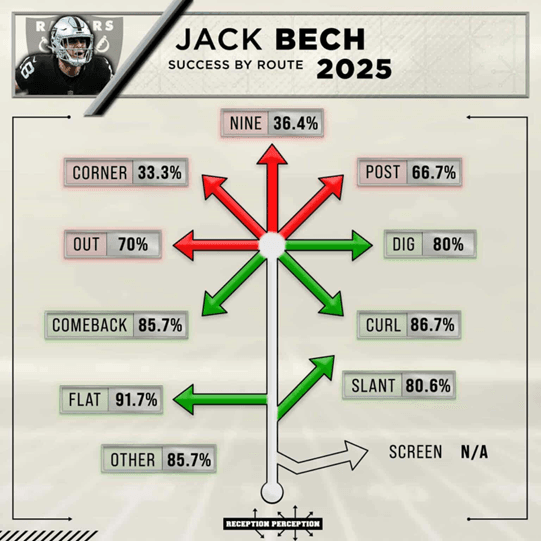
I know. I know.
Pointing to Ashton Jeanty as a bounceback candidate due to his utility as a pass catcher would be a safer bet. But nobody else on the roster fits the profile of a WR1 from a size perspective. Along with Kubiak’s penchant for using bunch formations as an easy button for creating separation, I’ll be throwing late-round darts at Bech this offseason.
Join Our Newsletter
Trusted by 400,000+ fantasy football players. Get access to Fantasy Life's free award winning newsletter and tools, all in one step.
By registering or logging in, you agree to our Terms of Use and Privacy Policy.
Players Mentioned in this Article
 CharlieKolarTELAC
 A.J.BrownWRNE
 SamDarnoldQBSEA
- PPG
- 14.1
- Proj
- 258.7
 JustinHerbertQBLAC
- PPG
- 17.4
- Proj
- 299.2
Published