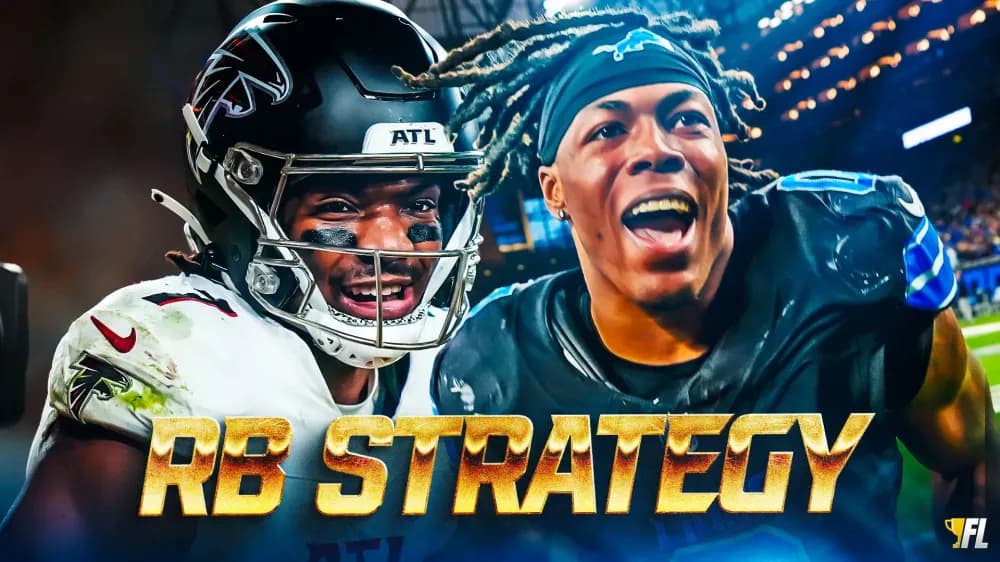
Robust-RB Fantasy Football Strategy: Target Ashton Jeanty, Chase Brown And More Early
Adam Pfeifer continues his fantasy football draft strategy series, offering a guide on how to approach Robust RB targets this summer.
First there was Zero RB. Punt the position and hopefully hit lottery tickets late in your draft. Then there was Hero RB. Draft an anchor to lead your room early and then deploy a Zero-RB approach from then on. And now?
All of the running backs.
We continue our strategy series with a look at the Robust-RB approach, which is polar opposite from the previous two we discussed. Rather than waiting on the position and leaning into backfield uncertainty around the league—because there are fewer true, every-down, workhorse running backs in the league—Robust RB calls for drafters to load up on as many running backs as possible during the first few rounds. You’re trying to lock up a handful of voluminous, league-winning-upside running backs, while at the same time, ignoring the yearly volatility of the position. We know the running back position tends to miss the most time due to injury, which makes this a risky proposition, especially when you consider all of the wide receiver talent you’re passing on.
But this past season, a Robust-RB approach could have paid dividends.

Unlock Our Tools!
Stop hitting the paywall. FL+ gives you access to our premium in-depth content, expert rankings & projections, mock draft simulator, and all the tools you need – all personalized to your league.
Robust RB Strategy Guide for Fantasy Football 2026
Of the top 12 running backs drafted in 2025 fantasy leagues, only two missed notable time due to injury: Josh Jacobs (two missed games, limited snaps in others) and Bucky Irving (seven missed games). Meanwhile, 10 running backs recorded at least 300 touches this past season, with three eclipsing 350. Loading up on as many of those players gives you that huge upside, but also weekly consistency. Because you are trying to secure as many elite, workhorse running backs as possible, it also ensures you avoid the vaunted RB Dead Zone, which usually kicks off in Round 7. The bust rate of running backs is much higher than wideouts in that draft range, while there are still upside wide receivers available.
Your decision to deploy a Robust-RB strategy can come down to a few different factors. For starters, how loaded is the elite tier of fantasy running backs? Our fantasy football projections currently have eight running backs slated for at least 300 touches in 2026. It would be in your best efforts to try to secure two, maybe even three of those players. Secondly, because you are foregoing the position during the early rounds, a deep WR pool will make deploying Robust RB a lot more palatable.
So. You’re ready to try a Robust RB draft. How do you begin?
You’re obviously trying to draft the elite players like Bijan Robinson, Jahmyr Gibbs, Christian McCaffrey, Jonathan Taylor and James Cook. But there are also some really strong candidates available at a discount. Saquon Barkley has now fallen from top 5 overall to the early second round of drafts, while Chase Brown and Derrick Henry are coming off the board in the middle of Round 2. Outside of the obvious top-5 running backs, let’s highlight a few of my favorite Robust-RB targets:
 Ashton Jeanty | RB | Las Vegas Raiders
ADP: RB5, 11 overall
As a rookie, Ashton Jeanty was busy, ranking third in snap share (78%), second in rush share (78%), sixth in route share (59%) and eighth in touches per game (18.8). That volume didn’t lead to league-alerting fantasy upside, as Jeanty finished as the RB15 in fantasy points per game, despite ranking sixth in touches (321).
Volume? Great. Efficiency? Not so much.
It was hardly Jeanty’s fault, though. Jeanty was stuffed at or behind the line of scrimmage on a whopping 26.7% of his carries, the highest rate in the NFL. The Raiders averaged 3.50 adjusted line yards per attempt, tied for the worst mark in the league, while Jeanty averaged just 3.3 yards per carry on runs inside the tackles. His 27.6% success rate on such runs was also comfortably the lowest rate among qualified rushers.
More often than not, the runway for Jeanty was blocked. But entering his sophomore season, the former top-6 pick should be cleared for takeoff.
This offseason, the Raiders signed center Tyler Linderbaum, who ranked fourth in PFF’s run block grade in 2025. That will drastically help the inside-run game, giving Jeanty more opportunities to hit home runs, rather than constantly grounding out. Las Vegas also hired Klint Kubiak as head coach, and he has already discussed his plans to feed his star running back early and often.
Now that you have your core running back room solidified, it’s time to attack the wide receiver position. And although this is a running back-focused strategy, hitting on the wide receivers can be equally important. And because you are already dropping the wide receiver position down the pecking order, you’ll likely need to pass on the top-tier quarterbacks or tight ends. So let’s also take a look at a few later-round wideouts who can help you round out your Robust-RB build.
 Chase Brown | RB | Cincinnati Bengals
ADP: RB11, 17.1 overall
I’ve written about Chase Brown all summer, and to me it’s pretty simple.
If Joe Burrow is sidelined, Brown will remain a serviceable fantasy running back. But if Burrow is healthy, Brown is elite.
During Weeks 3-12, the Bengals offense looked like a shell of its former self without its star quarterback. And although things did improve once Joe Flacco saved our fantasy rosters, it still wasn’t the same. With Burrow sidelined during that stretch, Brown averaged just 13.5 PPR points per game, ranking as fantasy’s RB20. He still averaged 5.7 targets per game, but only found the end zone twice during that span.
Brown did benefit a bit from the presence of Flacco, averaging 3 more fantasy points per contest. But with Burrow set to return, Brown’s final form was about to be reached.
From Weeks 13-18, with Burrow under center, Brown averaged 22.3 PPR PPG. The only non-quarterbacks in all of fantasy football to average more points during that span? Bijan Robinson and Puka Nacua. During that stretch, Brown also averaged 19.1 touches and 5.2 touches per game.
 Christian Watson | WR | Green Bay Packers
ADP: WR28, 57.6 overall
A 2024 late-season ACL tear sidelined Watson for the first seven games of last season, presenting serious risk as a fantasy option. But when he made his debut in Week 8, Watson wasted no time showing his immense upside. From Weeks 8-18, Watson ran 72% of the routes, while posting a 23% TPRR and 20% target share. During that stretch, Watson was the WR22 in fantasy points per game (13.2), but the underlying metrics prove that, with added volume, he can do so much more.
Watson Weeks 8-18:
- 17.5 Yd/Rec (2nd)
- 2.54 YPRR (8th)
- 11 plays of 20-plus yards (10th)
- 6 TDs (5th)
Overall, Watson ranked fifth among all wideouts in fantasy points per route (0.57) and entering the 2026 campaign, there’s a lot to be excited about.
For starters, the departure of Romeo Doubs and Dontayvion Wicks opens up more routes and targets, two things that have been a bit limited from Watson in Green Bay’s receiver rotation. Throughout his career, Watson is averaging just under five targets per game, while never eclipsing a 20% target share. I fully expect both numbers to rise quite a bit this season.
Already someone who finds paydirt, Watson has scored 20 touchdowns on 133 career receptions (15%) and if he plays a full season, it genuinely wouldn’t shock me if he reached double-digit scores. Since Watson entered the NFL in 2022, both he and Doubs are tied with 32 end-zone targets. And just last season, they also tied for a 33% end-zone target share when Watson was healthy. Doubs also accounted for 32% of the Packers targets from inside the 10-yard line, the eighth-highest rate in football.
 Brian Thomas Jr./Parker Washington | WR | Jacksonville Jaguars
Thomas: WR31, 62nd overall. Washington: WR34, 69.2 overall
Jacksonville's WR room is legitimately perfect for a Robust-RB build. Why? Because it’s essentially the equivalent of targeting an ambiguous backfield in a Zero-RB build.
Tons of uncertainty, but plenty of upside.
While the answer is somewhere in between his rookie and sophomore seasons, we’ve already seen immense upside from Brian Thomas Jr. His role changed into more of a field-stretching, vertical target. But he also wasn’t fully healthy last season, which certainly could have played a factor in his 5.2 target, 8.9 PPR PPG finish from Week 10 on. It remains to be seen if Thomas’ role will expand this season, but regardless, this is an offense we want pieces of.
Parker Washington, meanwhile, emerged as Jacksonville's top target during the final five weeks of the season. From Weeks 15-19, Washington dominated the usage, sporting a 27% target share and 28% TPRR, while averaging around 19 PPR PPG. The Jaguars continue to talk him up and seem to once again have huge plans for Washington.
Unlock Our Tools!
Stop hitting the paywall. FL+ gives you access to our premium in-depth content, expert rankings & projections, mock draft simulator, and all the tools you need – all personalized to your league.
Players Mentioned in this Article

Published