Elite WR Fantasy Football Draft Strategy: Targeting Ja'Marr Chase, Amon-Ra St. Brown And More
Justin Carlucci examines the elite WR draft strategy in fantasy football 2026, noting how gamers can still target the top wide receivers early.
The entire fantasy industry spent this offseason chirping about the same thing: draft running backs early. And you know what? They're not wrong. The data backs it up, the fantasy football ADP backs it up and I'm about to back it up, too. The elite wide receivers matter.
But you can’t just hammer RBs and figure the rest out later.
It's not about picking a side in the RB-vs-WR war. It's understanding that the alpha wide receiver might be quietly going extinct at the top. But there’s a ridiculous amount of usable receiver depth piling up in the middle rounds of our fantasy football rankings.
Grab a cold one and lock in. We have a lot to unpack.

Unlock Our Tools!
Stop hitting the paywall. FL+ gives you access to our premium in-depth content, expert rankings & projections, mock draft simulator, and all the tools you need – all personalized to your league.
Draft Strategy Targeting Elite Wide Receivers
Two Things Can Happen at Once
Over the last five years—2021 to 2025, PPR scoring—two things have been happening at the same time.
1) The pool of true alpha receivers is shrinking. The guys who command a monster target share AND score like a WR1 every single week are getting rarer.
2) The elite running back has come roaring back as the single-most-valuable asset in fantasy — think Christian McCaffrey putting up 416.6 PPR points in a full 2025 season. Video game numbers.
First, let's define the terms so we're not just vibing. I'm labeling an alpha WR season as a guy who cleared all three of these gates in the same year:
- 25%+ target share: he's the guy—the offense runs through him)
- 15+ PPR points per game: he's scoring like a legit WR1
- 12+ games played: he was actually available, not a mini sample size
That's a fair, strict bar. Command the volume, produce the points, stay on the field. Here's how many receivers hit all three, year by year:
| Season | Alpha WRs |
|---|---|
| 2021 | 4 |
| 2022 | 8 |
| 2023 | 10 (peak) |
| 2024 | 8 |
| 2025 | 6 |
We peaked at 10 in 2023, and we've been sliding since. Eight in 2024 and six in 2025. The top of the position is consolidating into fewer and fewer hands.
And who were the six who cleared all three bars in 2025? Puka Nacua (28.8% target share, 23.5 FP/G), Jaxon Smith-Njigba (32.6%, 21.2), Ja'Marr Chase (30.2%, 19.7), Amon-Ra St. Brown (28.5%, 19.1), Drake London (28.1%, 16.9) and Chris Olave (27.2%, 16.8). That's the whole club.
Remember those names—a few of them show up again in surprising places on this board.
Want it from another angle? Look at how many receivers even hit 250 PPR points in a season: it went 11 → 9 → 14 → 10 → 6. Same story. The big-boy club is getting smaller and harder to get into.
The drop-off behind the top guys is getting steeper. The gap between the WR5 and the WR24 in total scoring has widened over this stretch, meaning the demand for one of the few difference-makers is higher. The elite tier is pulling away from the pack.
Matthew Berry's Draft Day Manifesto
But the Running Back Surge Is Just as Real
Now let's give the RB-early crowd their due, because they earned it.
Christian McCaffrey's 416.6 PPR points in 2025—on 102 catches, running back caught 102 passes!—is the kind of season that single-handedly rewrites how people draft. But it's not just him. The top of the RB position, also featuring Bijan Robinson and Jahmyr Gibbs, has become a points fountain again after years of "receivers are safer" gospel. It reminds me of the peak Marshall Faulk years—a few running backs that do everything and then some on the football field.
Here's the flip side that tells the whole story: back in 2021, the top-24 overall scorers in fantasy included 17 wide receivers. By 2025, that same top-24 was headlined by 15 running backs. The positional center of gravity inverted in four years.
That's why you play the board. I do believe if you're picking in the top 9 in single-QB redraft leagues, you're already off to a good start and guaranteed a player who has a recent track record of an elite do-it-all No. 1 fantasy back or alpha wide receiver upside. Chop it up how you please, in no specific order:
- Bijan Robinson
- Jahmyr Gibbs
- Ja'Marr Chase
- Puka Nacua
- Christian McCaffrey
- Jaxon Smith-Njigba
- Amon-Ra St. Brown
- Justin Jefferson
- CeeDee Lamb
Wide Receiver Tiers
Tier 1 —The Alphas
These are the four receivers worth a premium top-half-of-Round-1 pick. Three of them are proven, repeat alphas. The fourth is the ascending target monster you pay up for on trajectory.
Ja'Marr Chase (Bengals): Three alpha seasons in five years, a peak of 23.7 FP/G, ADP around 3.1. When healthy, he’s the highest-floor-plus-ceiling combo at the position. Has proven to be very good with backup QB play, too. Nice to have Joe Flacco still hanging around in case anything happens to Joe Burrow, and it’s also nice the Bengals defense is still #notgood.
Puka Nacua (Rams): Nacua has two alpha seasons in three years, a 23.5 FP/G monster in 2025—129 catches, 1,715 yards … otherworldly—and an ADP around 4.0. His 2024 "miss"? He cleared the target-share bar (28.3%) AND the scoring bar (18.8 FP/G) — he missed the alpha label on one thing only: he played 11 games instead of 12. An injury-shortened season forced him under the games-played threshold, and that's it. Treat him like the top-tier alpha he is. I’d say his miss deserves an asterisk, because last year he cleared all three easily.
Jaxon Smith-Njigba (Seahawks): The one honest wrinkle in this tier. JSN has one alpha season on the board, not three or four. But that one season came with the highest target share in the entire 2021-2025 sample among qualifiers (32.6%) and a 21.2 FP/G line, at an ADP around 5.4. You're not paying for a long resume here—you're paying for a guy who just became the total focal point of his offense. The cons? Life after Klint Kubiak. Let’s hope he’s still deployed properly. If it ain’t broke, don’t fix it, Seattle.
Amon-Ra St. Brown (Lions): What more can you ask for? Four alpha seasons in five years, best year at 20.7 FP/G, and an ADP around 7.2. You know exactly what you're getting: a top-tier target hog in a great offense that produced sans Ben Johnson.
Tier 2 — Have Been, Could Be Again
Justin Jefferson (Vikings): Three alpha seasons in five years, 21.7 FP/G in his best year, and here's the kicker: an ADP around 10.0. Read that again. One of the best receivers of his generation is going outside the top 9. Why? His 2025 got dragged down by a quarterback carousel to an 11.9 FP/G. That's a situation problem, not a talent problem, and situations change. If you miss the Tier 1 window, this is your landing spot, and it might be the best value on the entire board. I’m hoping Kyler Murray wins the starting QB job. We’ve seen him support WR1s before.
CeeDee Lamb (Cowboys): Two alpha seasons, but the highest ceiling in the group (23.8 FP/G in his best year), ADP around 9.6. The offense around him got noisier with George Pickens in play—but you're buying a league-winner's upside at a discount. Lamb’s floor is unreal in one of the best offenses in the league, plus, what if he sees some positive touchdown regression?
Tier 3 —Former Alphas, Big Upside, More Questions
Drake London (Falcons): Two alpha seasons in four, 16.9 FP/G peak, ADP around 19.7. The talent is there; the fog is the Atlanta quarterback situation. Michael Penix is working back from an ACL rehab with an uncertain Week 1 timeline, and the alternative is Tua Tagovailoa. That uncertainty is baked into the price, which is exactly why London is where he is. Let’s hope there’s slightly-above-average QB play in Atlanta this year.
Chris Olave (Saints): Obvious historical health concerns here. But the 2025 numbers say something louder: Olave posted 100 catches, 1,163 yards, 9 TDs, a 27.2% target share, and 16.8 FP/G across 16 games. That's not a question mark — that's a guy who quietly played like a near-alpha. He's in a contract year, and rookie Jordyn Tyson adds target competition. But at an ADP around 29.6, you're getting someone with an alpha year under his belt at the Round 2-3 turn.
A.J. Brown (Patriots): Here's the definition of a polarizing pick, and the name that'll split your draft room in half. On pure track record, he is nearly an alpha: three straight seasons in Philly with a 27%+ target share and 16-18 FP/G (a 1,496-yard, 17.7 FP/G peak in 2022). Talent is not the question. The situation isbecause Brown was traded to the New England Patriots this offseason and into a completely new offense. His 2025 line dipped to 14.7 FP/G, which is why the market has him wobbling around an ADP of 19-24 ($28 auction). There is a narrative about New England throwing the ball a ton, but the Pats passed at around a league-average neutral rate.
Matthew Berry's Fantasy Football Rankings
Mid-Round Receiver Depth Is Real
Here's where it gets fun, and here's where you win your league. Everybody's so busy fighting over the top 6 receivers and the elite backs that they forget to look about 40 picks down the board. And when you look? It's stacked.
There's a whole cluster of receivers with legitimate low-end WR1-or-2 upside going for peanuts, because of plenty of uncertainty.
Here's some food for thought on the middle-round receivers.
Emeka Egbuka (Buccaneers): My favorite of the bunch. "Buka" is the one I keep coming back to. He was a first-round rookie (19th overall, 2025) and an Offensive Rookie of the Year finalist who broke out precisely because Mike Evans and Chris Godwin were banged up. He finished with 127 targets, a 22.8% target share, 63 catches, 938 yards as a rookie. And now? Evans is gone to San Francisco. With Buka healthy and Evans out of the fold, Baker Mayfield's offense is his to inherit, and Todd Bowles' staff can move him all over the formation. A sophomore boom is very much on the table. He goes a touch earlier than some of the others in this cluster, and I'm fine paying up.
Mike Evans (49ers): The red-zone lottery ticket. Evans left Tampa after more than a decade and signed with the San Francisco 49ers. That means Kyle Shanahan's offense, with CMC and George Kittle. Are you kidding me? The raw target volume might not be as huge in that ecosystem, and 2025 was injury-plagued for him. However, the efficiency might be through the roof in an amazing system. Evans has been a red-zone touchdown machine his entire career—double-digit touchdowns (14, 13, and 11) in each of 2021, 2023 and 2024 despite missing time in that last one. Cheers to a clean bill of health, Mike.
Davante Adams (Rams): The touchdown monster. If Evans is a red-zone lottery ticket, Adams is the red-zone jackpot. And here's the kicker: he did it in a partial season. In his first year with the Rams (2025), Adams played just 14 games and still tied for the NFL lead in red-zone targets (32) while catching 14 touchdowns. Such a great price for someone who keeps producing when healthy. Like Evans, if you can find a full season’s worth of games out of Adams, look out.
Terry McLaurin (Commanders): Don't let 2025 fool you. Jayden Daniels got hurt and was eventually shut down for the year with a dislocated elbow. Rewind to 2024 with a healthy Daniels, and McLaurin went for 13 TDs and 15.8 FP/G. That’s WR1 territory. Washington didn't add another mouth to feed at the top of the depth chart, so if Daniels is back and right, you're getting that WR1 upside at a WR-mid price.
DJ Moore (Bills): Moore got traded from Chicago to Buffalo this offseason, reuniting with HC Joe Brady (his old OC in Carolina) and, more importantly, catching passes from Josh Allen. With all of the capital Buffalo sacrificed to land him, they clearly believe Moore has gas left in the tank.
Carnell Tate (Titans): Tate, the No. 4 overall pick in the 2026 draft—out of that Ohio State Wide Receiver U pipeline that includes Olave, JSN, MHJ, Egbuka and now Tate—pairing with young QB Cam Ward under new OC Brian Daboll. As a top-5 NFL Draft pick, he's got a low-end WR1 ceiling this year. But, of course, Ward has much to prove, especially with a brand-new scheme to learn, even if it'll likely benefit him in the long run.
Boxed Out in the Back of the Draft
It’s much easier to get the roster you want in auction formats. The toughest part of snake drafts for me this season is picking in slots 10 through 12. You could be boxed out of those top-9 players we talked about earlier.
If you are fortunate enough to land either pick No. 1 or 2 overall, you're guaranteed one of the elite running backs, and with how high their production has been (and is projected), you can feel great about coming back to grab a Chris Olave and pairing him with, say, a Rashee Rice, because you know your lineup is a ticking time bomb for you when the 1.01 or 1.02 drop 30 PPR points on a given week.
But at the tail end of a snake draft, securing both your alpha and your star running back gets nearly impossible. If the board doesn't fall your way, it can feel like you're reaching early with your second-round pick.
Take the guys who just miss the top-9 cut. Jonathan Taylor is a perfect example. He probably just misses the boat as a first-tier back due to not having the same receiving upside—but in his own right, Taylor set career highs in 2025 with 54 targets, 46 receptions and 378 receiving yards last year.
He's an absolute monster running between the tackles with super-high touchdown equity. The problem is the top-3 running backs above him just offer too much more ground to make up in PPR formats.
So say the Jefferson/Lamb tier is gone and you're staring at pick No. 10, before the 1-2 turn. How early do you want to stomach an AJB, a Rice or a London and an Olave alpha-upside guys carrying real question marks?
Leveraging Brock Bowers in Head-to-Head Formats
Let’s say you land JT late in the first round and don't want to reach for a receiver that early. How do you try to get an edge on your peers? Do you go with someone like Brock Bowers on the way back?
Perhaps.
New Raiders’ HC Klint Kubiak has already been drooling over Bowers with big-time coachspeak. If anyone can unlock Bowers, it’s Kubiak. Just look at how Seattle used JSN with Kubiak in the saddle. I used Fantasy Life’s Draft Champion Mock Draft Simulator to test out a few scenarios. It just feels uncomfortable … but sometimes, that’s where the bread is earned. I absolutely hate not having an alpha WR, but this is where you’ll need big-time conviction behind your mid-round receivers.
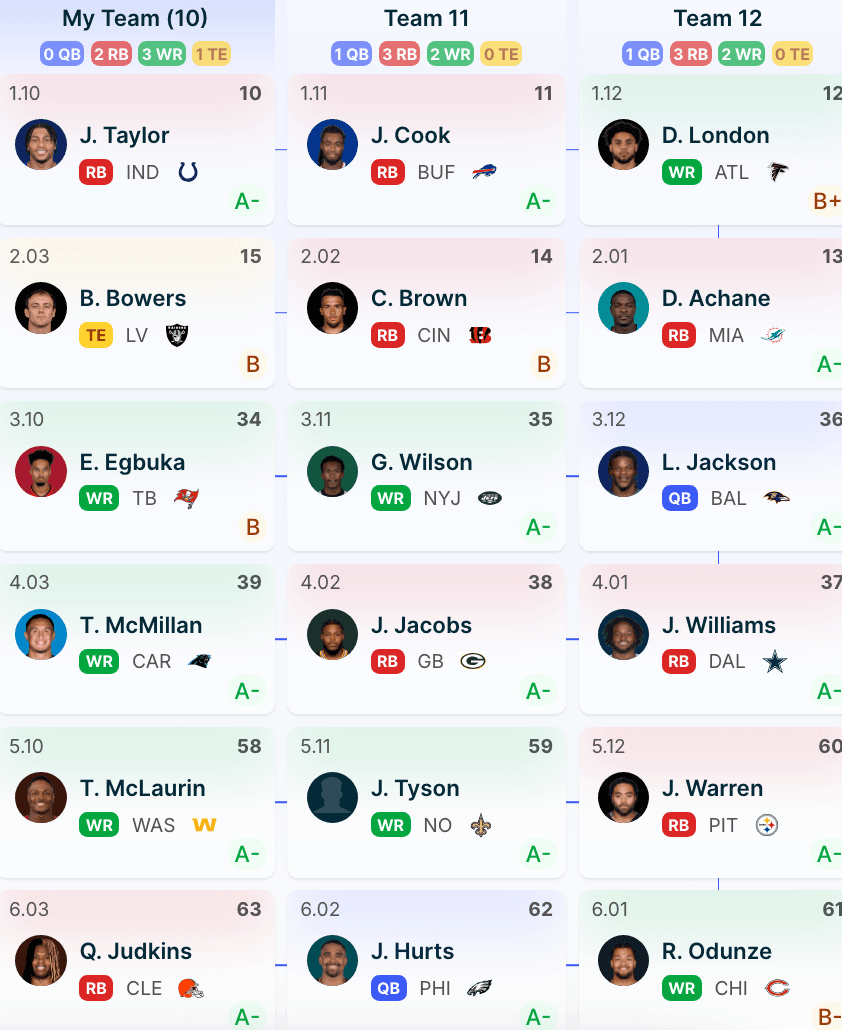
Go Taylor and Bowers in Rounds 1 and 2, and you almost certainly have to nail your Round 3 and 4 receivers. And at that point, you're probably taking two of them. Furthermore, you’re way behind for an RB2 (though this is way less of an issue in best ball). In this mock draft, I feel that I was very fortunate to land Quinshon Judkins at 63. That surely won’t be the case all of the time.
That being said, league size matters, too. In a smaller 10-team league, where everyone’s rosters are loaded, Bowers at a one-off position could carry much more weight in head-to-head formats when he hits ceiling weeks. Plus, you can find some better receivers and backs further down the board—it just gets much tougher in 12-team formats.
I actually really like the Egbuka range and the Tetairoa McMillan types at those ADPs, but understand the gamble in 12-plus team formats: you not only need to be right about hitting a low-end WR1 further down the board (or correctly identifying a new alpha heading into 2027), you also need Bowers to be worth that draft capital and deliver a sensational year. That’s a lot of outcomes that all have to break right.
Another thought process leads me to taking London at the tail end of Round 1 instead of Taylor. Why? Because I don’t mind the thought of a Josh Jacobs or a Javonte Williams somewhere between picks 34 and 39—or maybe a Breece Hall slips there, or a Travis Etienne falls a little after Alvin Kamara (who might be dust at this point) re-upped with the Saints. No news is good news for Jacobs, and Williams is grossly undervalued, in my opinion. Those two have the most reasonable paths to RB1 upside after the second round.
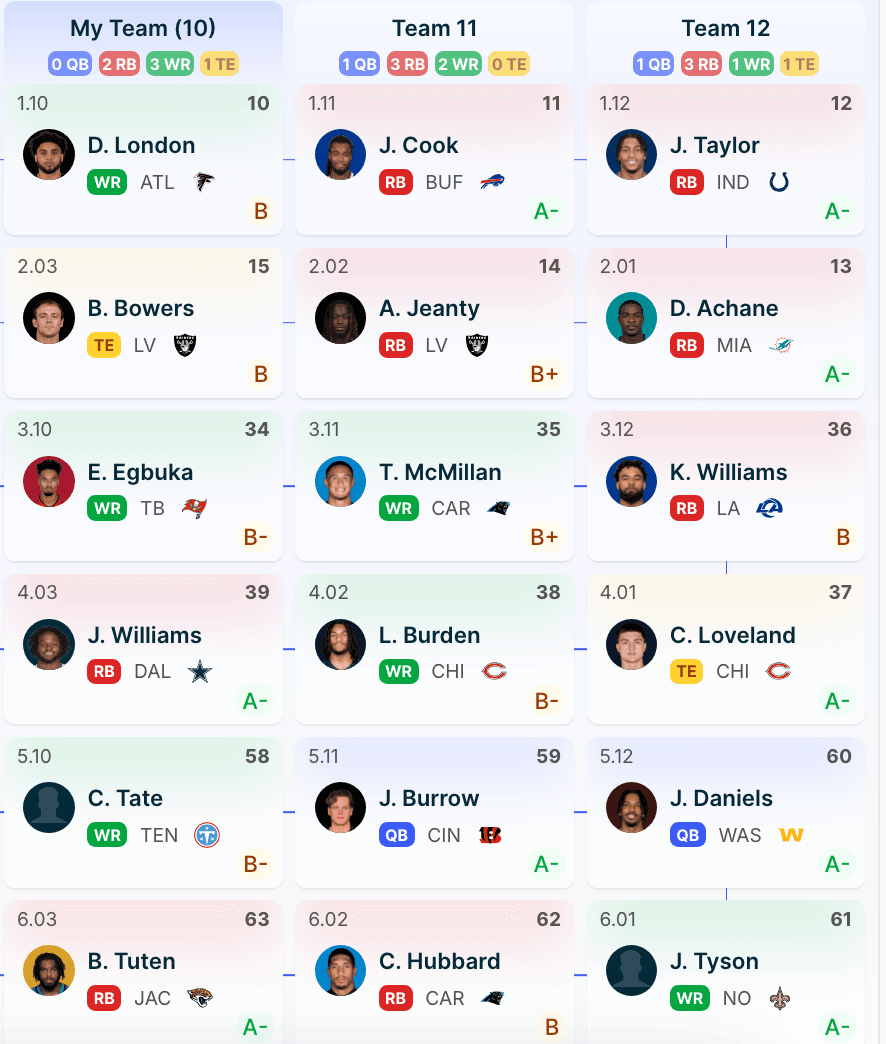
Taking London at 1.10 doesn't feel fantastic, but at least you've got a guy who finished last season as an alpha, and hopefully the QB play, a dome and some shootouts help. Then grab Bowers, come back for at least one (probably two) running backs at the 3-4 turn (I went Egbuka here), and that leaves you Rounds 5 and 6 to chase a DJ Moore, Jameson Williams, or a Carnell Tate. This is as long as you understand you just need to be right about so many more outcomes. Gun-to-head: I like the London mock more than the Taylor one.
The real sweet spot? Picking anywhere between 3 and 6. You can land a Ja'Marr Chase, Puka Nacua, Jaxon Smith-Njigba, or Amon-Ra St. Brown, and still come back and grab a Derrick Henry in Round 2 with super-high touchdown equity. Or grab a Saquon Barkley, who falls into your lap with a new offensive playcaller, or a Chase Brown in a high-octane, minimal-defense Cincinnati offense.
Those last couple of pick slots in snake formats are just tough. It can feel like you're chasing, hoping to capitalize on the other owners' mistakes.
The Bottom Line
Multiple things are happening here, and there won't be a definitive answer until the dust settles. Best ball formats give you much more wiggle room for roster construction—I'm running plenty of "Hero-RB" builds myself.
But when you're forced to submit a starting lineup every week, the situation is much different. Don't let anyone tell you a Round 1 receiver is a mistake, especially if you can follow up in Round 2 with a high-upside running back.
Players Mentioned in this Article




Published Updated