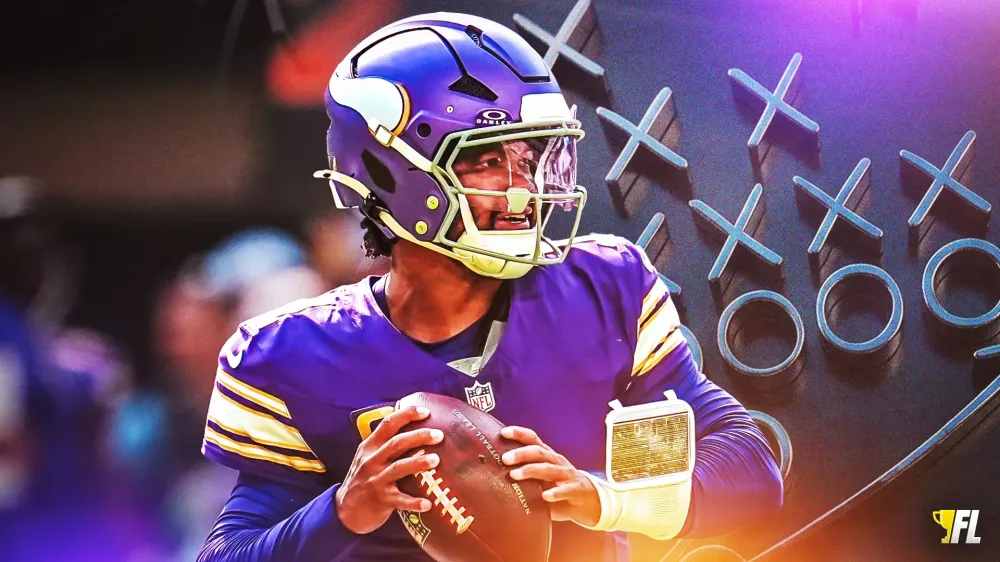
Week 4 Scheme Advantages & Disadvantages For Fantasy Football: Kyler Murray Set Up For A Big Game
Zain Dhanani identified the advantages and disadvantages in schemes to target in fantasy football for Week 4.
I’ve got a few matchups to target and some I’d rather avoid this week, with all of these calls reflected in my fantasy football rankings. Make sure to also check out our fantasy football projections.
Week 4 Fantasy Football Matchups I Like
Kyler Murray vs Dolphins Pass Defense
Miami has been an opponent I want to target with QBs, and I’m going back to it with Kyler Murray. The Dolphins have generated pressure on just 28% of opposing dropbacks through three games, which ranks 31st in the NFL, per PFF. Minnesota has earned an A+ in my pass-blocking grades this season, so Murray should have ample time to let his receivers get downfield. On top of that, Miami allows +0.49 EPA per dropback (worst in the NFL). It’s just a really strong matchup.
That’s important for a player like Jordan Addison, who had one of the deepest average depth of routes in the NFL. Kevin O’Connell can have Addison attack Miami’s safeties while T.J. Hockenson works underneath them, forcing those defenders to decide how much help they can give the corners. The Dolphins have earned an F in safety coverage through three games, and their pass rush hasn’t consistently forced QBs to get rid of the ball before those deeper routes develop, so Addison may have a shot—even if Justin Jefferson plays—to do very well on those plays. Addison is a low-end WR2 or high-end WR3 if Jefferson misses. Jefferson is a high-end WR1 in nearly every game, especially this one.
Miami has allowed 214 yards to inline tight ends, most in the NFL, and 12.4 yards per target to TEs overall (most in the NFL). Hockenson has a 78% route share and lines up inline on more than half of them. He’s someone you can stream in a pinch in this more-favorable matchup.
I’d feel much better about Murray if Jefferson can return from his ankle injury. Jefferson has a chance to play Sunday, but he hasn’t been cleared yet. Having him back would give Murray his best target and make it harder for Miami to devote extra coverage to Addison.
Murray is a nice streamer, especially if Jefferson plays—I have him at QB10 this week. I know he didn’t record a carry in Week 3, and Minnesota has leaned into the run so far this season (I am blaming the Wentz effect and the bad-weather game against the Bears), but this sets up to be a very low-pressure situation where most QBs should be able to take advantage.
Colts Passing Game vs Commanders Defense
Washington is a pass funnel this season that I’m going to continually attack weekly as well. Opponents have thrown on roughly 70% of their plays in the first three quarters with the score within 7 points, well above the league average of 60%. Dallas threw frequently against Washington without trailing at all—it’s the way to attack new DC Daronte Jones’ aggressive scheme.
The Commanders have allowed only 3.20 YPC to RBs and stopped 32% of their carries for no gain or a loss, the highest rate in the league. Their coverage has earned an F in my grades this season. This is likely why teams have chosen to forgo running against this defense in favor of passing.
Josh Downs is in the WR1/WR2 discussion for me. He has earned a target on roughly 30% of his routes in each of the last two games, and almost half his routes against Houston were slants, drags or other in-breakers. Those routes give Daniel Jones options across the middle when Washington brings pressure. Downs averages 2.73 YPRR against the blitz and the Commanders blitz the 2nd most in the NFL so far this season. On top of that, Mike Sainristil has allowed 14.5 yards per target, 5th worst of 160 qualifying defenders. Downs runs 72% of his routes from the slot, so it is a very strong situation.
Keenan Allen is a WR3/flex now that Alec Pierce is on IR. Laquon Treadwell has taken the outside routes Pierce left behind, but Jones is looking for Allen much more often. He drew 9 targets against Houston and moved into the slot on nearly half his routes. Indianapolis can use his in-breakers alongside Downs to attack the middle, and a full week to game plan without Pierce helped Allen’s route participation get back to 76% after it dipped in Week 2. He’s a WR3 for me this week.
You’re already starting Tyler Warren, but I have him at TE4 this week. His 93% route participation against Houston is hard to find at the position, and the Colts move him between inline, slot and outside alignments. They can send him up the seam or across the middle in, and Washington now has to replace Leo Chenal after his neck injury. This Commanders defense plays zone 81% of the time and Warren averaged 2.04 YPRR against zone coverage in 2025—another feather in Warren’s cap.
If you need a QB, I’d stream Jones here. The Commanders are 28th in my model’s pass-rush grade and 29th in coverage grade. That’s a similar combination to the Kyler Murray blurb above, except the Colts are only a “B” pass-protection team (still favorable—not as favorable as Murray’s situation). I like seeing those combinations because it means the QB will not be under pressure and can take advantage of a poor secondary. I have him at QB12.
Dalton Schultz vs Cowboys Coverage
Nico Collins could return this week, but I still like Dalton Schultz as a TE1 against Dallas. DeMeco Ryans is hopeful Collins can play, which would take some targets away from Schultz. He did earn 7 targets with Collins active in Week 1, however.
Houston’s TE group has earned an A in my receiving grades this season. Dallas’ linebackers and safeties have both earned Fs in coverage, and Schultz’s hitches and routes across the middle should let him attack those weaker defenders.
Dallas is also expected to be without Jalen Thompson and P.J. Locke for several weeks. Malik Hooker could return, but Markquese Bell has had to take on more safety snaps with those injuries. Schultz can still find room across the middle against this group even if C.J. Stroud looks for Collins first more often.
Last week, the Cowboys’ injury-ravaged secondary allowed a 24% TPRR to the Ravens’ TEs. That includes Durham Smythe and the rookies—Mark Andrews was at a 38% TPRR. With a very banged-up secondary this week and a consolidated pass offense, Schultz should continue to thrive.
Stefon Diggs vs Colts Coverage
Stefon Diggs gets a much better matchup after facing Seattle last week. Indianapolis has Sauce Gardner and Charvarius Ward outside, but its slot coverage has earned an F through three games. Justin Walley has been Indianapolis’ primary nickel corner, and he has struggled in coverage. The Colts have allowed a league-high 435 receiving yards to players aligned in the slot, per PFF. Washington has used Diggs in the slot on 65% of his routes, so he’s going to take advantage of the weak point of the defense.
Diggs ran plenty of hitches and outs against Seattle, which gave Marcus Mariota throws underneath the coverage. He earned 7 targets in Mariota’s first full start, so he can function as a similar security blanket in Week 4. I’m expecting Mariota to start again, but Jayden Daniels is returning to limited practice.
Diggs is a WR2 for me this week, especially if Washington keeps him on the field as much as it did against Seattle. His route share climbed to 77% after he rotated out much more often in the first two games. It’s still not a full-time role, but if it sticks, he will be a WR3 at worst ROS.
Braelon Allen vs Bears Defense
Breece Hall is week-to-week with a quad injury and unlikely to play against Chicago, which could make Braelon Allen a bell cow against a porous Bears run defense.
Allen handled all 6 backfield opportunities after Hall left against Detroit—3 carries and 3 targets. Isaiah Davis was not involved at all, so presumably Allen should soak up most of the RB opportunities.
The Bears have earned the lowest run-defense grade in my 2026 model and allowed a league-high 2.44 yards before contact per RB carry. The Jets’ line has earned a B in run blocking this season, which gives them a strong matchup advantage.
The Bears also allow 9.5 yards per target to RBs, most in the NFL (12 targets, so small). Allen ran 71% of the routes after Hall left, so there’s opportunities in the pass game to make an impact as well.
I have Allen ranked at RB18 and have him above names such as Omarion Hampton, D'Andre Swift and Bucky Irving.
Tougher Fantasy Football Matchups in Week 4
Quinshon Judkins vs Steelers Run Defense
The Browns want to be a run-first team, but they cannot get anything going on the ground so far this year and this sets up as a BAD matchup. Quinshon Judkins is averaging just 0.64 yards before contact per carry, and the Browns rank 28th in my blended run-blocking model. The Browns will be missing Teven Jenkins and Elgton Jenkins, which could make the blocking even worse on a short week.
On the opposite side, Pittsburgh has earned an A+ run-defense grade this season in my model. The Steelers stuff 24.3% of RB carries for no gain or a loss (4th best in the NFL). When we get bad run blocking against a strong run defending unit, especially in a low total environment, we look for other options.
Judkins is just a flex for me, especially since the team reduced his pass-game role in Week 3 in favor of Raheim Sanders. I have Bhayshul Tuten, J.K. Dobbins and David Montgomery ranked above him at RB25.
Saints Running Backs vs Falcons Run Defense
Travis Etienne is expected to miss time with his hamstring injury, and I’m still hesitant to start the remaining Saints backs against Atlanta. There are carries available, but the line has lost Kelvin Banks to IR and already ranks 31st in my blended run-blocking model.
Asim Richards has replaced Banks at left tackle—his run blocking graded poorly last season. Outside zone is New Orleans' top concept at 32.5% and Atlanta has allowed only 2.35 YPC against those runs through three games.
The Falcons have earned an A in run defense this season. On top of that, the Falcons allow 3.17 YPC to RBs (5th fewest), 0.64 yards before contact (6th fewest), -0.20 EPA per rush (5th fewest), a 10+-yard run on just 4.0% of carries (3rd fewest) and a stuff rate of 28% (4th best). If you don’t want to read those, just know they are all very strong and this is a top run-stopping unit.
After Etienne left the game in Week 3, Alvin Kamara and Kendre Miller split the RB opportunities 50/50. I’d also expect CJ Donaldson to get some opportunities. A bad run-blocking offensive line with a timeshare in the backfield against a good run-stopping defense is bad news for fantasy football. I would look for other options.
Omarion Hampton vs Seahawks Run Defense
I would sit Omarion Hampton this week if you have a reasonable alternative. The Chargers are splitting the backfield, he’s barely involved as a receiver, and Seattle is the last defense I want to face when a player needs rushing production to carry his fantasy day.
Keaton Mitchell was getting carries to cloud the rushing share and Kimani Vidal handled passing-down opportunities. Hampton ran just 6 routes without a target. If the Chargers fall behind and have to throw, which the 7-point spread insinuates, that would be problematic for Hampton’s workload.
The blocking matchup is just as concerning. Seattle has an A+ run-defense grade this season and ranks No. 1 in my blended model. The Chargers have earned a C+ in run blocking, with Jake Slaughter and Cole Strange struggling inside. Leonard Williams and Byron Murphy II might be the most elite unit in the NFL inside—they will cause a ton of disruption.
Outside zone has been the Chargers’ most-used run concept, and Seattle has allowed only 2.28 YPC against it. The Seahawks run defense is also allowing only 2.91 YPC to RBs (2nd fewest), 0.32 yards before contact (2nd fewest), -0.30 EPA per rush (2nd fewest) and 10+ runs on 4.2% of carries (4th fewest), so this is going to be a struggle.
No individual RB has exceeded 51 rushing yards against Seattle through three games, and Rhamondre Stevenson needed 18 carries to get there.
Again, with the ambiguity in the backfield and the run blocking and run defense mismatch, try to sit Hampton this week. You should be happy if he does well and show that he is the top RB so you can confidently start him in future weeks. As I said earlier, Braelon Allen is a better play than Hampton this week.
Dolphins Running Backs vs Vikings Run Defense
Ollie Gordon should get the first opportunity to replace De’Von Achane after his season-ending ACL injury. Gordon handled 17 carries for 41 yards after Achane exited against Kansas City. Obviously he’s someone many added and you’re usually looking to use your new prized possession, but the Vikings matchup is a really tough way to start.
Miami’s line ranks 29th in my blended run-blocking model, and the right side with Jonah Savaiinaea and Austin Jackson has struggled. Minnesota has earned an A in run defense this season and allowed just 3.13 YPC to RBs. Brian Flores will bring defenders toward the line and challenge Miami to beat him elsewhere, which makes it harder for those blockers to get Gordon into open space. We all know Flores has a blitz rate of 70%+, so that makes it tough to find any room to run.
The pass game won’t save Gordon here either. He drew 3 targets on 34 routes after Achane left, and Minnesota is the one defense where backs stop running routes entirely—opponents kept a back in on 40.6% of dropbacks against the Vikings last season, double the league average, and it's 46% so far this year with Flores blitzing on 70% of dropbacks.
Beyond that we can’t be certain about how much of a timeshare this backfield will be—Jaylen Wright was inactive. Jaylen Wright is day-to-day with foot and stinger issues, so he could play, but the team will also elevate Jarquez Hunter and/or Carlos Washington. I’d leave all of them on the bench—we need more data to see how it plays out and this is a very bad matchup.
Rome Odunze vs Jets Coverage
Rome Odunze is a sit for me against the Jets, particularly if Case Keenum starts again. Ben Johnson hasn’t named his Week 4 starter, but Keenum’s first game showed how Chicago can move the ball without relying on deep throws to its outside receivers.
Keenum got the ball out in an average of 2.31 seconds against Philadelphia, relying on the quick game and getting the ball out to his first read often (which is usually not Odunze). Ben Johnson schemed up quick throws across the middle and underneath, which lent itself to Luther Burden soaking up 11 targets. Burden runs a ton of underneath routes, which is useful against a Jets defense that plays plenty of two-high coverage.
The Jets' coverage numbers are strong across the board: 7.5% explosive pass rate allowed (3rd fewest), 5.5 yards per target when they play zone (2nd fewest), 6.7 yards per target to outside receivers (6th fewest), 38% deep completion (7th fewest), 134 deep yards allowed (6th fewest). Two-high on 63.8% of dropbacks (6th).
Odunze is still running farther downfield—he’s up there with Marvin Harrison Jr, Denzel Boston, Jordan Addison, and others in average depth of route—mostly from outside, which is where this Jets defense is strong (as seen in the metrics above). On top of that, the Jets’ outside corners have earned an A in coverage this season—both Azareye’h Thomas and Brandon Stephens grade well in my blended model.
Receiver Score also grades his per-route role at 36.9, below average among WRs. He’s spending a lot of time running outside routes that can stretch the coverage without becoming the QB’s preferred throw, and Chicago used him in motion on just 1 route last week.
He could end up being someone to drop—I wrote about him as someone to trade. The role is just not great even though I still believe he’s a good player. Sit him this week.
Players Mentioned in this Article




Published