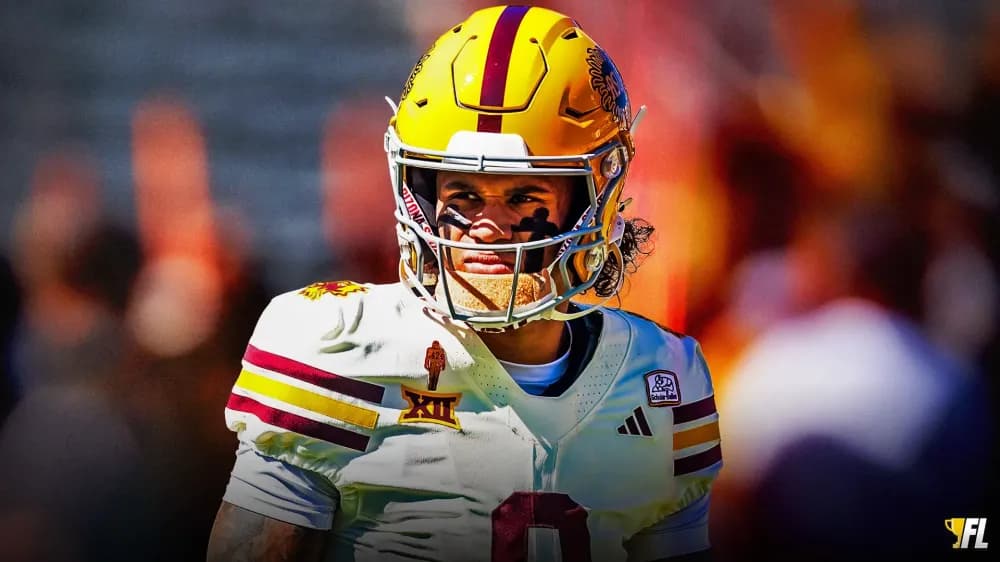
WR Rankings for the 2026 NFL Draft: Loaded Class Broken Down
Matthew Freedman previews the WR rankings prior to the 2026 NFL Draft.
My NFL Draft WR rankings for 2026 cover one of the deeper WR classes in recent memory. The top five all have legitimate Round 1 arguments, and the depth extends well into Round 3. Landing spot will matter more than usual for this group. Looking for landing spots? Take a look at our recent NFL mock drafts.
Here's how I see the top 15.

Join Our Newsletter
Trusted by 400,000+ fantasy football players. Get access to Fantasy Life's free award winning newsletter and tools, all in one step.
By registering or logging in, you agree to our Terms of Use and Privacy Policy.
NFL Draft WR Rankings: 1-5
1. Jordyn Tyson (Arizona State)
Tyson is a three-level alpha who has been his college team's No. 1 WR since his first year on campus. As an 18-year-old true freshman, he led a 1-11 pre-Coach Prime Colorado team with 22-470-4 receiving despite a season-ending knee injury. After transferring to Arizona State, he redshirted most of 2023 and then broke out in 2024 with 75-1,101-10 in 12 games. In 2025, he opened with 57-628-8 receiving and 2-4-1 rushing through seven games before hamstring injuries sabotaged the rest of his campaign (4-83-0 in two additional forgettable games).
At 6-foot-2 and 203 pounds, his Tetairoa McMillan comp captures the three-level win rate. He understands space, attacks leverage, varies tempo and snaps routes off with precision. His catch-point work is borderline cruel—late hands, outstanding timing, real hangtime, and the ability to elevate, twist and pluck through contact. After the catch, he runs with an edge. Tyson isn't a burner, but he'll win isolated matchups with CBs more often than he loses with craft, toughness and timing.
The drawback is obvious: he has a notable medical history. Freshman season ended with a knee injury. Redshirt sophomore campaign ended with a broken collarbone. Senior year wiped out by soft-tissue issues. Medicals will be crucial. But on the field, he looks like the No. 1 WR in the class and a first-round lock—with top-10 upside if he tests reasonably and gets cleared.
2. Carnell Tate (Ohio State)
Tate is, in some ways, just another Buckeye WR: big, young, a 4-5 star recruit who flashed enough at Ohio State to suggest he'll be a capable NFL player at worst. At the same time, he's more than just the college on his jersey. A long, savvy separator, Tate is a classic X receiver with a polished, efficient game and the ability to both move the chains and explode for big gains in a pro-style pass attack.
At 6-foot-2 and 192 pounds, his Chris Olave comp captures the length-plus-craftsmanship profile. He creates space with pacing, tempo and leverage. Against off and zone, he shows a veteran feel for sitting in windows. Against press, he uses length and timing to clear contact and restack CBs. His ball skills complete the profile: if it's in the zip code, it's in play, and he climbs the ladder on fades and posts.
But there's no shame in playing behind Marvin Harrison, Emeka Egbuka and Jeremiah Smith—and Tate has never been the No. 1 WR in his offense. A depth player as a freshman, the No. 3 as a sophomore, and the No. 2 last year (51-875-9 in 11 games). He's the least productive of the first-round pass-catching candidates to emerge from Ryan Day's program. His 4.53 40 is merely sufficient, his breaks can be choppy, and physical press can push him off his spot. Those are nitpicks. He profiles as a first-rounder and could be the No. 1 WR off the board.
3. Makai Lemon (USC)
Lemon is a high-volume slot man who moves like an RB once he has the ball. A reserve as a freshman (6-88-0), he topped the USC depth chart as a sophomore (52-764-3) and broke out as a junior with a monster all-around campaign: 79-1,156-11 receiving, 9-4-2 rushing, a 24-yard TD pass, 6-71-0 punt returning and 8-144-0 kick returning. He won the 2025 Biletnikoff Award.
At 5-foot-11 and 192 pounds, his Jaxon Smith-Njigba comp is dead-on. In the slot, he specializes in leverage—option routes, choice concepts, whips, crossers, and breaks with such suddenness that man defenders can't sit on any one move. After the catch, he's a true problem: contact balance and competitive toughness that belie his frame, and the lateral agility to turn underneath targets into explosive plays.
What Lemon offers won't be what every play caller wants. His smaller size and wingspan will likely prohibit him from the perimeter, where he's unlikely to win consistently on contested balls. His long speed is good but not great, so he wins vertically on craft and scheme. He needs a coordinator who will keep him clean with motion, bunch, stacks and option routes. Even so, he's a first-round lock and should be an immediate contributor, if not a starter.
4. KC Concepcion (Texas A&M)
Concepcion is a rollicking motion piece and space creator who leveraged early-career success and a shrewd portal move into centerpiece usage with the Aggies. As a true freshman, he broke out as the featured playmaker at NC State (71-839-10 receiving, 41-320-0 rushing, 17-yard TD pass, 13 games). After a quieter sophomore year, he transferred to Texas A&M as a four-star and reemerged as the team's top all-around producer (61-919-9 receiving, 10-75-1 rushing, 25-456-2 punt returning, 13 games).
At 6-foot and 196 pounds, his Luther Burden III comp fits the manufactured-touch, motion-slot profile. His strength is separation: advanced release package, stutters, tempo changes, lateral footfire to win early against man corners and manipulate zone defenders. After the catch, he looks like a return man—second gear suddenly, one-cut moves, stacked angles.
Size is an issue. He lacks ideal play strength, which enables longer press corners to re-route him. Some teams will see him as a slot-only player, and his tape bears evidence of concentration drops and insufficient blocks. He could go in Round 1 if his testing confirms the juice, but his limitations might destine him for Day 2.
5. Denzel Boston (Washington)
Boston is a textbook boundary X receiver with playmaking skills. After two reserve years behind 1,000-yard WRs Rome Odunze, Jalen McMillan and Ja'Lynn Polk, he ascended to the No. 1 perimeter role as a redshirt sophomore (63-834-9) and held it as the No. 1 WR overall last year (62-881-11 in 12 games).
At 6-foot-4 and 212 pounds, his Michael Pittman Jr. comp captures the tape-popping high-cut frame. Boston plays above the rim and tilts 50-50 balls in his favor. His body control is notable, his tracking is strong, and he boxes out DBs like a power forward on fades and red-zone crossers. For a tall wideout, he's fluid—sinks his hips, sells doubles, runs routes with intent. When in the slot, he becomes a mismatch bully on undersized nickels.
He has average athletic juice, though—lacks explosion off the line and is a build-up runner, not a sprinter. He can cruise if untouched, but he won't instantly erase cushions, and physical press CBs can stall him early. After the catch, he's more functional than frightening. Still, Boston seems likely to secure first-round draft capital, and even if he doesn't, he'll get a shot to start immediately.
Wide Receivers Ranked After The Top 5 Are Off The Board
6. Omar Cooper (Indiana)
Cooper is a rocked-up space tycoon who runs like a slot but bodies people like a splash-play Z. The 6-foot, 199-pound redshirt junior did little in his first two seasons but flashed as a sophomore (28-594-7) and served as co-No. 1 WR alongside Elijah Sarratt last year (69-937-13 receiving, 3-74-1 rushing, 16 games). His Matthew Golden comp reflects the tempo-plus-explosion profile. Fast-and-loose releases, real vertical burst, RB-like contact balance after the catch. Whether he goes Day 1 or Day 2, he could be a low-end No. 1 or scheme-independent No. 2 for a decade.
7. Chris Bell (Louisville)
Bell is a rocked-up YAC bully who broke out as Louisville's No. 1 WR last year (72-917-6 in 11 games). At 6-foot-2 and 221 pounds, his Michael Wilson comp tracks. He's built closer to a power back than a string-bean X, but he's also a former high-school sprinter with legit burst. Where he stands out is after the catch: pinballs through arm tackles, lowers his pads, turns in-breakers into chunk plays. Top-of-route fluidity is a question, and his season-ending ACL tear in November could jeopardize his rookie year. Round 1 talent pushed to Day 2 by the knee.
8. Germie Bernard (Alabama)
Bernard is a rocked-up, shape-shifting offensive weapon who quietly became the centerpiece of Alabama's offense (64-862-7 receiving, 18-101-2 rushing in 14 games). At 6-foot-1 and 206 pounds, his Devin Duvernay comp fits the alignment versatility—boundary, slot, auxiliary tailback. He explodes out of motion, carries real pop on contact, and understands leverage as a route runner. Lacks elite juice or pure twitch (4.48 40), but his multidimensional positionality, YAC and return-game functionality should draw Day 2 capital.
9. Zachariah Branch (Georgia)
The No. 1 WR in the 2023 recruitment class, Branch was a unanimous five-star recruit and the great-nephew of HOFer Cliff Branch. At 5-foot-9 and 177 pounds, he's a jitterbug slot and return elitist. His blazing speed is legit (4.35 40, 1.50 10-split), and his Wan'Dale Robinson comp captures the twitch-and-gadget profile. At Georgia last year he was the No. 1 WR (81-811-6). Still small, so most evaluators will see him as a slot/return contributor rather than an offensive centerpiece. Could sneak into Round 1; Day 2 otherwise.
10. Skyler Bell (UConn)
After a redshirt season, Bell served as the No. 2 WR at Wisconsin for two years (68-740-6, 13-160-0 rushing, 25 games) before transferring to Connecticut, where he immediately stepped up as the No. 1 WR in 2024 (50-860-5) and finished as a Biletnikoff Finalist in 2025 (101-1,278-13, 13 games). At 6-foot and 192 pounds, he's a chains-moving craftsman who wins with pacing, leverage and short-area twitch more than size and deep-speed juice. But he was markedly faster and more explosive than expected at the combine: 4.40 40, 1.53 10-yard split, 41-inch vertical, 11-1 broad jump. He might have hidden upside in the league, but even if he doesn't, his polished professionalism gives him a shot to go on Day 2 and stick as a plug-and-play slot/Z contributor.
11. Elijah Sarratt (Indiana)
Sarratt is an old-man-at-the-rec-center spirit in a Big Ten WR body—in the best of ways, a chain mover. A zero-star recruit, he earned first-team all-NEC recognition as a red-zone dominant freshman at FCS Saint Francis (42-700-13 receiving, 7-47-0 rushing, 5-84-0 kick returning, 12 games) and then leveled up at James Madison (82-1,191-8, 13 games) before following HC Curt Cignetti to Indiana, where he served as the No. 1 WR for his final two seasons (118-1,787-23 in 27 games).
At 6-foot-3 and 210 pounds, his positives are size, feel and reliability. He lives on digs, outs, crossers and back shoulders. He finds soft spots, boxes out, vacuums anything in range and comes through in crunch time. He'll probably place last in a track meet, but he's a professional route runner and contested-catch winner with three-level production and a long tape-based history of helping QBs. He didn't test at the combine, but if he posts reasonable numbers at his pro day, he could go in Round 2. If not, Round 4 feels like his floor.
12. Malachi Fields (Notre Dame)
A high school QB, Fields did little in his first two seasons at Virginia as he converted to receiver (16-230-1), but he produced as the top perimeter receiver for the Cavaliers over the next two years (113-1,619-10 in 24 games) before entering the portal as a four-star transfer and finishing his career at Notre Dame (36-630-5 in 12 games). At 6-foot-5 and 218 pounds, he's a classic boundary bully who overwhelms CBs with a massive catch radius and wins more than his fair share of contested targets. His game is built more on technique and effort than athleticism (4.61 40), but play callers who value ball skills and grown-man physicality might see him as a Day 2 asset.
13. Ja'Kobi Lane (USC)
Lane is a skyscraping boundary X who has quietly evolved from buzzy red-zone specialist to respected downfield player. As a deep reserve, he flashed TD bonafides in his freshman season (7-93-2), and then he exploded with end zone effulgence as a sophomore (43-525-12). His junior year saw a marked decline in scoring but all-around development in a larger role (49-745-4).
At 6-foot-4 and 200 pounds, Lane checks the boxes as a classic X. Long arms, big catch radius, build-up speed that stresses corners vertically once he gets going. His strength is his ability to win in the air: focused body control, muscular high-point dexterity, vicelike grip strength. In the red zone, he plays like a power forward. He's a surprisingly smooth route runner for his size.
But like many X archetype prospects, Lane has middling separation skills—more linear than sudden, which limits his effectiveness on sharp-breaking underneath routes. He has never been the No. 1 WR for the Trojans. With his ball skills and size/speed profile (4.47 40), evaluators will likely see him as a solid Day 2 selection, but in the NFL he probably won't be more than a supplementary perimeter playmaker.
14. Antonio Williams (Clemson)
Williams is a jitterbug schemed-touch slot savant with space-creating nuance. At 6-foot and 187 pounds, the redshirt junior flashed as an 18-year-old freshman (56-604-4), battled injuries, bounced back as a sophomore (75-904-11 receiving, 7-101-1 rushing), and fought through a hamstring last year (55-604-4 in 10 games). His Jaylin Noel comp captures the third-and-medium/red-zone profile. Plenty of speed (4.41 40), just not the size to erase press or win contested balls. Legitimate Day 2 potential in a modern spread offense.

Unlock Our Tools!
Stop hitting the paywall. FL+ gives you access to our premium in-depth content, expert rankings & projections, mock draft simulator, and all the tools you need – all personalized to your league.
Published Updated