Draft Strategy From The 1.09 In 2026 Fantasy Football: Start With CeeDee Lamb In 3-WR Builds
Chris Allen breaks down how to build the optimal 2026 fantasy football team when drafting from the 1.09 in 12-team drafts.
I've been an engineer for the better part of 20 years now. No, this isn't a segue into how smart I am. Positive updates about Rashod Bateman in training camp have me looking at his season-long prop odds. I make mistakes from time to time. Anyway, one of the biggest lessons I've learned since being out in the industry is simple.
Theory and reality don't always match.
We read books, listen to podcasts, watch shows and even have our own anecdotal theories about how drafting teams should work. But they're just guides. Besides, if we used the wisdom of the community, you'd believe drafting from the 1.09 was the end of your chances to win. Too many good players will be gone by then. However, let's use some of the tools at hand to see if that theory aligns with our reality.
Draft Strategy From The 1.09 In 2026 Fantasy Drafts
The Late Round … Tight-End?
If you’ve followed me this far into the series (and still three to go!), you know I lean on analytics to make my points. But I’ll switch it up and give a qualitative take. This season feels like the resurgence of the early-round TE.
Admittedly, it’s me; I’m (part of) the problem. I recently made the case for Brock Bowers as a second-round pick. And we’ve still got Trey McBride and Colston Loveland coming off the board before we get to the 4/5 turn. However, we’re already drafting from a later slot. We may have to get contrarian to keep things in our favor. The problem is we don’t have a long runway if we decide to wait until the backend of the draft to find our TE1.
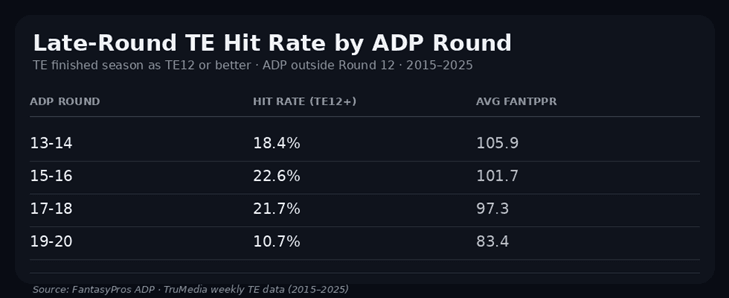
I went back over the last 11 years to see how often the cheap TEs found their way into the top-12 conversation by season’s end. And no matter how I sliced the data, the takeaway was bleak. Simply put, it’s not that often. Sure, 22.6% and 21.7% seem like strong numbers for this “dart-throw” area of the draft. But our sample size in those rounds is maybe four guys. That means just one is a hit. However, at least we have a few hints as to what would make a TE available this deep into the draft a worthy bet.
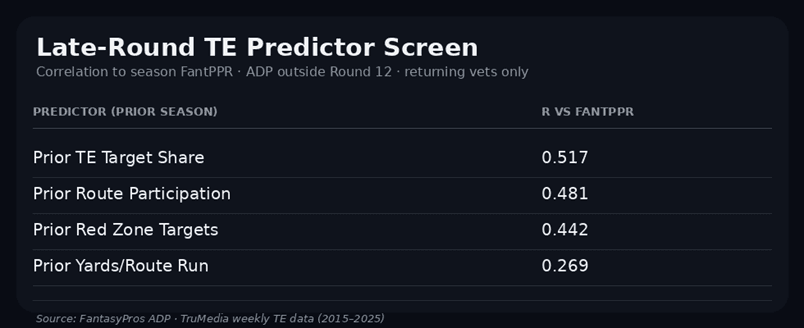
If they’ve shown a propensity for earning targets, they’re likely to keep it up in the future. I noted earlier that TEs getting cardio instead of blocking were a big indicator. They’re the first step to doing the thing that actually scores us fantasy points: earning targets!
Now, I know what you’re thinking because I had the same thought. Just find the guys that can earn targets on good teams, and we’re good to go. Those TEs would be shoe-ins for a top-10 spot by the end of the season. But the data told me a different story.
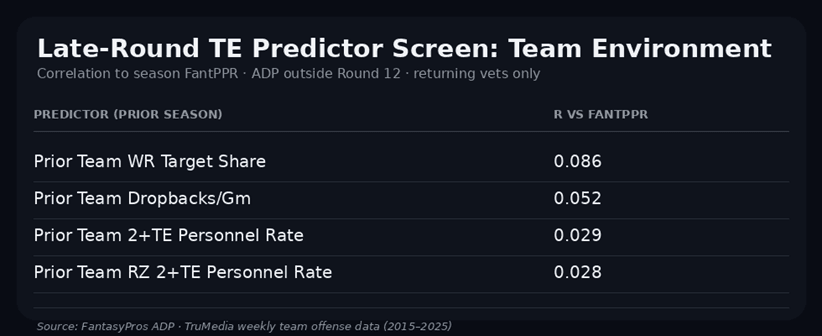
Before you tell me I’m wrong, check the table again. That’s a 0.086 R-value and not 0.86. It’s a nothing burger. And the same sentiment runs across the board of every team-level metric I had at my disposal. They didn’t matter. Honestly, this makes sense now that I think about it.
- Bears: 5 (players with Top-100 ADP), 3rd (scoring rank amongst all teams)
- Lions: 4, 2
- Rams: 4, 1
- Cowboys: 4, 5
We’ve harvested all of the goodness out of the offenses that were either highly productive or high scoring by the late rounds. Seven of the 11 teams with at least four players inside the Top 100 were our most efficient squads from ’25. If our options were good players on good teams, they wouldn’t have a price tag in the triple digits. Regardless, applying these ideas to the 2026 landscape yielded a few names of note.
- Juwan Johnson: 144.4 (fantasy football ADP)
- T.J. Hockenson: 147.8
- Brenton Strange: 147.8
- Dalton Schultz: 160.9
I’ve already laid out the case for investing in the Saints’ offense when I pointed to Tyler Shough as a viable late-round arbitrage play if you can’t get an elite QB. Johnson is just a cheaper extension of the same wager. New Orleans’ TE1 was already fifth in routes amongst all his peers before his former college teammate took the starting QB spot. After, Johnson was 13th in targets per route run and just inside the Top 10 in PPR PPG. Even with the team adding a high-end WR in the draft, Johnson should still command enough usage to be a hit in the later rounds.
Now, let’s draft!
For reference, here’s the format I chose:
- 12 teams
- PPR
- 1QB, 2RBs, 3WRs, 1TE, 1FLEX, 1K, 1DST
You’re On the Clock With The 1.09!
Let me set the scene.
I fired up the Draft Champion tool, put in my league settings, and let the simulator play out until the 1.09. My face progressively fell with each pick.

I wasn’t ready for this. I mean, come on. Even Justin Jefferson is off the board with Kyler Murray now locked in as the Vikings' QB1.
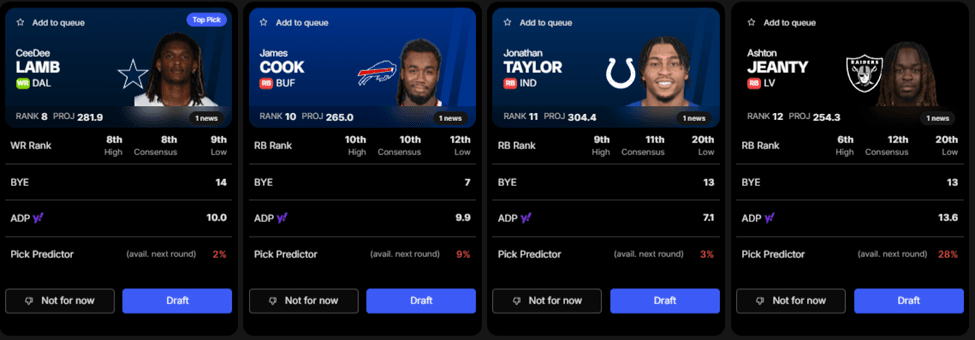
James Cook has the mix of talent and situation to produce like his counterparts at the 1.01 and 1.02. Jonathan Taylor can boast a similar case. But the three-WR-start roster requirement already has me leaning toward a receiver early. And we’ve seen the top pick in the first-round conversation for multiple seasons.
I’ll add one more non-data-backed statement. I’d guess most people’s feelings about CeeDee Lamb have some connection to their evaluation of George Pickens’ first campaign as a Cowboy. If you think Pickens will play his way out of Dallas, Lamb is an excellent pick at cost. But, in the case of Pickens being a good addition to Dak Prescott’s arsenal, Lamb is now at risk. However, the data would point you in another direction.
- Target Rate: 26.0% (2026, W7-17), 27.6% (2022-2024)
- Air Yard Share: 36%, 32.5%
- End Zone Target Rate: 34%, 30%
We’ve seen other duos succeed in the league. I’m partial to a couple of receivers playing down in Cincinnati, but they’re not the only example. Furthermore, when you play with a QB like Prescott, you’re bound to generate points.
- EPA per Dropback: 10th (2021), 4th (2023), 10th (2025)
- Dropbacks per Game: 5th, 10th, 6th
I didn’t skip a couple of years on purpose. Prescott didn’t mean to, either. Those were the years he missed multiple games due to injury. Outside of those, he’s been a top-10 passer from an efficiency and volume standpoint. So, if we’re looking for a receiver’s innate skill and their team surroundings as indicators for them to exceed their value, Lamb has (and has had) both without question.
Optimal Fantasy Football Draft Positions
The Rest of the Early Rounds From The 1.09
Normally, we’d get into the second round, find some decision point worth diving into, and branch from there. But the real action came at the 3.09.
- (Available) QB: Josh Allen
- WR: Garrett Wilson, Jaylen Waddle
- TE: Colston Loveland
In a vacuum, there’s no question which player provides the most upside (hint: it’s the guy who plays in Buffalo). But I can draft Brock Purdy or Dak Prescott in about five rounds. Meanwhile, I can add a strong WR2 to Lamb. Or, even better, swing at this year’s rising TE. The need to give my roster more ceiling outcomes has me considering either of the onesie positions. And despite both giving me an edge, taking Josh Allen is the better option.
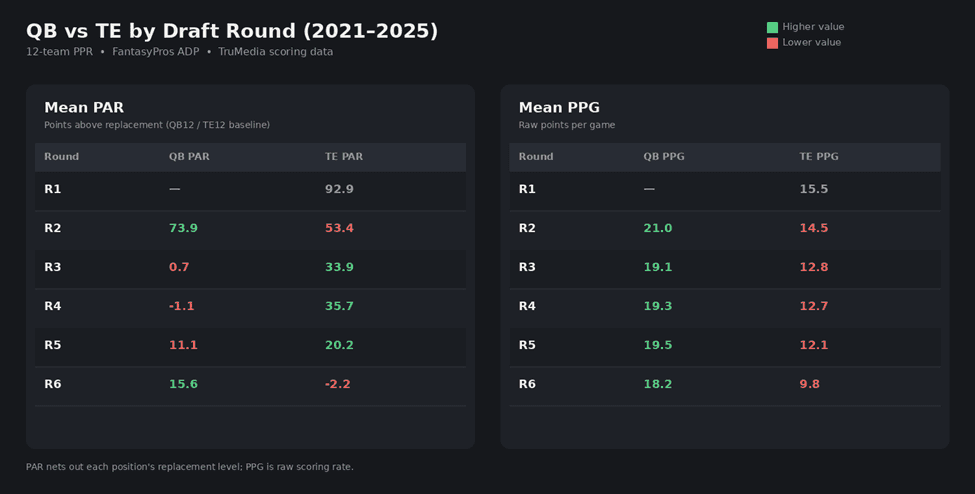
As I mentioned, drafting a passer will always look better on paper because they score more points. Looking back over the last five years, at no point has a TE drafted in the same round as a QB averaged more PPG. But points above replacement (PAR) offers a better view. The value of the QB1 or QB2 is more than the TE3 or TE4 we’d typically find at this cost, making Allen the better selection.
Remember, though. By taking a detour to pick up a QB, that leaves us with weaker options for our core positions. And I realized the situation I was putting myself in only after I was back on the clock in the fourth round.
These were my top RB options. Sure, I could use Chase Brown in a Hero RB build. I used our UR Player Comparison tool and put Brown against the rest of the first-round RBs by 2026 ADP. His usage rates are in line with all of them. But a stronger RB2 would raise my roster’s weekly floor. However, at the same time, we’re entering the traditional “Dead Zone” for rushers. In the past, they were guys with increased ambiguity surrounding their role. But at least for one, there’s a path to meet his draft cost.
- 2023: 16.9%, 4th (out of 70 qualifying RBs – min. 10 games)
- 2024: 13.8%, 4th
- 2025: 11.1%, 14th
Breece Hall falls into the category, but he has multiple outs. Not only has Hall been involved as a receiver, but he’s retained the lead job when the Jets have gotten into scoring position. The Jets may look like a situation we want to avoid. But a workload like Hall’s has merit in the early rounds.
Late-Round Lessons For Fantasy Drafts From 1.09
Let’s look at the squad through ten rounds.
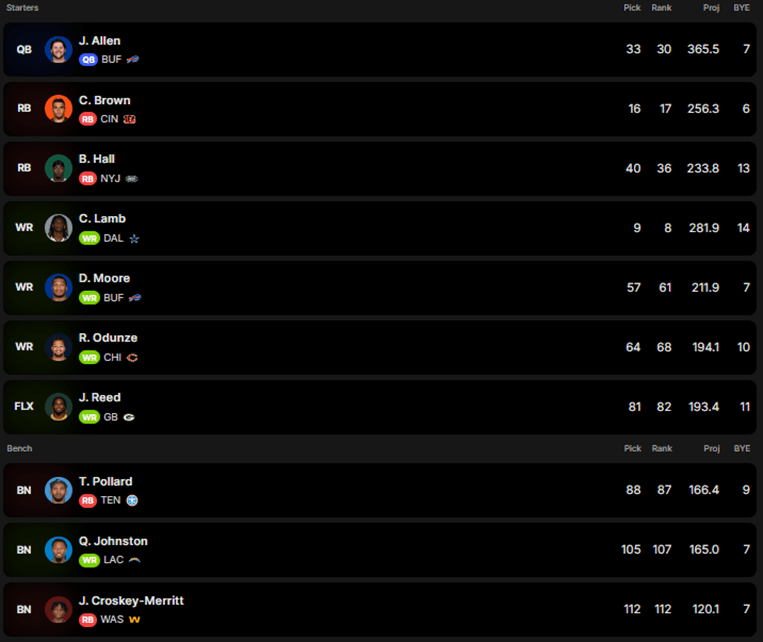
We’re not going to do the usual team evaluation as we do for the middle rounds. I aimed for upside with DJ Moore and Rome Odunze (both hop up a couple of spots if looking at just their ceiling projections). Drafters can and should lean into uncertainty with RBs in rounds 6-12. Say an offense were to rebound with a Year 2 QB and new playcaller (Titans) or a second-year RB shows more than flashes of talent as he did during his rookie campaign (Croskey-Merritt). But, anyway, let’s apply our process for filling the TE spot.
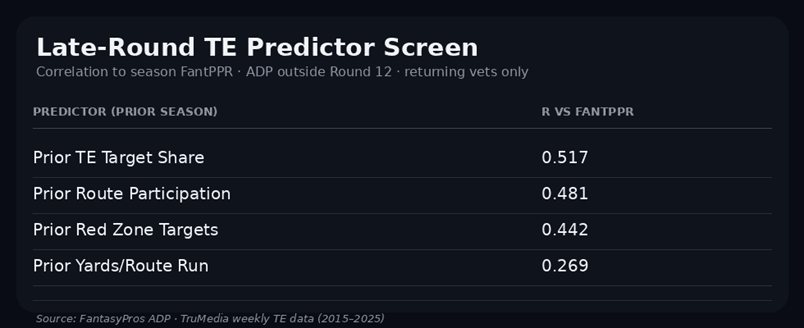
By the 13th round, there were 20 TEs on rosters. It may feel uncomfortable to see so many go by, but with the predictor metrics we prioritized earlier, I could select Dalton Schultz with some confidence.
- Target Share Rank: 10th (2025), 16th (2024), 14th (2023)
- Route Rate Rank: 13th, 10th, 15th
- RZ Targets: 19th, 26th, 10th
Schultz’s route rate has crept up each year C.J. Stroud has been Houston’s QB1. Along with his target share hitting a career-high, Schultz checks most of the boxes for a late-round hit at the TE position. If the passing game can regress to where it was earlier in Stroud’s career, Schultz will not only have the talent but the situation to leap into the TE1 discussion.
Building a Championship Fantasy Football Roster When Drafting From The 1.09
Let’s look at the full squad.
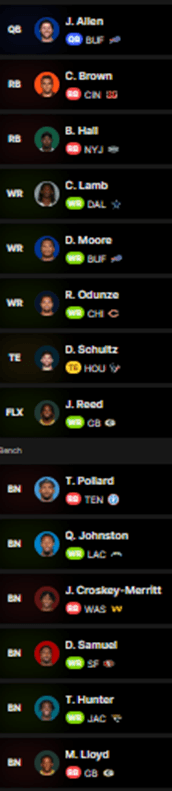
Again, the goal with even the later picks was to maximize undersold talent. Drafters burned by Travis Hunter don’t want to hear he’s still rotating in at WR in camp. MarShawn Lloyd will vault into the first six rounds should Josh Jacobs’ investigation go the other way. Essentially, I’m assuming the projections won’t favor my team. Still, the draft will leave us in the best position to adjust to differences in preseason expectations and the reality of the 2026 season.
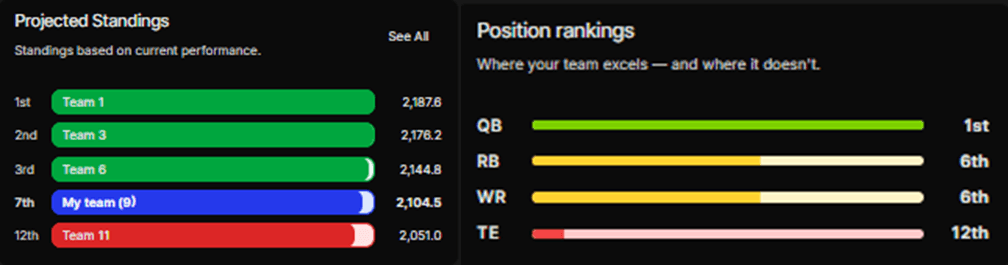
No surprise. We’re just outside of playoff contention. An earlier selection at TE (e.g., Mark Andrews – 10.05, Brenton Strange – 11.05) would’ve improved our standing there. We could’ve shored up our RB stable by swapping Jayden Reed or Quentin Johnston for another rusher (e.g., Rhamondre Stevenson, J.K. Dobbins). In short, there are minor tweaks available to strengthen our roster. But the core process of building the team is how you should attack the 1.09.

Join Our Newsletter
Trusted by 400,000+ fantasy football players. Get access to Fantasy Life's free award winning newsletter and tools, all in one step.
By registering or logging in, you agree to our Terms of Use and Privacy Policy.
Players Mentioned in this Article

Published Updated