What Matters For Wide Receivers In 2026 Fantasy Football: Uncovering The Scheme Cheat Codes For WRs
Dwain McFarland breaks down which stats best predict next-season performance for WRs, how we can identify regression candidates and everything else that matters for WRs in fanatsy football.
Figuring out which data points and context matter most for wide receivers is one of my favorite parts of each offseason. The core signals don’t change much year to year, but I’m always digging for new trends, refining the process and finding better ways to translate the data into fantasy decisions.
With that in mind, today we turn our attention to the WR position.
We'll answer the following questions:
- Which stats best predict next-season performance?
- How can we spot positive and negative regression candidates?
- What do good WRs look like in fantasy football?
- How are league-wide trends impacting WRs?
- Which playcallers help WRs the most with scheme?
- Should we draft WRs on bad passing teams?
- At what ages do WRs peak and decline?
This research serves as a baseline for my WR tiers for the 2026 season.
If you are interested in this kind of research, I have already published pieces on the QB, RB and TE positions, along with tiers for each.
- What Matters for QBs in Fantasy Football
- 2026 QB Tiers
- What Matters for RBs in Fantasy Football
- 2026 RB Tiers
- What Matters for TEs in Fantasy Football
- 2026 TE Tiers
Which Stats Matter Most for WRs in Fantasy Football?
I love advanced data, but fantasy points per game (PPG) remains the gold standard for predicting future fantasy production at the WR position. And it is closely followed by three key per-game categories: receiving yards, receptions, and targets, as well as target share.
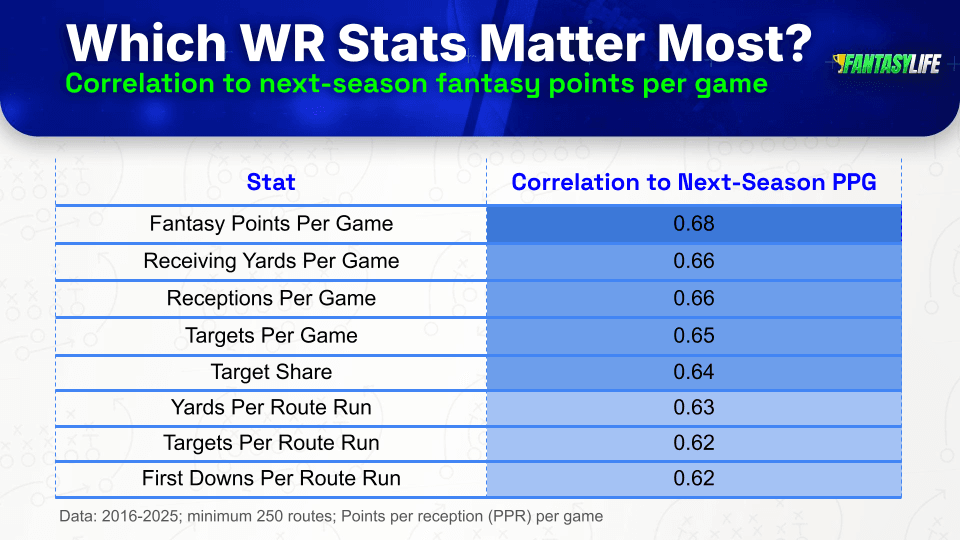
I have researched over 100 data points for WRs, and to put it simply: the most predictive ones are the most straightforward.
The best way to think about this data is in layers. Essentially, we want to determine if a player's fantasy PPG are legit. Do the underlying data points support their PPG?
This is a great time to discuss TDs, because they matter a lot for fantasy. For WRs, receiving TDs have a 0.80 correlation with same-season PPG. But they are less stable year to year and are less predictive, with a 0.48 correlation to next-season fantasy PPG.
One of the best ways to stress-test fantasy PPG is to compare receiving yards and TDs per game. They are strongly correlated (0.70), which helps us spot players who may be due for positive or negative TD regression.
 Nerd Note: Team context matters here. We can’t compare a player’s last-season data to this season in a vacuum, because offensive environment and target competition can change everything.
Puka Nacua and DeVonta Smith are great examples of how receiving yards per game (YPG) can help us spot TD upside and downside. Let's take a look at how they performed from 2024 to 2025.
Nacua finished 2024 as the No. 3 WR in receiving YPG (90.2) but just No. 52 in receiving TDs per game (0.27), before jumping to No. 4 in TDs per game in 2025 (0.63).
Smith was the opposite: he ranked No. 24 in receiving YPG in 2024 (64.1) but No. 8 in TDs per game (0.62), before falling to 37th in 2025 (0.24).
Positive TD Regression Candidates for 2026:
- CeeDee Lamb | Cowboys: 76.9 YPG (6th); 0.21 TDs per game (41st)
- Justin Jefferson | Vikings: 61.6 YPG (14th); 0.12 TDs per game (54th)
- DeVonta Smith | Eagles: 59.3 YPG (17th); 0.24 TDs per game (38th)
- Ricky Pearsall | 49ers: 58.7 YPG (19th); 0.00 TDs per game (67th)
Negative TD Regression Candidates for 2026:
- Davante Adams | Rams: 56.4 YPG (24th); 1 TD per game (1st)
- Kayshon Boutte | Patriots: 39.4 YPG (42nd); 0.43 TDs per game (13th)
- Michael Pittman | Colts: 46.1 YPG (32nd); 0.41 TDs per game (17th)
Per-game stats are great for identifying breakouts and busts, but they have a blind spot: part-time players the year before. That’s where per-route data becomes especially valuable.
Jarvis Landry is a good example. In 2014, he posted a borderline WR1-worthy 24% TPRR as a rookie, but his 47.2 receiving YPG was in WR4 territory because he played just 67% of the routes. The next year, with Mike Wallace traded and Brian Hartline released, he moved into a full-time role and his PPG jumped from 11.8 to 16.8.
Chris Godwin followed a similar path. In Year 2, he was a part-time player in 2019 with a 62% route participation rate, averaging 11.6 PPG (WR4 territory) with 52.6 YPG (WR3 territory). But his first downs per route run (FDRR) were in line with historical WR2s. In Year 3, with DeSean Jackson traded and Bruce Arians taking over as the head coach, Godwin stepped into a full-time role (96% routes) and erupted for 19.6 PPG.
Those were extreme hits, but they also underscore the importance of team context. Landry and Godwin both had clear paths to more playing time, and were young players with solid NFL Draft capital. If we ignore that context and just chase per-route data blindly, the hit rate drops.
For example, if we isolate WRs who scored under 12 PPG but posted a 2.00+ YPRR, we get some big wins—but also plenty of misses. Only 6 of 19 players (27%) became WR2s or better the following season from 2011 to 2025.
Three of those six breakouts were tied to meaningful environmental changes:
- George Pickens: 11.9 → 17.1 PPG, after trade to Cowboys (Dak Prescott).
- Golden Tate: 11.7 → 16.2 PPG, after signing with the Lions (Matthew Stafford).
- Demaryius Thomas: 10.1 → 18.6 PPG, after the Broncos signed Peyton Manning.
Again, context matters. Pickens was a Round 2 pick heading into Year 4, Tate was a Round 2 pick heading into Year 5, and Thomas was a Round 1 pick heading into Year 3.
With that in mind, here are three WRs who posted strong per-route numbers in 2025 and now have the kind of offensive shakeup that can unlock a 2026 leap:
- Luther Burden | Bears: 2.36 YPRR (WR1 worthy); 24% TPRR (borderline WR1 worthy); 0.10 FDRR (WR2 worthy) + DJ Moore traded to Bills + heading into Year 2 as a Round 2 NFL Draft pick.
- Christian Watson | Packers: 2.30 YPRR (borderline WR1 worthy); 22% TPRR (WR2 worthy); 0.11 FDRR (WR2 worthy) + Romeo Doubs and Dontayvion Wicks gone + Round 2 NFL Draft pick.
- Jaylen Waddle | Broncos: 2.25 YPRR (borderline WR1 worthy); 25% TPRR (WR1 worthy); 0.12 FDRR (WR1 worthy) + traded to Broncos, a significant upgrade over the Dolphins + Round 1 NFL Draft pick.
So, where am I getting the WR1- and WR2-worthy language above? That is our next topic.
What Do Good WRs Look Like In Fantasy Football?
In the table below, you can see the average data profiles for WR1s through WR5s over the last three years. For example, the top 12 WRs (WR1s) have averaged 18.3 PPG and 83.3 receiving YPG, versus 14.2 and 65.7 for WR13 to WR24 (WR2s).
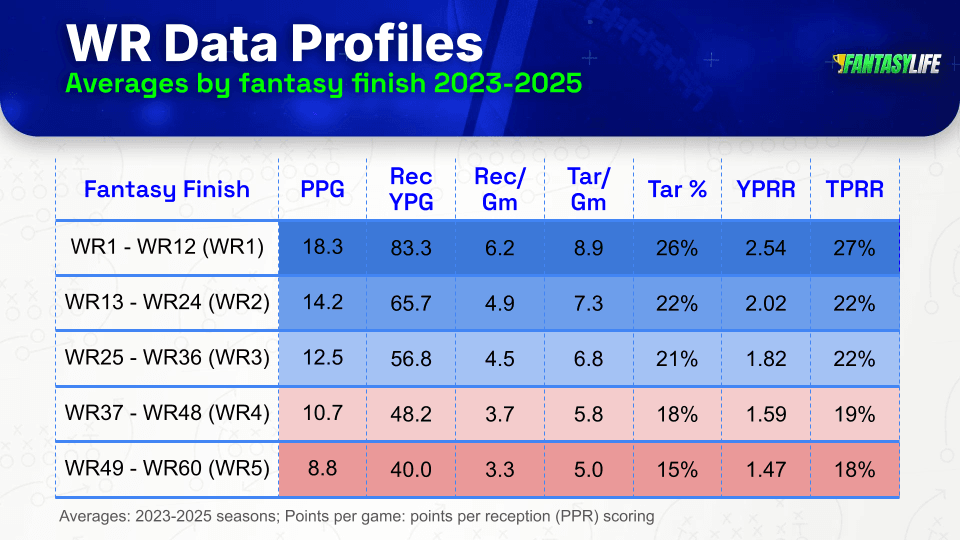
The biggest drop-off comes from WR1 to WR2, and then the decline is steadier from there. Notably, the sharpest falloff shows up in yards and receptions, not targets, which is another reminder that team environment matters—not all targets are created equal.
The Game Is Changing For WRs
For this exercise, I went with the last three years of data due to the decline in passing yards per game, which has a trickle-down effect on WRs. In 2025, passing yards per game reached their lowest mark since 2008 (224).
- 2023: 236
- 2024: 234
- 2025: 225
Defenses are focused on limiting big plays and forcing QBs to throw shorter passes—a trend first spotted by Ben Gretch years ago. That shows up in league-wide average depth of target (aDOT) for QBs with at least 250 dropbacks over the last ten seasons.
- 2016: 8.3
- 2017: 8.2
- 2018: 8.1
- 2019: 8.3
- 2020: 7.8
- 2021: 7.8
- 2022: 7.7
- 2023: 7.7
- 2024: 7.7
- 2025: 7.8
Defenses are prioritizing the pass and inviting teams to run more. Expected points added (EPA) data backs that up, with the gap between dropbacks and designed runs narrowing.
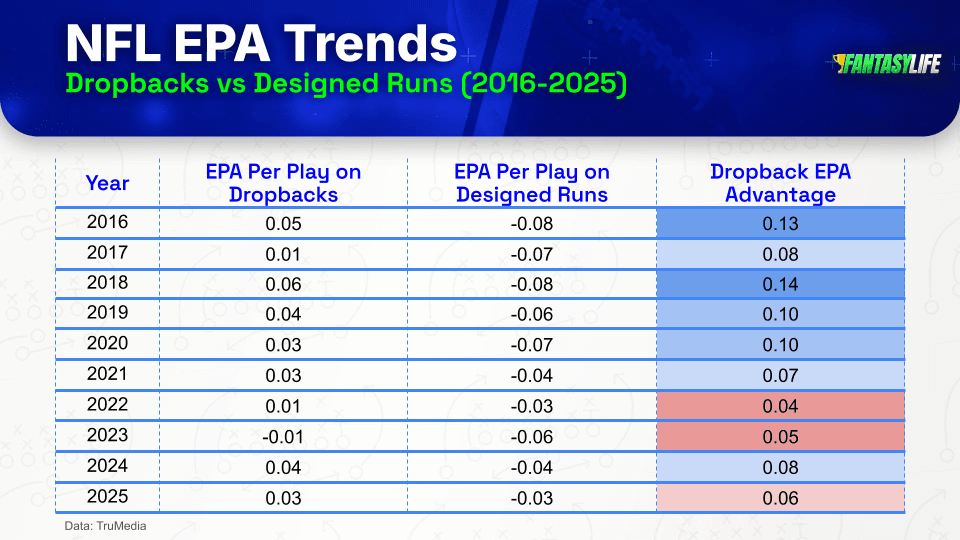
Offenses are responding by passing less and utilizing more heavy TE personnel to manipulate coverages. Last season, the league hit its highest rates since 2013 in both 12-personnel (16.1%) and 13-personnel (1.7%).
That has come at the expense of WRs. In 2025, WRs accounted for 58.4% of targets—the lowest mark since 2017.

Comparing 2016-2020 data versus 2021-2025 data, WR routes are down across the board, and targets are down or flat in every bucket. Even so, top WRs are up in receiving YPG, boosting PPG by 2%.
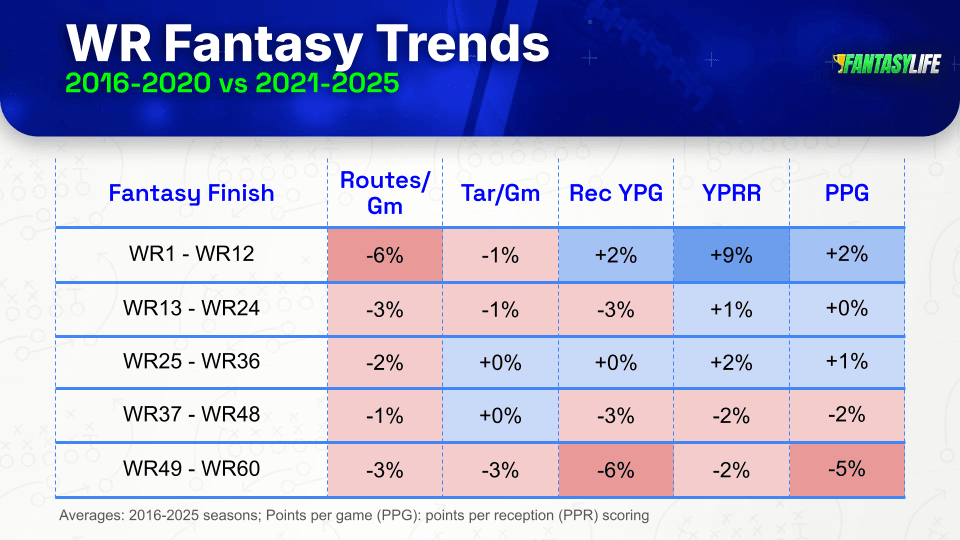
When you put it all together, we want to lean into talented WR profiles using historical data that is most predictive of next-season fantasy production. It remains the No. 1 factor, but given the shift in the NFL landscape, scheme matters more than ever.
What Are The Scheme Cheat Codes For WRs In Fantasy Football?
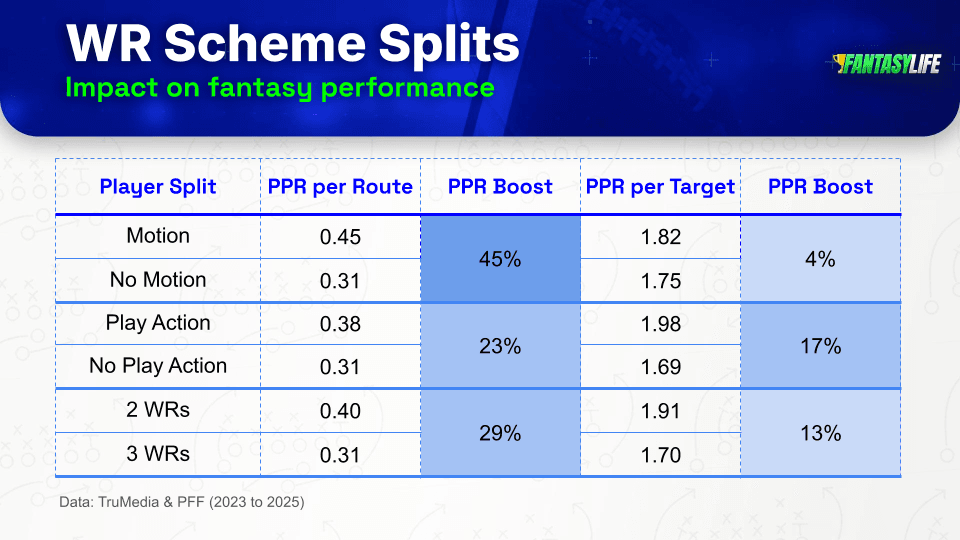
Over the last three seasons, three measurable play-calling levers have consistently boosted WR fantasy production on a points-per-route basis: motion at the snap, play action and 2-WR sets.
Motion at the snap is the biggest easy win. WRs in motion gained a 45% boost, likely because motion makes coverage harder to diagnose and creates confusion before the snap.
Play action is next, with WRs seeing a 23% boost in PPR points per route. Even when defenses respect the run less than they used to, they still have to honor run fits at the snap, and that opens space for playmakers.
The third lever is 2-WR sets, where WRs posted a 29% boost compared to plays with three WRs. These looks often reduce target competition on the field and can create easier matchups against base defensive personnel.
2025 Play-Calling Leaders
To make this actionable, here are the top playcallers in each category using 2025 data. I’ve bolded playcallers who appear in multiple categories and italicized new teams. For new OCs who did not call plays, I’m using the offense they came from as the best available reference point.
If you only want the takeaways, scroll to the team winners.
Motion Leaders
NFL Average: 52%
Most:
- Kyle Shanahan | 49ers: 70%
- Brian Fleury | Seahawks: 70% (was not the playcaller under Shanahan)
- Zac Robinson | Buccaneers: 64%
- Kellen Moore | Saints: 61%
- Joe Brady | Bills: 60%
- Mike McDaniel | Chargers: 59%
- Ben Johnson | Bears: 59%
- Declan Doyle | Ravens: 59% (was not the playcaller under Johnson)
- Klint Kubiak | Raiders: 58%
- Shane Steichen | Colts: 57%
- Liam Coen | Jaguars: 56%
- Sean McVay | Rams: 56%
- Mike LaFleur | Cardinals: 56% (was not the playcaller under McVay)
- Todd Monken | Browns: 54%
- Brian Schottenheimer | Cowboys: 54%
- Matt LaFleur | Packers: 54%
- Sean Mannion | Eagles: 54% (was not the playcaller under LaFleur)
Least:
- Brian Daboll | Titans: 37%
- Davis Webb | Broncos: 40% (was not the playcaller last year under Payton)
- Drew Petzing | Lions: 43%
- Zac Taylor | Bengals: 45%
- Brad Idzik | Panthers: 47% (Dave Canales called plays last year, but Idzik was OC)
- David Blough | Commanders: 48% (was not the playcaller under Kingsbury)
Play-Action Leaders
NFL Average: 25%
Most:
- Sean McVay | Rams: 36%
- Mike LaFleur | Cardinals: 36% (was not the playcaller under McVay)
- Ben Johnson | Bears: 33%
- Declan Doyle | Ravens: 33% (was not the playcaller under Johnson)
- Shane Steichen | Colts: 32%
- Mike McDaniel | Chargers: 31%
- Joe Brady | Bills: 31%
- David Blough | Commanders: 29% (was not the playcaller under Kliff Kingsbury)
- Klint Kubiak | Raiders: 28%
- Davis Webb | Broncos: 28% (was not the playcaller last year under Payton)
- Brian Schottenheimer | Cowboys: 27%
- Kevin O'Connell | Vikings: 27%
- Todd Monken | Browns: 26%
- Matt LaFleur | Packers: 26%
- Sean Mannion | Eagles: 26% (was not the playcaller under LaFleur)
- Drew Petzing | Lions: 26%
Least:
- Zac Taylor | Bengals: 17% (strike two)
- Kellen Moore | Saints: 19%
- Zac Robinson | Buccaneers: 22%
- Andy Reid | Chiefs: 23%
- Matt Nagy | Giants: 23% (was not the playcaller under Reid)
2-WR Set Leaders
NFL Average: 25%
This category has a caveat: the goal of playcallers is to get their best players on the field, so 2-WR usage is less sticky than motion or play action. I’ll dig deeper by player in the tiers article, where coaching history and roster construction matter more.
Most:
- Todd Monken | Browns: 55%
- Kyle Shanahan | 49ers: 43%
- Brian Fleury | Seahawks: 43% (was not the playcaller under Shanahan)
- Zac Robinson | Buccaneers: 38% (doubtful this sticks given personnel in TB)
- Klint Kubiak | Raiders: 35%
- Mike McDaniel | Chargers: 35%
- Josh McDaniels | Patriots: 32%
- Drew Petzing | Lions: 32%
- Andy Reid | Chiefs: 32%
- Matt LaFleur | Packers: 32%
- Sean Mannion | Eagles: 32% (was not the playcaller under LaFleur)
- Ben Johnson | Bears: 30%
- Declan Doyle | Ravens: 30% (was not the playcaller under Johnson)
- Zac Taylor | Bengals: 29%
Least:
- Sean McVay | Rams: 7% (but this was due to 13 personnel, with 1 WR on the field)
- Nick Caley | Texans: 13%
- Davis Webb | Broncos: 15% (was not the playcaller last year under Payton)
- Kellen Moore | Saints: 15%
- Joe Brady | Bills: 15% (uses heavy a lot, but 22 and 13 personnel mean 1 WR)
- Brad Idzik | Panthers: 17% (Canales called plays last year, but Idzik was OC)
- Liam Coen | Jaguars: 19% (drafted TEs, but strength is WRs)
- Brian Schottenheimer: 20%
- Kevin O'Connell: 20%
WR Scheme Winners
These are the teams where the ingredients line up best, even if the exact target distribution still needs to settle.
- Bears: Luther Burden and Rome Odunze. Johnson is one of the league’s best playcallers, and DJ Moore being gone shrinks the tree.
- Rams: Puka Nacua and Davante Adams. The 13-personnel stuff could trim routes, but the motion and play-action volume still give these WRs strong efficiency.
- 49ers: Mike Evans and Ricky Pearsall. Plenty of motion and 2-WR sets make this a favorable environment.
- Colts: Josh Downs and Alec Pierce. Steichen pulled the right levers last year, and Michael Pittman Jr. being gone opens things up.
- Chargers: Ladd McConkey and Quentin Johnston → McDaniel is one of the top playcallers in the NFL, regularly spamming all the cheat code buttons. But there is some risk, depending on how playing time shakes out. Tre Harris and Brenen Thompson are also in the mix, and that could squeeze routes in 2-WR sets.
- Packers: Christian Watson. LaFleur checks all three boxes, and Watson is the most likely to stay on the field.
- Cowboys: CeeDee Lamb and George Pickens. Schottenheimer had a strong first season, and they have a strong QB in Dak Prescott.
- Buccaneers: Emeka Egbuka and Chris Godwin. Robinson has leaned into motion, and this offense should give WRs useful looks.
- Lions: Amon-Ra St. Brown and Jameson Williams. Petzing looks like an underrated hire and should be a cleaner fit than John Morton.
Situations To Monitor
I can’t fully call these wins yet, but the setup is intriguing.
- Bills: TBD. Brady’s scheme is a plus, and the WR room has a path for someone to emerge with Josh Allen.
- Jaguars: TBD. Coen has revived passing games before, but the target tree is crowded.
- Vikings: Justin Jefferson and Jordan Addison. O'Connell is one of the better schemers historically, and Kyler Murray could swing the offense.
- Ravens: Zay Flowers. Doyle is not a clear upgrade over Monken, but the background is strong.
- Eagles: DeVonta Smith. Mannion is unproven, but the offense should be more fluid.
- Seahawks: Jaxon Smith-Njigba. The concepts should stay similar, even if Fleury is not clearly an upgrade.
- Raiders: TBD. Kubiak’s scheme can help lesser talent, but the room has real question marks.
- Browns: KC Concepcion. The QB situation is rough, but Monken remains a plus.
Speaking of potential bad QB situations …
Should We Draft WRs On Bad Passing Teams In Fantasy Football?
If we’re aiming for WR1 outcomes, drafting WRs on bad passing teams is a hard bet to win. Over the last 10 years, 108 WRs have run at least 400 routes on teams that averaged 200-224 passing YPG, and only three finished as top-12 WRs (3%).
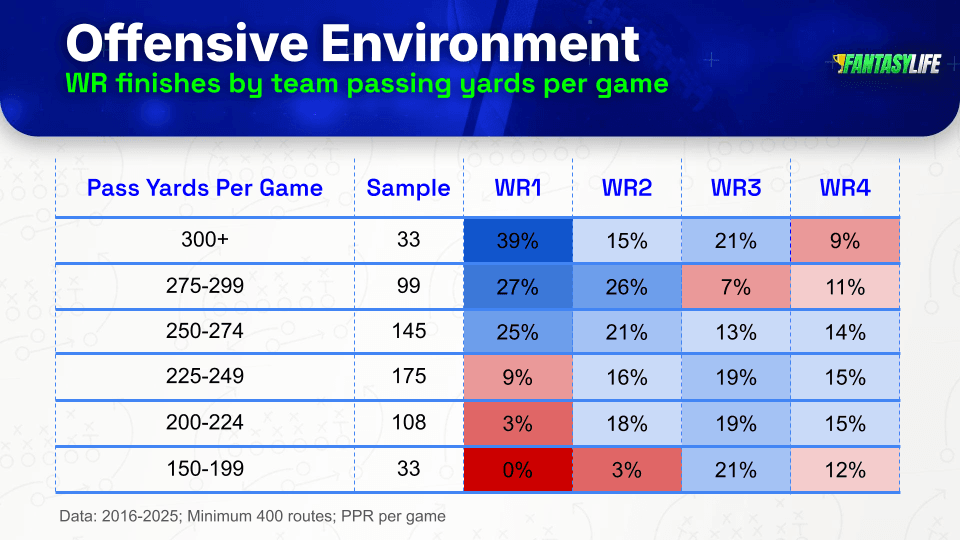
The exceptions were high-end target earners:
- Malik Nabers | Giants | 2024: 207 passing YPG → 18.1 PPG (35% targets)
- DJ Moore | Bears | 2023: 201 passing YPG → 17.0 PPG (25% targets)
- Brian Thomas Jr. | Jaguars | 2024: 219 passing YPG → 16.5 PPG (29% targets)
If we drill down further on WRs on bad passing teams (200-224 YPG) who had a target share of 24% or better, our odds improve some. Since 2016, 23 WRs have cleared that threshold, and only three reached 16+ PPG (13%). The group averaged 14 PPG overall, and most of the rest landed in WR2 territory, between 13 and 15.9 PPG.
Once we move into the WR2 range (WR13-WR24), things balance out a little, but there is still a slight edge for teams with better passing.
For WR3s, the team passing yards are less of an obstacle. But ultimately, we are aiming higher than WR3 outcomes if we want to hit on league-winning picks in our fantasy drafts. Since 2016, only 4% of WR3s have shown up on 45% or more of ESPN playoff rosters.
As a rule of thumb, the better the passing attack, the less we have to worry about target competition and vice versa.
- Good passing teams: We want high-end talents, but target competition is okay.
- Bad passing teams: Only target high-end talents with low target competition.
2026 Passing YPG Projections
The team environment matters most at the extremes.
Highest:
- Cowboys: 263 YPG
- Lions: 261 YPG
- Bengals: 255 YPG. This could be a massive rebound spot for Tee Higgins if Burrow is healthy.
- Rams: 255 YPG
- Chiefs: 244 YPG. That keeps things favorable for Rashee Rice with low target competition.
- Patriots: 241 YPG. A.J. Brown gets a significant boost with Drake Maye.
- 49ers: 241 YPG. Mike Evans is aging, but the setup is strong.
Lowest:
- Dolphins: 192 YPG
- Panthers: 196 YPG. Tetairoa McMillan could be an outlier if he becomes a high-end target earner, but the margin for error is thin with Bryce Young.
- Browns: 206 YPG. This could be crowded, so we need Todd Monken to work his magic with the quarterbacks.
QB Changes Matter
Since 2011, 21 WRs have jumped from 12 or fewer PPG to 16+ PPG, and 12 of them (57%) were tied to a QB change or a starter returning from injury.
The Commanders get Jayden Daniels back. While they don't rate as one of my top passing teams, Daniels is good enough to support a fantasy producer, making Terry McLaurin a viable target in drafts. Two of the big rebounders from the cohort above were later in their careers: Larry Fitzgerald (17.8 PPG in Year 12) and Emmanuel Sanders (16.1 PPG in Year 9).
Kyler Murray is the early favorite to win the starting job for the Vikings. Justin Jefferson and Jordan Addison are prime bounceback candidates.
Baker Mayfield battled a plethora of injuries in 2025 and was a far better QB early in the season. He averaged 256.5 YPG over the first six games. That could bode well for Egbuka and Godwin.
What Age Do WRs Peak And Decline In Fantasy Football?
For this exercise, I compared each season of a WR’s career, bucketed by age, to that player’s best three-year stretch. That helps isolate real growth and decline without the noise of early ramp-up or late-career falloff.
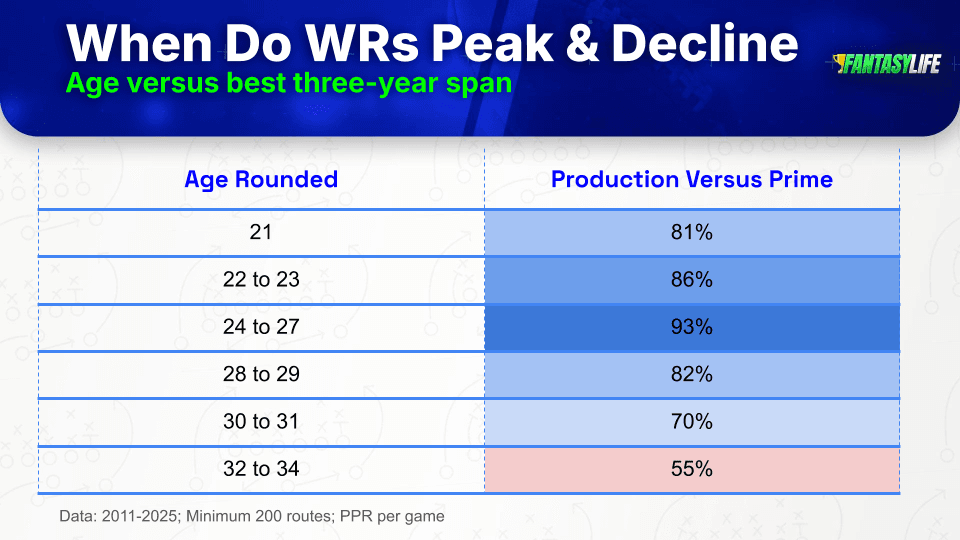
Key takeaways by age bucket:
- Pre-Prime: Age 21. Some players break this mold, but most are still ramping up.
- Early Prime: Ages 22-23. Clear progression toward peak efficiency and role.
- Prime: Ages 24 to 27. The sweet spot for high-end production.
- Late Prime: Ages 28 to 29. Still productive, with spike-season potential.
- Post-Prime: Ages 30 to 31. More fragile, but some veterans can still pop.
These are guidelines, not rules, but the betting edge is clear: we want to lean into age buckets where growth is still likely.
Another way to think about this is how often players in different age buckets have outperformed their ADP.
Another way to frame it is through ADP outperformers. Since 2016, among WRs drafted in the first five rounds of fantasy drafts, the younger buckets have been better bets to beat cost.
- Ages 21-23: -0.30 PPG over expected vs ADP; 31% exceeded ADP by 2+ PPG
- Ages 24-27: 0.19 PPG over expected vs ADP; 25% exceeded ADP by 2+ PPG
- Ages 28-29: -0.23 PPG over expected vs ADP; 22% exceeded ADP by 2+ PPG
- Ages 30-31: -0.40 PPG over expected vs ADP; 16% exceeded ADP by 2+ PPG
- Ages 32-33: -1.8 PPG over expected vs ADP; 11% exceeded ADP by 2+ PPG
The takeaway: pre-prime and prime WRs are more likely to return league-winning value. Since 2016, WRs who beat ADP by 2+ PPG have added 2.7 WAR and appeared on 45% or more of ESPN playoff rosters.
What Does Almost Every WR Eruption Season Have In Common?
For this analysis, an eruption season is a WR scoring 16+ PPG after scoring 12 PPG or less the year before. There have been 21 such seasons since 2011.
These criteria do not guarantee a hit rate; they simply identify the common threads across eruption seasons. Most of the signals we care about have already shown up elsewhere in this piece, but this is the cleanest place to put them together.
The Common Threads
- 20 of 21 were selected in Rounds 1 to 3 of the NFL Draft.
- 17 of 21 were in their pre-prime or prime years.
- 11 of 21 had a new QB or a starter returning from injury.
- 7 of 21 saw a meaningful change in target competition.
The Eruption List
- DK Metcalf (2019-2021): 11.9 PPG → 17.1 PPG; Age 23
- Cooper Kupp (2017-2018): 11.9 → 16.9; Age 25
- George Pickens (2024-2025): 11.9 → 17.1; Age 25; Dak Prescott
- Jarvis Landry (2014-2015): 11.8 → 16.8; Age 23; Mike Wallace & Brian Hartline gone
- DJ Moore (2022-2023): 11.8 → 17.0; Age 26; traded to Bears
- Golden Tate (2013-2014): 11.7 → 16.2; Age 26; Matthew Stafford
- DeSean Jackson (2012-2013): 11.7 → 16.8; Age 27; Jeremy Maclin injured preseason
- Chris Godwin (2018-2019): 11.6 → 19.6; Age 24; DeSean Jackson & Adam Humphries gone; Bruce Arians big-slot
- Allen Robinson (2014-2015): 11.5 → 19.0; Age 22; Cecil Shorts gone
- Tee Higgins (2023-2024): 11.5 → 18.7; Age 26; Joe Burrow healthy
- Emmanuel Sanders (2013-2014): 11.2 → 18.8; Age 28; Peyton Manning
- T.Y. Hilton (2017-2018): 11.1 → 17.1; Age 29; Andrew Luck healthy
- Larry Fitzgerald (2014-2015): 11.0 → 17.8; Age 32; Carson Palmer healthy
- Drake London (2024-2025): 10.7 → 16.5; Age 23; Arthur Smith out, Zac Robinson in; Kirk Cousins + Michael Penix Jr.
- Doug Baldwin (2014-2015): 10.5 → 16.8; Age 27; Seahawks shift from run-heavy to pass
- Demaryius Thomas (2011-2012): 10.1 → 18.6; Age 25; Peyton Manning
- Josh Gordon (2012-2013): 10.0 → 22.5; Age 22; Just a freak; Norv Turner replaced Brad Childress
- Nico Collins (2022-2023): 9.7 → 17.2; Age 25; C.J. Stroud; Brandin Cooks traded
- Eric Decker (2011-2012): 9.6 → 16.8; Age 26; Peyton Manning
- Emmanuel Sanders (2017-2018): 9.5 → 16.1; Age 32; Thomas traded mid-season; stabilized QB carousel
- Alshon Jeffery (2012-2013): 7.9 → 17.7; Age 24; Marc Trestman flipped to a pass-heavy scheme (Lovie Smith and Mike Tice fired)
2026 Players To Watch
That gives us a practical checklist for 2026: young or prime-age WRs with strong draft capital, a path to more targets, and either better QB play or reduced target competition.
- Justin Jefferson | Vikings: Round 1 NFL Draft pick; 27; Kyler Murray QB1?
- A.J. Brown | Patriots: Round 2; 29; Drake Maye; weaker target competition
- DeVonta Smith | Eagles: Round 1; 28; Brown gone; Mannion scheme
- Tee Higgins | Bengals: Round 2; 28; Burrow healthy
- Emeka Egbuka | Buccaneers: Round 1; 24; Evans gone; Robinson scheme; Mayfield healthy
- Jaylen Waddle | Broncos: Round 1; 28; traded to Broncos
- Mike Evans | 49ers: Round 1; 33; signed with 49ers; Shanahan scheme
- Terry McLaurin | Commanders: Round 3; 31; Daniels healthy
- Christian Watson | Packers: Round 2; 27; Doubs & Wicks gone
- DJ Moore | Bills: Round 1; 29; traded to Bills; weaker target competition
- Chris Godwin | Buccaneers: Round 3; 31; Evans gone; healthy; Mayfield healthy
- Jayden Reed | Packers: Round 2; 26; Doubs & Wicks gone
- Jordan Addison | Vikings: Round 1; 25; Murray QB1?
- Josh Downs | Colts: Round 3; 25; Michael Pittman Jr. gone

Join Our Newsletter
Trusted by 400,000+ fantasy football players. Get access to Fantasy Life's free award winning newsletter and tools, all in one step.
By registering or logging in, you agree to our Terms of Use and Privacy Policy.
Players Mentioned in this Article





Published Updated