Running Back Rankings For 2026 Fantasy Football: Jeremiyah Love, Breece Hall & More
Adam Pfeifer breaks down RBs 13-24 in the Fantasy Life consensus rankings for 2026.
The running back position is always changing.
Players get injured and committees form, making it likely that upwards of 40 running backs become fantasy relevant at some point in the season. And that means you need to be fully versed in much more than just the top 12 players.
Let’s continue our in-depth analysis of the consensus fantasy football rankings. This time? The RB2 options.

Unlock Our Tools!
Stop hitting the paywall. FL+ gives you access to our premium in-depth content, expert rankings & projections, mock draft simulator, and all the tools you need – all personalized to your league.
RB2 Rankings For 2026 Fantasy Football
 13) Jeremiyah Love | ARI
Round 1 draft capital for running backs, let alone a top-five pick, is very conducive to fantasy success. Since 2016, there have been 13 running backs drafted in Round 1. Five of those running backs eclipsed 300 total touches, with four of those players being selected as top-six picks in the NFL Draft. And if you look at the six running backs drafted in the top-10 since 2016, the average touches per game is 19.1 and about 300 touches per season.
It’s possible James Conner and Tyler Allgeier limit Love’s upside, at least in the early stages of the season. Of course, it’s also possible that Conner isn’t even on the roster by Week 1, which could result in this Arizona backfield resembling Atlanta’s during Bijan Robinson’s rookie year, who just so happened to also share work with Allgeier. Our projections have Love slated for 218 carries and 71 targets in his rookie season, flirting with 300 touches.
 14) Javonte Williams | DAL
This time last season, we were legitimately debating whether Williams, Jaydon Blue or Miles Sanders would lead this Dallas backfield. That was a thing that actually happened.
Swing and a miss.
Hindsight is obviously 20/20, but we probably should have sided with the former top prospect who was finally healthy and moving to a great offense. But hey, these things happen. Williams wasted no time clearing up any ambiguity, logging 80% of the snaps, 71% of the rush attempts and 77% of the routes in Week 1. And from that point on, he didn’t look back.
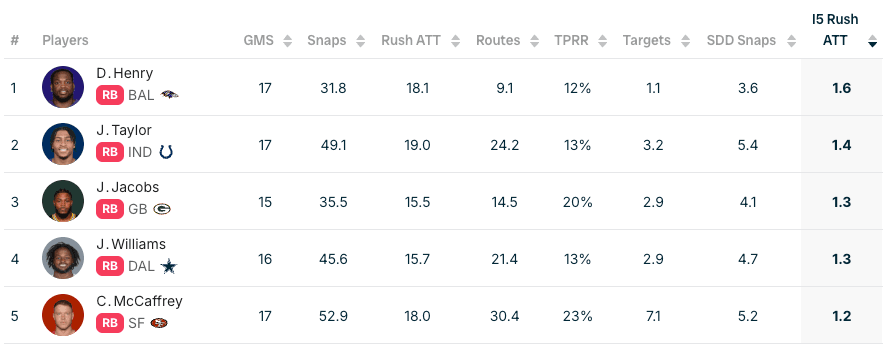
Once considered uncertain, the Dallas backfield fully belonged to Williams, who logged 69% of the snaps, 64% of the rush attempts, 79% of the short-down-and-distance snaps and 77% of the inside-the-5 rush attempts. Williams remained efficient with that volume, ranking 11th in yards per carry (4.8), ninth in rushing yards (1,201), ninth in first downs per rush (26.6%) and 10th in avoided tackle rate (21.4%). His 13 total touchdowns were a career high, as the move to a high-powered Dallas offense boosted his scoring chances. Williams averaged a very strong 1.3 carries per game from inside the 5-yard line, good for the fourth most in football.
The early-down and goal-line role isn’t going anywhere. But if Williams can improve his efficiency in the passing game, he could build on his RB11 finish. Last year, Williams ranked 66th among 72 qualified running backs in YPRR (0.40) and 32nd in target share (8%).
 15) Breece Hall | NYJ
Look, I know touchdowns are difficult to predict. But this is just getting ridiculous.
Last season, Hall handled 66% of the Jets’ rush attempts, while logging 64% of the snaps and 62% of the two-minute snaps. His 243 carries ranked 11th in the NFL, while averaging a healthy 17.4 touches per game. Overall, his fantasy production once again underwhelmed, largely due to the New York offense being consistently inept. As a result, Hall has ranked 35th among all running backs in goal-to-go carries during that span (29), averaging an ugly 0.3 carries from inside the 5-yard line per game.
The lack of fantasy ceiling has been especially frustrating when you consider that Hall remains a very good player. Among running backs with at least 200 carries since 2023, Hall ranks 15th in YAC per rush (3.15) and seventh in avoided tackles. Unfortunately, he is scoring a rushing touchdown every 48 carries, one of the ten-worst rates among qualified rushers during that stretch.
Hopefully, the improvements to the Jets offense can present Hall with more scoring opportunities.
 16) Josh Jacobs | GB
Jacobs joined the Packers in 2024. Since then, here are his ranks among running backs:
- 6th in carries per game (16.7)
- 3rd in rushing TD per game (0.88)
- 1st in goal-to-go carries per game (1.94)
- 10th in PPR PPG (16.5)
Last season, Jacobs was well on his way to another massive workload year. Through Weeks 1-10, Jacobs handled 68% of the snaps, 71% of the rush attempts and averaged 21.1 touches per game. But a Week 11 knee strain plagued him the rest of the season, resulting in two missed games, as well as a smaller role when healthy. From Week 12 on, Jacobs fell to a 45% snap share, 53% rush share and 14.6 touches per game.
Entering 2026, Emanuel Wilson is gone, leaving just Chris Brooks and the perpetually injured MarShawn Lloyd behind Jacobs. As long as he is on the field, Jacobs should once again dominate the workload, while contending for the league lead in rushing touchdowns.
 17) Kyren Williams | LAR
Despite the fantasy community’s best efforts to dethrone him, Williams remains the lead running back in Los Angeles. Sure, Blake Corum has seen more involvement each year, but it hasn’t suddenly led to Williams becoming a poor fantasy option. His 15.4 PPR PPG were 10th-best among running backs, while his efficiency took a huge step forward from 2024. This past season, Williams ranked 11th in YPC (4.8), sixth in YBC/ATT (1.70) and fourth in first downs per rush (28.6%). Williams greatly benefited from much-improved blocking, largely due to the Rams' trend-setting spike in 13 personnel (3TE sets). The Rams deployed 13 personnel a league-leading 30.4% of the time, with Williams obviously leading all running backs with 100 carries from the formation. On those carries, he averaged 3.05 YBC/ATT, while scoring seven touchdowns. In this scheme, I’d expect similar efficiency in 2025.
The real question surrounding Williams is how involved Corum will be on a weekly basis. Williams was the unquestioned lead back to open the season, but following the Rams Week 8 bye, Corum saw a larger role, averaging nearly 11 touches per game, while handling 37% of the rush attempts. From Weeks 1-8, Corum accounted for just 26% of the carries, averaging 6.4 touches per game.
Williams is a rock-solid RB2 that should continue to make up for some dip in volume for increased efficiency. Plus, I heard playing for elite offenses is good for fantasy football.
 18) Travis Etienne | NO
One of the best running back values in drafts, Etienne finished as a top-12 fantasy running back last season, averaging just under 15 points per game. He now heads to New Orleans to join an ascending, fast-paced Saints offense. His efficiency took a hit during the second half of the season, while a ton of his fantasy upside came from the passing game. Etienne ranked 10th among running backs in targets (52) and second in touchdown catches (6), as he benefited from Liam Coen’s screen-heavy attack. Etienne ranked third among running backs in screen routes (21), first in targets (12) and second in receptions (9).
Perhaps that role remains his with the Saints, but that depends entirely on the status of Alvin Kamara. It sure sounds like the Saints are planning to move on from the New Orleans legend, but until that happens, it’s tough to project huge receiving work for Etienne. The rankings are a bit lower on Etienne than his fantasy football ADP, but if Kamara is released, Etienne would have top-12 upside again, especially in an offense that led the league in pace under Kellen Moore.
 19) Cam Skattebo | NYG
From Weeks 4-7 last year, Skattebo handled 60% of the carries, 85% of the short-down-and-distance snaps, 78% of the carries from inside the 5-yard line and 69% of the overall snaps. During that same span, he averaged 18.8 carries, 74 rushing yards, 4.3 targets, 33 receptions and 18.7 PPR points per game, good for RB8 in fantasy.
A Week 8 season-ending injury derailed a breakout rookie year from Skattebo, making it possible that his early-season workload isn’t as elite. But his competition for touches is Tyrone Tracy and Devin Singletary, the same two players that Skattebo quickly passed on the depth chart as a rookie last season. The lead running back who gets goal-line work and targets has serious upside, especially in a rising Giants offense. Last year’s brutal injury does carry some risk, but the reward is massive.
 20) David Montgomery | HOU
After joining forces with Jahmyr Gibbs to form the best running back duo in the NFL, Montgomery will now return to starting duties following a trade to the Texans. We knew Gibbs’ role would increase over time, but halfway through the 2025 season, Montgomery was nearly phased out of the Detroit offense altogether. Once Dan Campbell took over playcalling duties, Montgomery’s usage fell off. From Week 10 on, Montgomery logged just 35% of the snaps, 33% of the rush attempts, 47% of the short-down-and-distance snaps and averaged just 8.9 touches per game.
Now in Houston, the efficiency may take a hit, but an uptick in volume should make up for that. Woody Marks is likely to handle more of the passing downs work, but Montgomery should be in line to eclipse the 14.1 touches per game he averaged in three seasons with the Lions. And for what it’s worth, once Marks emerged as the lead RB last year, the rookie averaged a healthy 17.5 touches per game.
 21) Bucky Irving | TB
Shoulder and foot injuries sidelined Irving for seven games last season. And when he did return, the usage wasn’t exactly what we're looking for from a fantasy running back. Sure, he averaged a strong 18.8 touches per game from Week 13 on, but it didn’t translate to stellar fantasy production. Irving was dominating the carries between the 20s, but wasn’t seeing the high-value touches we covet for fantasy.
He was suddenly a trap back.
From Weeks 13-18, Irving handled 65% of Tampa Bay’s rushing attempts (good), but averaged 11.1 PPR points per game (not so good). That ranked outside the top 25 running backs during that stretch. Per the Fantasy Life Utilization Report, Irving logged just 13% of the long-down-and-distance snaps after returning from injury, while 41% of the two-minute snaps went to Rachaad White. Irving averaged just 1.8 receptions and 14 receiving yards per game, but perhaps most importantly, he saw zero carries from inside the five-yard line all year long.
Sean Tucker became this team’s short-yardage option, accounting for 88% of the inside-the-5 carries. And with Kenneth Gainwell set to take the Rachaad White role (and then some), Irving could still lead this team in carries, but the absence of high-value touches will lead to some empty stat lines for fantasy.
 22) Quinshon Judkins | CLE
Judkins should handle just about every carry he can get.
As long as the Browns can remain somewhat competitive.
Last year, Cleveland ran 298 offensive plays when trailing by 10+ points, the seventh-most in football. That did not bode well for Judkins’ late-game usage, as the rookie averaged just 3.7 fourth-quarter touches per game, which ranked 20th among all running backs. Judkins was Cleveland’s clear early-down option, but he ceded plenty of third-down passing work to Dylan Sampson and Jerome Ford. According to the Fantasy Life Utilization Report, Judkins logged just 9% of the long-down-and-distance snaps, as well as 11% of the two-minute opportunities.
Cleveland’s favorable schedule does help matters, however.
They’ll face arguably the weakest division in football in the NFC South, with the Atlanta Falcons and Carolina Panthers being at home. But they also face the Tennessee Titans, Las Vegas Raiders, New York Jets and New York Giants. Judkins' PPR upside is capped, but if Cleveland can keep games close (especially now without Myles Garrett), he should see a ton of volume.
 23) D’Andre Swift | CHI
Swift was quite efficient last year, averaging 4.8 yards per carry (10th), while ranking fourth in YBC/ATT (1.87) and 12th in explosive rush rate (8.5%). He finished 16th among running backs in fantasy points per game, though it will be interesting to see what his workload looks like this time around.
The Bears found a gem in seventh-round pick Kyle Monangai, who carved out a meaningful role during the second half of the season. Following Monangai’s breakout Week 9 game, the Bears backfield became more of a two-headed unit. From then on, Swift handled 51% of the rush attempts and logged 56% of the snaps, a 10% drop in snap share compared to the first nine weeks. Chicago’s offense is ascending, but if the second-half usage carries over into 2026, Swift’s ceiling will be capped as a low-end RB2.
 24) Jadarian Price | SEA
Price is set to lead the Seahawks’ backfield as a rookie, and given the draft capital, he should see plenty of work. Since 2016, running backs selected in the first round of the draft are averaging 17.9 touches and 89.6 scrimmage yards per game, while logging around 63% of the snaps. Price is a good player who would have made a lot more noise if he weren’t backing up the best running back in the country, in Jeremiyah Love.
With Zach Charbonnet expected to be sidelined into possibly October, Price will have every chance to seize the Seattle backfield. We’ll see if his lack of pass game involvement in college leads to George Holani taking that role. But given the draft capital and talent, there’s no reason Price can’t emerge as an 18-to-20-touch-per-game running back as a rookie.

Join Our Newsletter
Trusted by 400,000+ fantasy football players. Get access to Fantasy Life's free award winning newsletter and tools, all in one step.
By registering or logging in, you agree to our Terms of Use and Privacy Policy.
Players Mentioned in this Article
Presented by


Published Updated