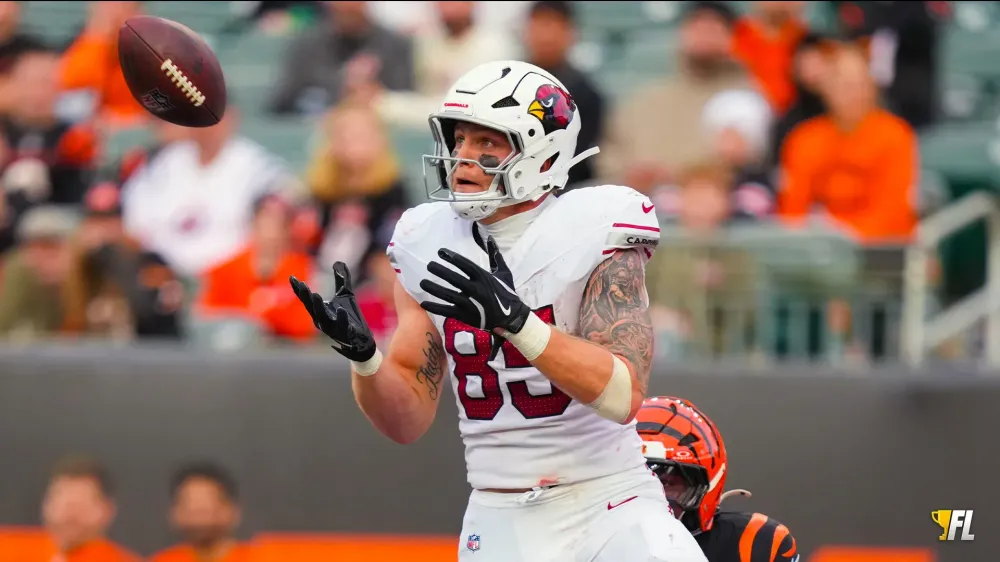
Trey McBride Makes Case To Be TE1 Over Brock Bowers
Ian Hartitz analyzes whether Arizona Cardinals Trey McBride could repeat as TE1 in fantasy football.
Remember when it used to look like Trey McBride was not allowed to be in the end zone without an invitation? That was so 2024. Last year, McBride was his usual target monster, turning 169 looks into 126 catches for 1,239 receiving yards and 11 TDs. He finished as the TE1 by more than 80 points. Now we beg the question: What does he do for an encore? Ian Hartitz breaks down his chances to repeat in the 2026 Arizona Cardinals Team Preview.

Join Our Newsletter
Trusted by 400,000+ fantasy football players. Get access to Fantasy Life's free award winning newsletter and tools, all in one step.
By registering or logging in, you agree to our Terms of Use and Privacy Policy.
 Can Trey McBride repeat as fantasy's overall TE1?
- TE1: Trey McBride (TE1 in Fantasy Life ranks)
- TE2: Elijah Higgins
McBride has spent the last two seasons looking a LOT like one of the NFL's very best receiving options at the position.
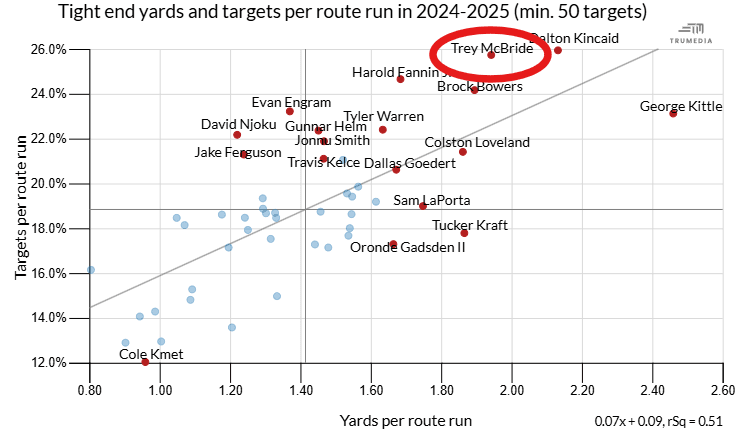
Of course, the counting numbers aren't even close: McBride leads the position in receptions, receiving yards, and fantasy points by a WIDE margin. Hell, McBride's average of 17.1 PPR points per game over the past two seasons ranks seventh among tight ends *and* wide receivers!
Ultimately, everyone agrees that McBride is deserving of TE1, at worst TE2, status … but how high should he actually go in fantasy drafts?
Well, early ADP has the rising fifth-year talent going off the board at the Round 2-3 turn alongside top-12 wide receivers like George Pickens and Nico Collins as well as top-15 running backs like Jeremiyah Love and Josh Jacobs. That's awfully expensive, especially when considering the hit rate of early-round tight ends hasn't exactly been fantastic over the years.
I looked at 40 tight ends with an ESPN ADP inside the top-50 overall players since 2017 (that's how far back I could find ESPN ADP). Among these players:
- Their average TE positional finish in PPR points per game: 6. Median: 3.5. Not bad!
- BUT their average FLEX (RB, WR, TE) finish in PPR points per game: 58.3. Median: 47. That's not good relative to their average overall ADP (33.2) and median (35.5).
- All in all: 12 of 40 (30%) tight ends posted a FLEX rank better than their overall ADP. This percentage drops to 25% if you look at tight ends not named Travis Kelce or George Kittle.
Now, to McBride's credit, he's two for two in returning overall FLEX numbers greater than his ADP; just realize early-round tight ends haven't been the surest bet over the years, and there should be at least some level of concern with McBride's 2026 projection when considering the new offense and potential to cycle through multiple (bad) quarterbacks. Personally, I'm more keen to gamble on a bounceback season from Brock Bowers—there's a bit more reason for optimism in his QB room, and he's dealing with far less target competition at wide receiver.

Unlock Our Tools!
Stop hitting the paywall. FL+ gives you access to our premium in-depth content, expert rankings & projections, mock draft simulator, and all the tools you need – all personalized to your league.
Players Mentioned in this Article
Presented by








Published