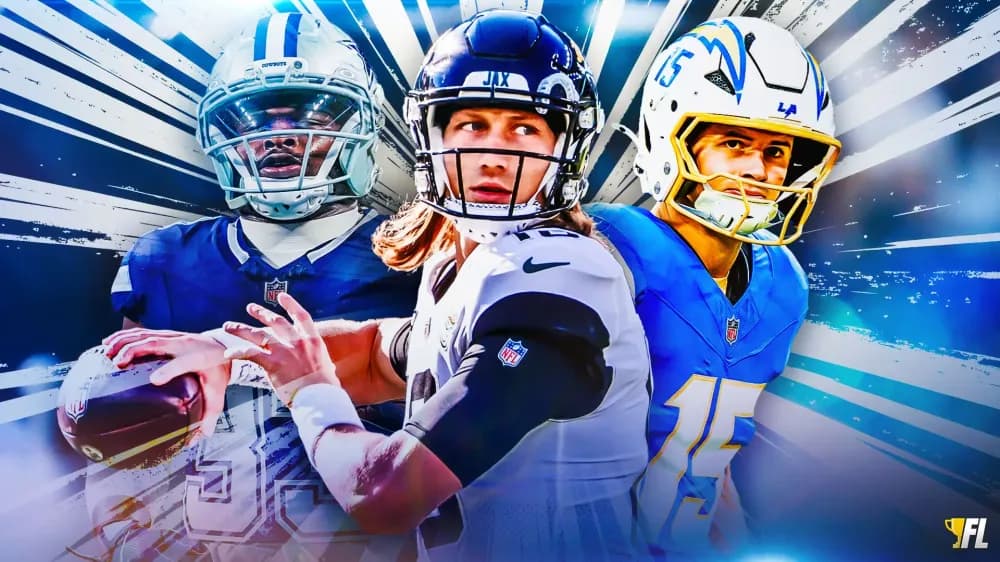
32 NFL Teams, 1 Player To Draft From Each For Fantasy Football: Trevor Lawrence, Ladd McConkey And More
Adam Pfeifer identifies one player from each of the 32 NFL teams to draft in fantasy football.
First it was 32 stats. This time around?
32 players.
With fantasy draft season rapidly approaching, let’s highlight a player that I want to draft from every team in the NFL. Of course, these aren’t the only players I’m targeting from each team, but they do stand out.

Unlock Our Tools!
Stop hitting the paywall. FL+ gives you access to our premium in-depth content, expert rankings & projections, mock draft simulator, and all the tools you need – all personalized to your league.
One Player to Draft on All 32 NFL Teams
 Arizona Cardinals: Jeremiyah Love | RB
I’m not sure I agree with the Cardinals selecting Love third overall in the NFL Draft, but I am sure of one thing.
It’s a great thing for fantasy football.
Round 1 draft capital for running backs, let alone a top-5 pick, is very conducive to fantasy success. Since 2016, there have been 13 running backs drafted in Round 1. Five of those running backs eclipsed 300 total touches, with four of those players being selected as top-6 picks in the NFL Draft. And if you look at the six running backs drafted in the top-10 since 2016, the average touches per game is 19.1 and about 300 touches per season.
I know the Cardinals still have James Conner on the roster, and signed Tyler Allgeier in the offseason. But history tells us a team doesn't spend such a high draft pick on a running back to give Jeremiyah Love a middling workload.
 Atlanta Falcons: Drake London | WR
A slow start last year had some worried about Drake London’s prospects. During the first three weeks, London averaged just just 5.3 receptions, 53 yards and 10.6 PPR PPG. But from then on, he wasn’t just good.
London was the best receiver in all of fantasy.
From Weeks 4-11, London was otherworldly, averaging 11.2 targets, 7.3 receptions, 108.5 yards and 24.2 PPR PPG. He was fantasy’s WR1, while recording five 100-yard games over that stretch. During that stretch, there was no secret where the ball was going in Atlanta, as London ranked second in TPRR (31%) and first in target share (36%), while accounting for a whopping 75% of Atlanta’s end-zone targets.
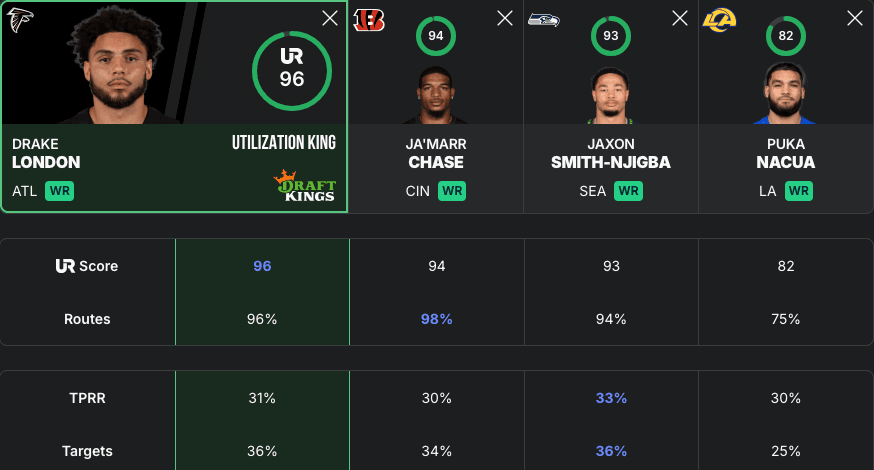
Entering 2026, London remains the clear alpha in Atlanta. We’ll see if Michael Penix is ready for Week 1, but even if he’s not or once again misses time, the addition of Tua Tagovailoa guarantees that London will have a quarterback who can at least support great fantasy receiver seasons.
 Baltimore Ravens: Mark Andrews | TE
I’ve written thousands of words over the past few months, and roughly half of them have been about Mark Andrews.
OK, maybe not half. But it sure as hell feels like it.
What can I say? I’m fully bought in on the bounceback season from a soon-to-be 31-year-old tight end. Surely nothing can go wrong. After finding the end zone 11 times in 2025, Andrews scored just 5 touchdowns this past season, resulting in a TE23 finish in fantasy points per game (7.7). Between the age and poor production, the price has fallen on Andrews, but I’m buying. The departure of Isaiah Likely simply cannot be overlooked. Over the past two years, Likely has carved out a larger role, limiting Andrews’ upside. With Likely on the field since 2024, Andrews has been targeted on 18.6% of his routes, while seeing a 14% target share. But with Likely off the field during that span, Andrews’ rates climbed to 21% and 19%, respectively.
Likely’s presence also hurt Andrews’ overall playing time. In four games without Likely since 2024, Andrews has run 79.2% of the routes, but in games with Likely active, his route participation drops to 64%, to go along with a 60% snap share. Andrews should return to more of a full-time role this year, and a fantasy-friendly one at that. Since 2023, 41.5% of Lamar Jackson’s red-zone pass attempts have gone to the tight end position.
Sounds like double-digit touchdown upside to me.
 Buffalo Bills: DJ Moore | WR
Some believe DJ Moore is on a rapid decline. And while he may not be quite the same player, I still believe he’s easily the best receiver on the Bills. And sometimes it’s as simple as “Oh, he’s about to go play with Josh Allen? That seems like a good thing.”
Now I’m not expecting Moore to replicate Stefon Diggs’ huge seasons in Buffalo. The offense is more run-heavy and, well, Moore isn’t that caliber of player. But I absolutely expect him to improve on his 15% TPRR and 16% target share from last season.
 Carolina Panthers: Jalen Coker | WR
We often see wideouts really find their groove in Year 3, and Coker could be this year’s Michael Wilson. Maybe. Once Jalen Coker was finally healthy last year, he made an impact, and following Carolina’s Week 14 bye, Coker saw a healthy 22% target share. And during that stretch, Coker averaged 6.0 targets, 4.8 receptions, 61 receiving yards and 14.5 PPR PPG, which included an impressive 9-134-1 stat line in a playoff loss against the Rams. A healthy start to the season and an uptick in passing could lead to a breakout Year 3 from Coker.
 Chicago Bears: Rome Odunze | WR
All of the hype is around Luther Burden and Colston Loveland. And don’t get me wrong, it is very, very warranted. Both are elite breakout candidates this season.
But dammit, I refuse to forget about Rome Odunze’s first half of 2025.
From Weeks 1-8, Odunze was dominant, sporting a 23% TPRR and 26% target share. During that span, Odunze averaged 15.5 PPR PPG, good for 10th among qualified wide receivers. He had one more good game before suffering a foot fracture, which sidelined him from Weeks 14-18, ruining what could have been a true breakout campaign. But I still believe a massive season is in store for Odunze, especially if he and Caleb Williams can get on the same page.
This past season, Odunze posted just a 59% catchable target rate, the 12th-lowest mark among wideouts with at least 150 routes. Odunze was seeing a lot of the downfield usage, averaging over 100 air yards per game, but Williams completed just 39% of his deep passes. I’d like to see more schemed usage for Odunze, which could happen following the departure of Moore. But regardless, I’m still chasing the upside. Odunze scored 5 touchdowns during his first four games and since 2024, his 27 end-zone targets rank seventh in all of football.
 Cincinnati Bengals: Chase Brown | RB
If Joe Burrow is sidelined, Chase Brown will be a good, serviceable fantasy running back.
But if Burrow is healthy, Brown will be elite.
Last year was evidence of just that. During Weeks 3-12, the Bengals offense looked like a shell of its former self without its star quarterback. And although things did improve once Joe Flacco saved our fantasy rosters, it still wasn’t the same. With Burrow sidelined during that stretch, Brown averaged just 13.5 PPR points per game, ranking as fantasy’s RB20. He still averaged 5.7 targets per game, but only found the end zone twice during that span. Surprise, surprise. The Bengals’ scoring opportunities plummeted without Burrow under center:
Weeks 3-12 (without Burrow):
- 36% drives with a score (20th)
- 21% drives with a TD (23rd)
- 15% rushing TD rate (32nd)
- 59.4 plays per game (21st)
Again, Flacco’s presence did give this offense a much-needed boost, as the Bengals climbed to 11th in percentage of drives with a TD (11%) and sixth in percentage of drives with a score (46%) from Weeks 6-12. And Brown improved with Flacco, averaging 3 more fantasy points per contest.
But his final form was about to be reached. Burrow returned in Week 13 and once he did, only Bijan Robinson scored more fantasy points than Brown (22.3).
Weeks 13-18 (with Burrow):
- 47% of drives with a score (6th)
- 34% of drives with a TD (6th)
- 29% rushing TD rate (24th)
- 68.0 plays per game (1st)
Brown is one of my favorite players to draft in all of fantasy and even coming off the board at RB12, I still believe you are getting a discount.
 Cleveland Browns: Quinshon Judkins | RB
Hopefully Cleveland’s defense can hold up without Myles Garrett. Because Quinshon Judkins will be as game-script dependent as most running backs in fantasy. Last year, Cleveland ran 298 offensive plays when trailing by 10+ points, the seventh-most in football. That did not bode well for Judkins’ late-game usage, as the rookie averaged just 3.7 fourth-quarter touches per game, which ranked 20th among all running backs. Judkins was Cleveland’s clear early-down option, but he ceded plenty of third-down passing work to Dylan Sampson and Jerome Ford. According to the Fantasy Life Utilization Report, Judkins logged just 9% of the long-down-and-distance snaps, as well as 11% of the two-minute opportunities.
Cleveland’s favorable schedule does help matters, however.
They’ll face arguably the weakest division in football in the NFC South, with the Atlanta Falcons and Carolina Panthers being at home. But they also face the Tennessee Titans, Las Vegas Raiders, New York Jets and New York Giants.
 Dallas Cowboys: Javonte Williams | RB
One of the best values in fantasy drafts last summer, Javonte Williams returns as the Cowboys’ lead running back. That alone is enticing. Once considered uncertain, the Dallas backfield fully belonged to Williams, who logged 69% of the snaps, 64% of the rush attempts, 79% of the short-down-and-distance snaps and 77% of the inside-the-5 rush attempts. Williams remained efficient with that volume, ranking 11th in yards per carry (4.8), ninth in rushing yards (1,201), ninth in first downs per rush (26.6%) and 10th in avoided tackle rate (21.4%). His 13 total touchdowns were a career high, as the move to a high-powered Dallas offense boosted his scoring chances. Williams averaged a very strong 1.3 carries per game from inside the 5-yard line, good for the fourth most in football.
The early-down and goal-line role isn’t going anywhere. But if Williams can improve his efficiency in the passing game, he could build on his RB11 finish. Last year, Williams ranked 66th among 72 qualified running backs in YPRR (0.40) and 32nd in target share (8%).
 Denver Broncos: Jaylen Waddle | WR
Talented wideouts joining a new team via trade actually often works out for fantasy purposes. Stefon Diggs, A.J. Brown and George Pickens can all attest to this. So consider me interested in Jaylen Waddle, who, after spending most of his career as the WR2 behind Tyreek Hill, finally gets his time to shine. We did see a dress rehearsal of Waddle as the WR1 last season, too. From Week 5 on, Waddle posted identical target shares and TPRR (25%) and although the fantasy production was underwhelming, the Miami offense was far from fantasy-friendly.
Holy alliteration!
Last year, the Dolphins ranked 32nd in plays per minute (1.9), 31st in plays per game (55.6) and 24th in dropback rate over expected (-3%). Waddle now joins a Denver offense that ranked third in dropback rate over expected (4%), and he should see far more designed targets in Sean Payton/Davis Webb’s offense. During his time in Miami, Waddle was mostly used on post routes, while the motion/screen/designed looks went to Hill. Over the past two seasons, Waddle has seen a total of 10 screen targets. Expect that to change immediately, as Waddle is now playing in a Broncos offense that averaged 4.5 screen attempts per game, good for the third most in football.
 Detroit Lions: The Good Players
Honestly, the Lions are a pretty simple team. I want the 1.01 to draft Jahmyr Gibbs. If I’m not blessed with the first pick, I’d be happy to draft Amon-Ra St. Brown or Jameson Williams. Good offenses have good fantasy players. Imagine that.
 Green Bay Packers: Jayden Reed | WR
Get Jayden Reed on the football field. Please.
Since entering the league in 2023, Reed has logged only 31 total snaps and run seven routes out of 12 personnel, which is why his route rate during that span is an underwhelming 69%. Bumping that to 75%-80% would do wonders for Reed, who should be in line for more opportunities following the departure of both Romeo Doubs and Dontayvion Wicks. As a rookie in 2023, Reed ranked eighth in football in fantasy points per route (0.56). Don’t expect that level of efficiency to remain once the routes come up, but it just illustrates the damage he can do when he gets the football.
 Houston Texans: David Montgomery | RB
After forming the league’s top running back duo with Gibbs, David Montgomery will now return to starting duties following a trade to the Texans. We knew Gibbs’ role would increase over time, but halfway through the 2025 season, Montgomery was nearly phased out of the Detroit offense altogether. Once Dan Campbell took over playcalling duties, Montgomery’s usage fell off. From Week 10 on, Montgomery logged just 35% of the snaps, 33% of the rush attempts, 47% of the short-down-and-distance snaps and averaged just 8.9 touches per game.
Now in Houston, the efficiency may take a hit, but an uptick in volume should make up for that. I’d still expect Woody Marks to handle plenty of the pass-game work, but Montgomery should be in line to eclipse the 14.1 touches per game he averaged in three seasons with the Lions. And for what it’s worth, once Marks emerged as the lead RB last year, the rookie averaged a healthy 17.5 touches per game.
 Indianapolis Colts: Josh Downs | WR
The case for Josh Downs is very similar to that of Jayden Reed—a good player who needs to get on the field more.
And like Reed, Downs should be in store for more playing time in 2026.
With Michael Pittman and his 21% target share gone, Downs is set to step in and run more routes. And considering he commands targets when he’s on the field, that’s an exciting development. Among wideouts with at least 100 routes last season, Downs ranked 11th in TPRR vs man coverage (29%). The absence of Pittman should open up more opportunities for Downs, who didn’t play when the Colts were in two-wide sets last season. Last season, Downs ran just 17 routes out of 12 personnel, which ranked outside the top-100 wideouts in football. But in that very small sample size, Downs was targeted seven times. No matter what the personnel or situation, Downs simply earns targets.
 Jacksonville Jaguars: Trevor Lawrence | QB
“The wide receiver room is too crowded.”
“I have no clue which Jacksonville pass catcher to draft.”
OK, no worries. Just draft Trevor Lawrence.
Lawrence broke out last year, finishing as the QB6 in fantasy. But from Week 12 on, he won leagues, ranking as the QB1 (26.3 PPG). During that span, Lawrence also posted a 9% designed rush rate, which ranked third among signal-callers. He’s the one who gets to benefit from a deep WR room and a terrific playcaller in Liam Coen. If I’m waiting on the quarterback position, Lawrence is someone I’m targeting.
 Kansas City Chiefs: Kenneth Walker | RB
Patrick Mahomes and Andy Reid will both be a welcome sight for Kenneth Walker.
Playing running back in a Mahomes-led offense certainly has its perks. For starters, you know opposing defenses will rarely ever hone in on stopping you. This past season, Isiah Pacheco saw stacked boxes on just 14.4% of his carries, the third-lowest rate among qualified running backs. That’s a relief for Walker, who, per Next Gen Stats, saw stacked boxes on about 22% of carries during his first four seasons. Secondly, scoring opportunities will always be present. Last season, despite logging just 47% of the snaps, K9 ranked 10th in the NFL with 13 carries from inside the 5-yard line, averaging nearly one such carry per contest. Walker, meanwhile, lost that role to Zach Charbonnet in Seattle, averaging just 0.5 inside-the-five carries per game, accounting for only 32% of the Seahawks’ total carries from that area of the field.
Now in Kansas City, Walker could be thrust into a true workhorse role, giving him top-10 fantasy upside.
 Los Angeles Chargers: Ladd McConkey | WR
The run game isn’t the only part of this offense that’ll benefit from the addition of Mike McDaniel.
His heavy use of motion at the snap is great to get wide receivers free releases and advantageous matchups, something Ladd McConkey needs to see more of. Last year, McConkey saw just 13 targets from motion, which ranked 33rd among all wideouts. For reference, Malik Washington had 18 such targets with McDaniel in Miami last season. The Dolphins utilized shift-motion a league-leading 68% of the time last year, while the Chargers were down at 50%. Look for McConkey to take advantage of this new fantasy-friendly scheme.
 Los Angeles Rams: Blake Corum | RB
Obviously, everyone would love to add Puka Nacua to a fantasy roster. But let’s focus on Blake Corum, an elite Zero-RB candidate. Kyren Williams remains entrenched as the starter, but Corum is going to continue to carve out a role, especially if he builds on last season. Among running backs with at least 145 carries, Corum ranked:
- 4th in YPC (5.1)
- 2nd in 1D/Rush (30.3%)
- 1st in YBC/ATT (2.54)
Following the Rams’ Week 8 bye, Corum became more involved, averaging nearly 11 touches per game, while handling 37% of the rush attempts. From Weeks 1-8, Corum accounted for just 26% of the carries, averaging 6.4 touches per game.
 Las Vegas Raiders: Ashton Jeanty | RB
After finding little running room during his rookie season, Ashton Jeanty will welcome any and all additions to the offensive line. In 2025, Jeanty was stuffed at or behind the line of scrimmage on a whopping 26.7% of his carries, the highest rate in the NFL. The Raiders averaged 3.50 adjusted line yards per attempt, tied for the worst mark in the league, while Jeanty averaged just 3.3 yards per carry on runs inside the tackles. His 27.6% success rate on such runs was also comfortably the lowest rate among qualified rushers. The addition of Tyler Linderbaum, who ranked fourth in PFF’s run block grade in 2025, will drastically help the inside-run game, giving Jeanty more opportunities to hit home runs, rather than constantly grounding out.
 Miami Dolphins: Malik Willis | QB
We’ll see if his small sample size from Green Bay can carry over. But if it's any indication, Malik Willis could be the breakout fantasy quarterback of the year. On 89 pass attempts over the last two years, Willis is averaging 11.1 yards per attempt. And across three starts during that span, Willis is averaging 23.3 fantasy points, seven rush attempts and 58 rushing yards per game. With Willis, we’re chasing elite rushing upside, which can provide such high floors and ceilings in fantasy. Our projections currently have Willis for 122.8 rush attempts (2nd-most), and if he hits that mark, it’s a tremendous sign for his fantasy prospects. Since 2020, there have been 16 seasons where a quarterback has recorded at least 120 rushes. The average fantasy points per game of that group is 21.4, which would have been good for QB2 this past season.
 Minnesota Vikings: Justin Jefferson | WR
It can’t be worse than last year, right?
Justin Jefferson’s 67.4% catchable target rate ranked 63rd among wideouts, while over 21% of McCarthy’s attempts were deemed bad throws, the second-highest rate among qualified signal callers. But when he actually had serviceable quarterback play, Jefferson did Justin Jefferson things.
In five games with Wentz under center, Jefferson averaged 10 targets, 6.8 receptions, 95.4 receiving yards and 16.3 PPR points per game. And the fantasy production is even more impressive when you consider Jefferson didn’t score a single touchdown during those games. Jefferson should benefit from the addition of Kyler Murray, who helped DeAndre Hopkins haul in 15 passes for 1,407 yards back in 2021.
 New England Patriots: A.J. Brown | WR
Last year was a down year for A.J. Brown, but he remained strong in many metrics, ranking top-10 in target share (29.5%), TPRR (25%) and FPPG (10th). Moving from Kevin Patullo’s vanilla hitch-heavy scheme will help Brown return to doing damage on crossing routes. And the uptick in pass volume certainly won’t hurt either.
 New Orleans Saints: Jordyn Tyson | WR
The Saints offense is one the most intriguing for fantasy and Jordyn Tyson is a key reason why. When on the field in college, all Tyson did was command targets, and that trait should carry over into the NFL. After Chris Olave, there are so many targets up for grabs, and we know the Saints will be a fast, pass-happy offense. During Kellen Moore’s first season in New Orleans, the Saints led the NFL in no-huddle rate (22.7%), while their 2.2 plays per minute also paced the league.
 New York Giants: Cam Skattebo | RB
From Weeks 4-7 last year, Cam Skattebo handled 60% of the carries, 85% of the short-down-and-distance snaps, 78% of the carries from inside the 5-yard line and 69% of the overall snaps. During that same span, he averaged 18.8 carries, 74 rushing yards, 4.3 targets, 33 receptions and 18.7 PPR points per game, good for RB8 in fantasy. Even with Tyrone Tracy returning from injury, Skattebo remained the clear starter, which continued into a Week 8 game in Philadelphia. Skattebo recorded six of the first 10 RB opportunities before suffering a season-ending injury, derailing a breakout season.
Tracy will have a role, but even with a new regime in town, I’d expect Skattebo to lead the Giants backfield again. Our fantasy football projections have Skattebo at 222 carries to Tracy’s 101, with the former seeing another 54 targets. With Matt Nagy coming over from Kansas City to call plays, expect plenty of designed screens to the running back. Last season, the Chiefs dialed up the sixth-most RB screens.
 New York Jets: Breece Hall | RB
I’m warming up to Breece Hall, mostly because he’s a good player who has to play in a league-average offense at some point, right?
Right?
Last season, Hall handled 66% of the Jets’ rush attempts, while logging 64% of the snaps and 62% of the two-minute snaps. His 243 carries ranked 11th in the NFL, while averaging a healthy 17.4 touches per game. Overall, his fantasy production once again underwhelmed, largely due to the New York offense being consistently inept. As a result, Hall has ranked 35th among all running backs in goal-to-go carries during that span (29), averaging an ugly 0.3 carries from inside the 5-yard line per game.
Please, Geno Smith. Move this offense. Get Breece some touchdowns.
 Philadelphia Eagles: DeVonta Smith | WR
Over the last few seasons, “Skinny Batman” has been closer to Robin in this Eagles passing attack. Those days are over. Following the trade of A.J. Brown, DeVonta Smith is set to operate as the WR1, a very exciting thought. Back in 2023, Smith saw 136 targets, resulting in a 95-1,196-7 slash line and a WR9 fantasy finish. He may not quite reach that many looks, but the per-route volume is sure to increase. With Brown off the field since 2022, Smith has been targeted on 28% of his routes, which would easily be his highest TPRR rate over an entire season. Smith will be the unquestioned alpha in this offense, and between the talent and uptick in volume, he should be selected as a top-15 fantasy wide receiver, while having top-10 upside.
 Pittsburgh Steelers: Michael Pittman Jr. | WR
The Steelers traded for Michael Pittman this offseason and following the return of Aaron Rodgers, I’d expect him to lead his new team in targets right away. As his career has progressed, Rodgers has become a lot more reliant on quick-hitting slant routes and timing concepts. Over the last two seasons, no quarterback has targeted slant routes more than Rodgers (96). Pittman, meanwhile, was often used on such concepts, especially on RPO plays, during his time in Indianapolis. This past season, his 15 targets off slant routes were good for the eighth-most in football. The way Pittman wins correlates with where Rodgers wants to go with the football, which is why he’s my highest-ranked Steelers wide receiver.
 Seattle Seahawks: Jaxon Smith-Njigba | WR
Perhaps the easiest team in the league for fantasy. Rookie Jadarian Price is intriguing, but the Seahawks are pretty much Jaxon Smith-Njigba or bust for me this season. Sam Darnold has no fantasy ceiling, while no other pass catchers are currently viable if JSN is seeing 35% of Seattle’s targets.
 San Francisco 49ers: Brock Purdy | QB
Brock Purdy won me my most important fantasy league last year, so admittedly, there is some bias here. He ended the season on a tear, averaging 225.9 passing yards, 2.3 passing touchdowns and 20.7 fantasy points per game once returning from injury in Week 11. His 7% touchdown rate trailed only Matthew Stafford, while Purdy has ranked top-3 in touchdown rate in three seasons since 2022.
And now the 49ers just added Mike Evans.
Last season, RB Christian McCaffrey actually accounted for 31.7% of the 49ers’ targets from inside the 10-yard line, the 10th-highest rate in football. The addition of Evans gives San Francisco a true red-zone threat, and a second once George Kittle is healthy. Purdy could absolutely contend for the league-lead in touchdown passes this season.
 Tampa Bay Buccaneers: Chris Godwin | WR
I know what you’re probably thinking. “Really, Adam? You want to draft the 30-year-old, injury-prone wideout over the sophomore star?”
And to that I say… why not both?
Emeka Egbuka is coming off draft boards in the fourth round, and deservedly so. But I still think Chris Godwin (WR41 in ADP) is a tremendous value. Yes, injuries have limited him to just 16 games over the past two seasons. And he surely isn’t the player he once was. But, especially at this stage of his career, a full-time slot role could be terrific for him. Always more efficient from the inside, Godwin’s splits over his last 16 regular-season games are pretty glaring:
Slot: Elsewhere:
2.10 YPRR 1.49 YPRR
33% TPRR 21.3% TPRR
12.1 YPC 9.9 YPC
5 TDs 2 TDs
I expect Baker Mayfield and the Bucs passing attack to get back on track, giving Godwin at least one more strong fantasy campaign.
 Tennessee Titans: Tony Pollard | RB
It may legitimately be the most boring selection in fantasy drafts. But drafting Pollard in Round 8 can only help your fantasy roster. Pollard finished last season with 242 carries, despite the Titans ranking fourth in dropback rate (65%) and third in plays when trailing by 8+ points (444). And down the stretch last season, Pollard showed he still has plenty left in the tank.
Weeks 13-18:
- 17.0 carries
- 93.3 rushing yards
- 14.1 PPR PPG
- Three 100-yard games
 Washington Commanders: Terry McLaurin | WR
One of the most logical bounceback candidates for 2026, Terry McLaurin (and Jayden Daniels) really just need to stay healthy to get back on track. A quad injury cost him seven games, while he ran only 101 routes with Daniels on field. Entering 2026, McLaurin has laughable target competition, especially if new OC David Blough remains steadfast in his attempts to get him 10 targets a game. McLaurin accounted for 38% of Washington’s air yards last year (15th among WRs with 20+ targets) and could flirt with WR1 status if health is on his—and Daniels’—side.
Unlock Our Tools!
Stop hitting the paywall. FL+ gives you access to our premium in-depth content, expert rankings & projections, mock draft simulator, and all the tools you need – all personalized to your league.
Players Mentioned in this Article
Presented by



Published Updated