Fantasy Football Rookie Rankings For 2026: Jeremiyah Love, Carnell Tate and More
Dwain McFarland breaks down how he's ranking the 2026 rookie class for fantasy football.
With landing spots revealed, it's time to dive into fantasy football rookie rankings for 2026. A major component of how I rank players comes from the Rookie Super Model, a data-driven approach that has historically predicted future NFL success better than the draft pick alone.
You can find the full Rookie Super Model write-ups for each position here:
Now, let's dive into the rankings.

Join Our Newsletter
Trusted by 400,000+ fantasy football players. Get access to Fantasy Life's free award winning newsletter and tools, all in one step.
By registering or logging in, you agree to our Terms of Use and Privacy Policy.
2026 Fantasy Football Rookie Rankings and Tiers
For each player, we will evaluate the player's Year 1 outlook, where landing spot can play a larger role, and the multi-year outlook, where talent becomes the bigger factor. So, whether you are trying to prepare for a dynasty rookie draft or just the 2026 season, we have you covered.
Note: Rankings will be updated each day as we receive more draft picks.
Tier 1: One RB Stands Alone
 1. Jeremiyah Love | RB1 | Cardinals
- Rookie Super Model Rating: 91.8 (5th All-Time)
- NFL Draft Pick: 3
- 2026 Outlook: Mid-Range RB2 with RB1 Upside
- Multi-Year Outlook: High-End RB1
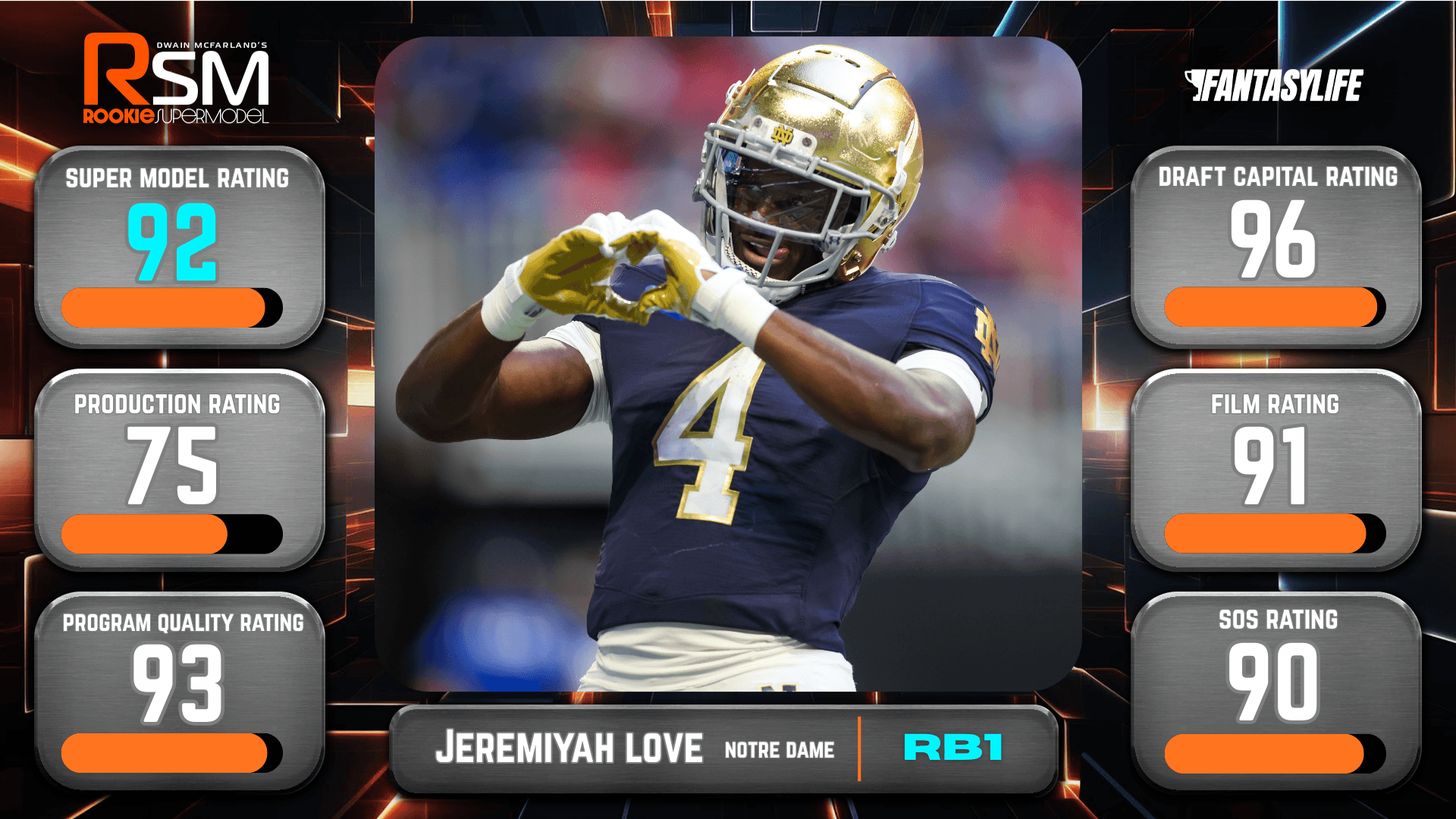
Love is an electric playmaker with the size-speed combo that NFL talent evaluators drool over. While his Production Rating (75) is lower than that of historical top-10 NFL Draft picks, sharing the backfield with Jadarian Price, Love's underlying data profiles similarly.
| Player | Missed Tackles Forced % | Average Yards After Contact | 10+ Yard Carries | Targets Per Route | Yards Per Route |
|---|---|---|---|---|---|
| Saquon Barkley | 25% | 3.51 | 16.2% | 18% | 1.66 |
| Ashton Jeanty | 38% | 4.76 | 16.6% | 18% | 1.60 |
| Leonard Fournette | 22% | 3.04 | 16.7% | 19% | 1.62 |
| Jeremiyah Love | 31% | 4.35 | 17.1% | 20% | 1.59 |
| Bijan Robinson | 39% | 4.40 | 16.0% | 14% | 1.48 |
And Love's NFL Combine testing matches those numbers. At 212 pounds, he ran a blistering 4.35-second 40-yard dash at the NFL Combine. His 117.3 Speed Score falls in the 82nd percentile for prospects dating back to 2017 in the Rookie Super Model database.
The 21-year-old isn't on the same level as a Jahmyr Gibbs or Christian McCaffrey as a receiver. Still, he is capable of posting similar receiving numbers to Barkley, Jeanty and Robinson, who have all provided receiving goodness at different points in their career.
Since 2017, five RBs have reached a Rookie Super Model Rating of 89 or higher. All five of those RBs have produced a top-six fantasy finish by Year 3. The cohort averaged 19.8 points per game over the first three campaigns.
As the No. 3 pick in the draft, Love's rookie deal includes a rookie RB record-setting $50.5 million in guaranteed money. His average annual salary ranks seventh among NFL backs.
Since 2015, most top-10 RBs have received a significant workload in their first year (excludes games missed):
- Ashton Jeanty: 78%
- Saquon Barkley: 76%
- Ezekiel Elliott: 75%
- Leonard Fournette: 71%
- Todd Gurley: 66% (coming off ACL)
- Bijan Robinson: 45%
- Christian McCaffrey: 26% (23% targets)
In an interesting twist, Love finds himself in a backfield with Tyler Allgeier, who subdued Robinson's rush share as a rookie. Allgeier signed a two-year, $12.3M contract with Arizona with $8M guaranteed. From a cap percentage perspective, that isn't a huge number at 1.3% in 2026 per Over The Cap.
In our fantasy football projections model, I am giving some respect to Allgeier, but still leaning into historical top-10 pick trends, giving Love 63% of the rushing attempts. In an offense with a lot of questions, the touchdown upside could be limited. Especially if Allgeier usurps attempts inside the five-yard line. When you add it all up, Love projects as a mid-range RB2 with RB1 upside in my early 2026 projections.
Bottom Line: Love is a near lock for eventual top-six RB stardom. He should be the consensus No. 1 pick in rookie drafts—even Superflex. For 2026, he is a mid-range RB2 with RB1 upside should he get a larger role and the Cardinals surprise on offense.
Tier 2: Who's Your Rookie WR1?
 2. Jordyn Tyson | WR1 | Saints
- Rookie Super Model Rating: 88.9 (14th All-Time)
- NFL Draft Pick: 8
- 2026 Outlook: Borderline WR2
- Multi-Year Outlook: High-End WR2
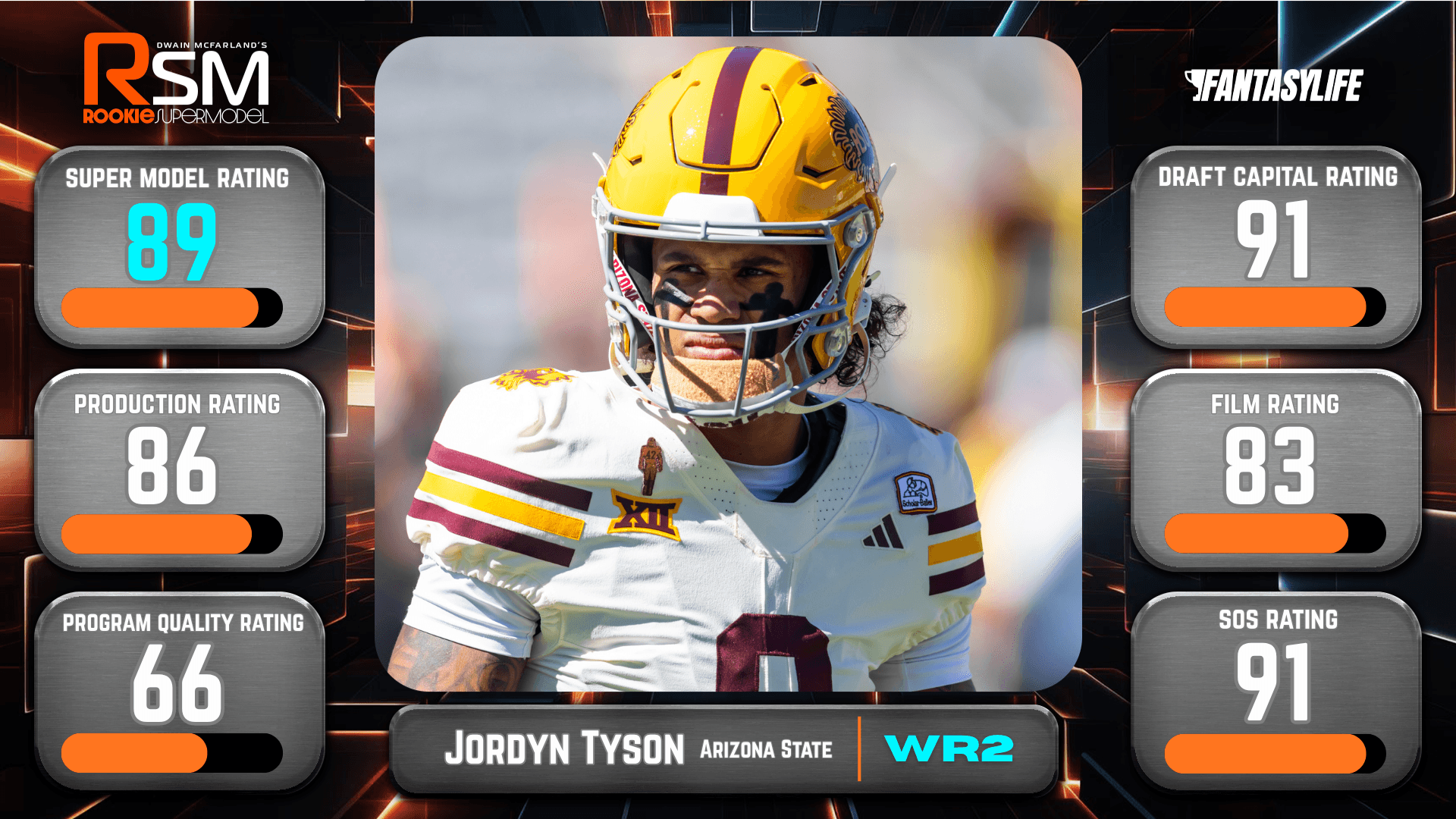
Tyson was an absolute target hot in college, notching a 28% career target share (77th percentile) and a 38% best-season target share (83rd percentile). Oink. Oink, y'all. He dominated versus man and zone coverage with 39% and 27% target-per-route-run marks. His 86 Production Rating is the highest of any Round 1 pick in 2026.
The 22-year-old delivered above-expected Receiving Yards Per Team Pass Attempt (RYPTPA) every season versus historical Round 1 picks:
- Year 1: 1.61 (R1 WR average: 0.91)
- Year 2: N/A (injury)
- Year 3: 3.46 (R1 WR average: 2.54)
- Year 4: 2.43 (R1 WR average: 2.40)
The result is an adjusted career RYPTPA at the 78th percentile, which is the model's No. 1 production input.
 Nerd Note: Production Rating normalizes prospect data based on team pass attempts in games played, year of eligibility, teammate target competition, quarterback play, and strength of schedule. Production in Years 1-3 correlates more strongly with future NFL success and gets more weight in the model.
Since 2018, 12 WRs have notched a Rookie Super Model Rating between 84 and 94, with 75% securing a top-24 finish by Year 3. The cohort averaged 12.1 points over their first three years.
- Top-six: 25%
- Top-12: 33%
- Top-24: 75%
- Top-36: 92%
Nerd Note: It is worth pointing out that the numbers above may be slightly high due to the lack of blue-chip prospects at other positions in the draft. Draft capital is the No. 1 input in the model, and not all draft classes are created equal. While the Rookie Super Model likes Tyson, it views him as a mid- to late-Round 1 pick, not a top-10 talent.
Technically, Tyson is the WR2 in the Rookie Super Model, but I have him as the WR1 in my rookie ranks, ahead of Carnell Tate. My reasoning is pretty simple: Tyson has dominated targets in a way that remains a question for Tate.
Tyson can line up anywhere in the formation, providing alignment versatility for an imaginative play-caller like Kellen Moore in New Orleans. With the Saints, the WR depth chart is barren behind Chris Olave. Look for Tyson to immediately carve out a full-time role, easily leapfrogging names like Devaughn Vele, Mason Tipton and Ja'Lynn Polk.
My expectation for 2026 is a passing attack highly consolidated around Olave and Tyson. The biggest question is whether Tyler Shough's second-half rookie breakout, when he averaged 251 passing yards, is real. If so, there is room for two strong fantasy producers.
Bottom Line: Tyson is my No. 2 rookie prospect in 1QB formats and my No. 3 player in Superflex behind Fernando Mendoza. He profiles as a WR2 with decent WR1 upside and a strong WR3 floor. For 2026, he projects as a borderline WR2 and should be the first rookie WR off the board.
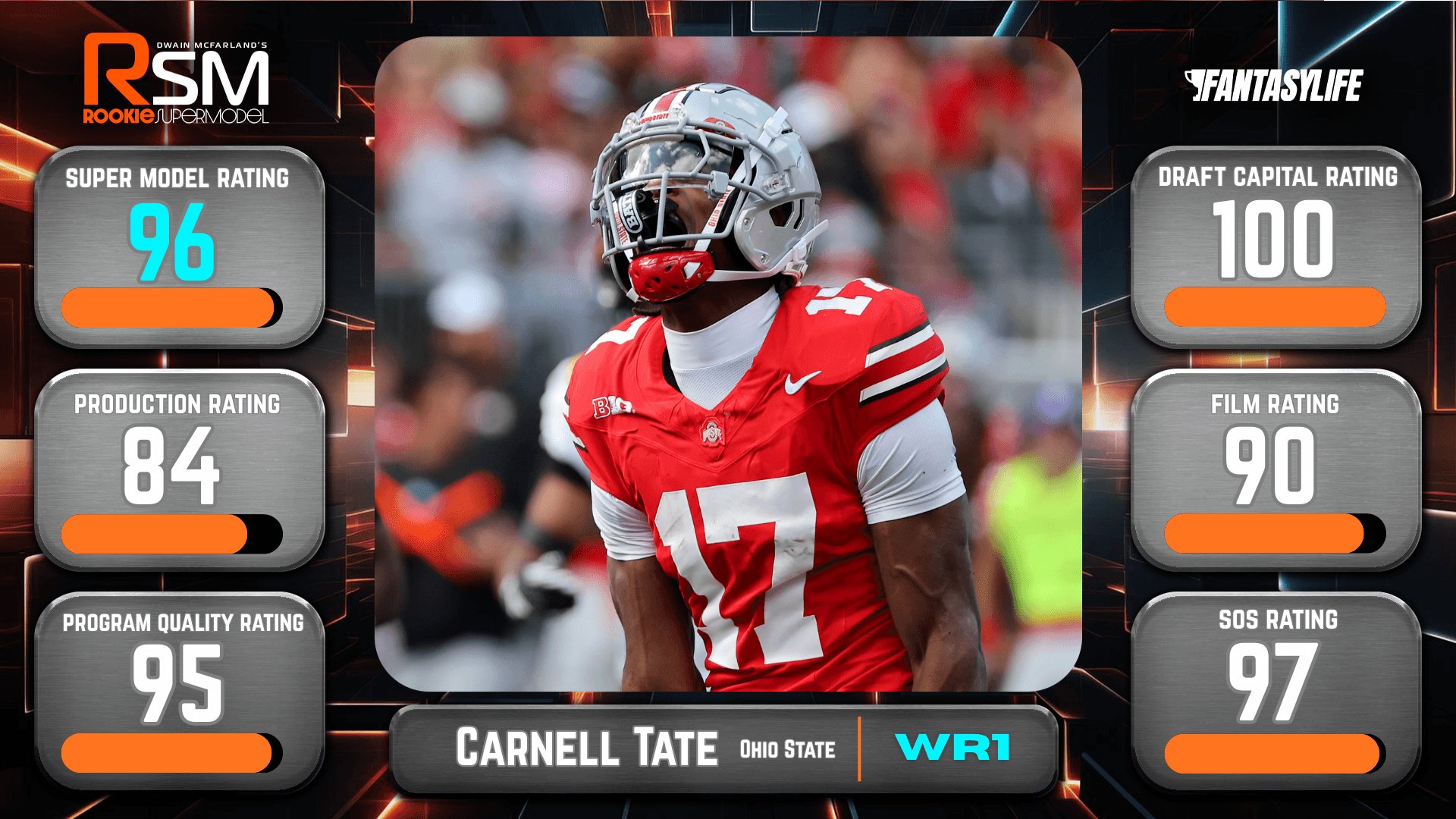
 3. Carnell Tate | WR3 | Titans
- Rookie Super Model Rating: 95.7 (5th All-Time)
- NFL Draft Pick: 4
- 2026 Outlook: Borderline WR3
- Multi-Year Outlook: Mid-Range to High-End WR2
Tate had to compete with high-end target competition, playing alongside Jeremiah Smith, Marvin Harrison Jr. and Emeka Egbuka at Ohio State. Despite that, he contributed early in his collegiate career, and his RYPTPA marks were still near or above the average for Round 1 WRs each year.
- Year 1: 0.79 (Round 1 WR average: 0.91)
- Year 2: 1.70 (Round 1 WR average: 1.98)
- Year 3: 2.74 (Round 1 WR average: 2.54)
The 21-year-old posted a +0.56 RYPTA over expected for his career, after adjusting for his teammates, which is strong but slightly below several past-year Buckeyes who played in loaded WR rooms.
- Marvin Harrison Jr: +1.02
- Jaxon Smith-Njigba: +0.81
- Garrett Wilson: +0.92
- Chris Olave: +0.72
- Emeka Egbuka: +0.46
Tate is a good WR, but the lack of high-end prospects at other positions in the 2026 draft very likely inflated his draft position. As the No. 4 pick, that gives him a 100 Draft Capital Rating, tying with Harrison Jr. as the highest WR taken since 2018. Given that Draft Capital is the model's No. 1 input, it is a big deal.
While this might all feel like a negative write-up for Tate, that isn't my intent. He is a strong prospect; the Rookie Super Model just views him as a mid-Round 1 pick, not a top-four selection. Tate could still go on to have a great NFL career, and we can't rule out him becoming a high-end target earner. While his 16% career target share (38th percentile) and 22% best target share season (44th percentile) leave us with questions, he will likely never play in an NFL offense as loaded as what he faced at Ohio State.
Tate is a contested catch maestro, securing 69% of contested targets—far above the prospect average of 46%. He can unlock the intermediate and deep areas of the field, potentially leading to significant touchdown upside. His 130.6 career QB rating when targeted comes in at the 79th percentile—he was highly impactful when given opportunities.
In Tennessee, I expect Tate to step into a full-time role immediately and could lead the team in yards and touchdowns as a rookie. He will compete with Wan'Dale Robinson and Calvin Ridley for the attention of Year 2 QB Cam Ward. Ultimately, Tate will need Ward to take a step forward to unlock a significant ceiling in fantasy football.
Bottom Line: Tate is my No. 2 WR in rookie ranks and No. 3 player overall. Matthew Freedman aligns with the Rookie Super Model with Tate as his WR1. He profiles as a mid-range to low-end WR2 long-term. In 2026, Tate projects as a borderline WR3.
Tier 3: Mid-Range WR3s With WR2 Upside For Dynasty Leagues
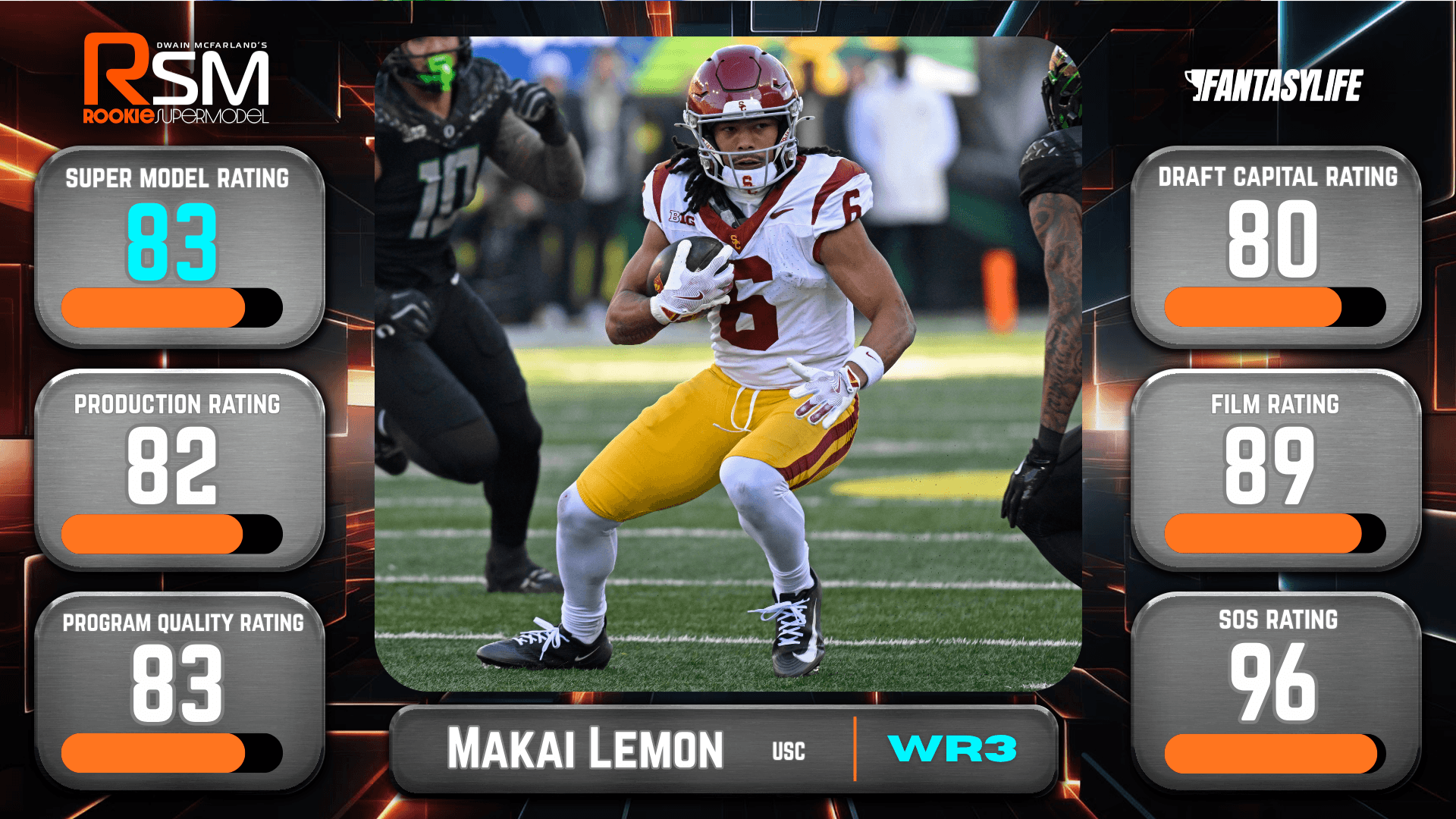
 4. Makai Lemon | WR3 | Eagles
- Rookie Super Model Rating: 83.3 (25th All Time)
- NFL Draft Pick: 20
- 2026 Outlook: Mid-Range WR4
- Multi-Year Outlook: Mid-Range WR3 with WR2 Upside
Lemon is a five-star recruit who delivered his best season in Year 3 after Zachariah Branch left for Georgia. He was slightly below average for a Round 1 NFL Draft pick in his first two seasons.
- Year 1: 0.42 (Round 1 WR average: 0.91)
- Year 2: 1.56 (Round 1 WR average: 1.98)
- Year 3: 2.74 (Round 1 WR average: 2.54)
When you put all of the normalization factors into play, Lemon's Adjusted Career RYPTPA comes in at the 55th percentile. That is slightly below the average of the 62nd percentile for Round 1 picks since 2018.
Still, he flashed significant target-earning ability with a 29% share in his best season and is a sure-handed option (2.2% drop rate) who can add value after the catch. Lemon averaged 6.8 yards after the catch (YAC), +1.4 yards over expected after adjusting for his 10.1 average depth of target (aDOT).
Since 2018, there have been 28 prospects with a Rookie Super Model Rating between 78 and 88. Of that cohort, 57% delivered a WR3 fantasy season by Year 3.
- Top-six: 14%
- Top-12: 21%
- Top-24: 50%
- Top-36: 57%
This data is what pushes Lemon a tier below Tyson and Tate. To unlock his full potential, he must avoid playing in a slot-only role. He has sneaky deep speed, garnering 23% of his targets 20-plus yards downfield—more than Tyson or Tate.
As a Round 1 pick, I am assuming the Eagles have a plan for Lemon and view him as a player who can play on the outside as a Z option, regularly working the underneath and intermediate ranges of the field with deep shots sprinkled in. This also assumes that A.J. Brown gets traded.
Bottom Line: Lemon is my No. 3 WR in the rookie ranks and projects as a mid-range WR3 with WR2 upside long-term. In 2026, Lemon projects is a mid-range WR4 with upside.
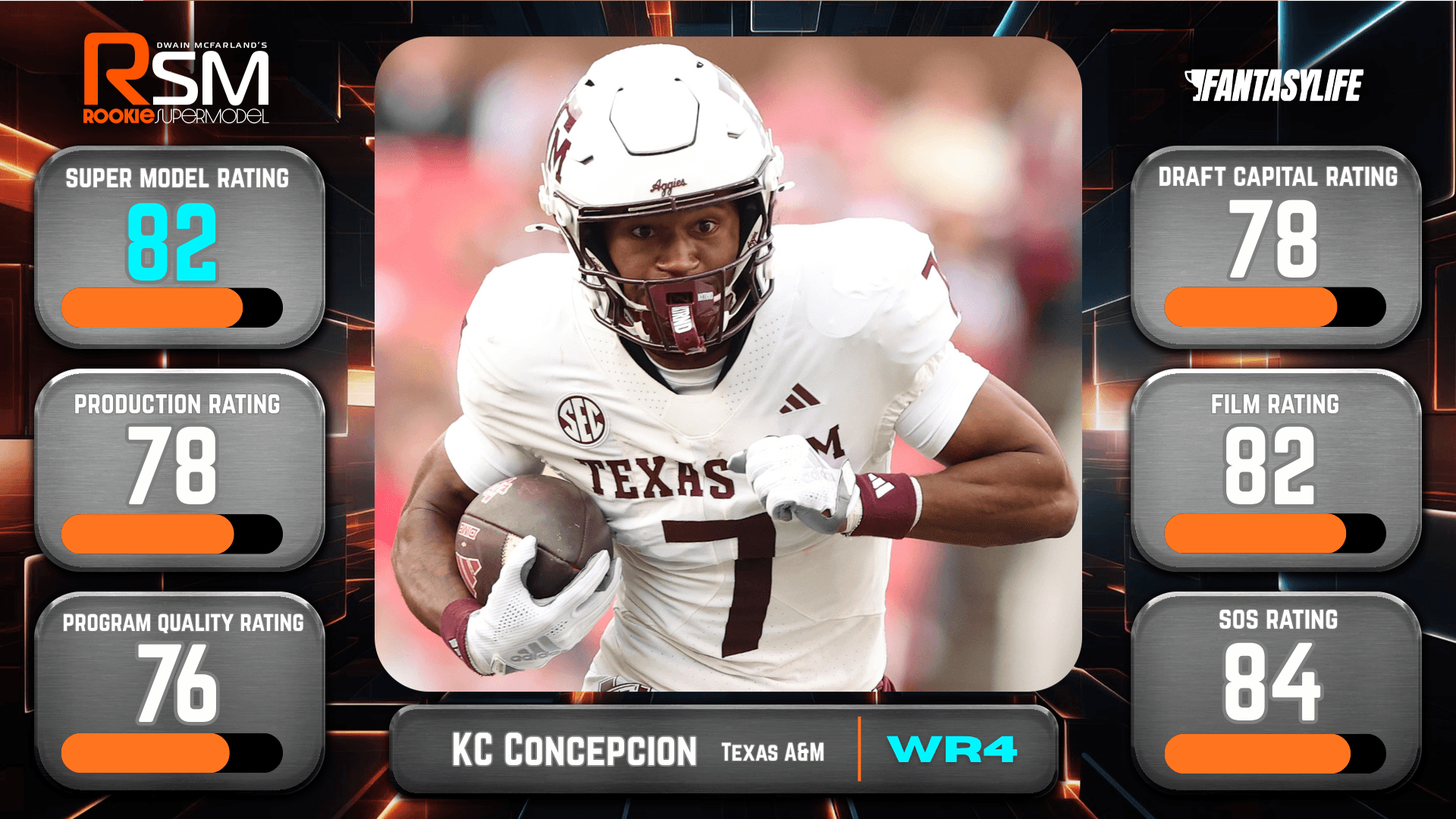
 5. KC Concepcion | WR4 | Browns
- Rookie Super Model Rating: 82.1 (32nd All-Time)
- NFL Draft Pick: 24
- 2026 Outlook: Low-End WR4
- Multi-Year Outlook: Mid-Range WR3 with WR2 Upside
Concepcion boomed as a three-star prospect in Year 1 before regressing in Year 2 at NC State, battling injuries and an unimaginative scheme. So, he transferred to Texas A&M, where he blossomed into a much more versatile player, and his RYPTPA rebounded.
- Year 1: 2.22 (Round 1 WR average 0.91)
- Year 2: 1.26 (Round 1 WR average 1.98)
- Year 3: 2.24 (Round 1 WR average 2.54)
At TAMU, Concepcion's aDOT jumped from 6.9 to 12.2, and his number of snaps playing wide climbed from 15% to 65%. In that final season, 21% of his targets came 20-plus yards downfield. The 22-year-old also demonstrated strong target-earning ability with a 27% career target share (27th percentile).
If the Browns view Concepcion as a player who can play the role he did at TAMU, there is a lot to like about his profile. Honestly, I was torn between him and Lemon for the WR3 in my ranks and could see myself flipping them at some point. But that is the beauty of tiers—both players offer a similar range of outcomes.
Ultimately, I leaned into Lemon over Concepcion because QB is a massive question mark for the Browns with Deshaun Watson and Shedeur Sanders battling for the starting role in 2026. Theoretically, the Browns could secure their QB of the future next year in the draft, but there are no guarantees, so I leaned toward the more stable offense, despite the Eagles' recent struggles. I think both players have similar target competition with DeVonta Smith and Harold Fannin. Both players can add value in the run and return game, although Concepcion profiles better in that aspect.
Bottom Line: Concepcion is my WR4 in the rookie ranks, but I wouldn't argue with anyone (like Freedman) for having him as the WR3 in the class. He profiles as a mid-range WR3 with WR2 upside long-term and projects as a low-end WR4 for 2026.
Tier 4: A Tight End Enters The Picture
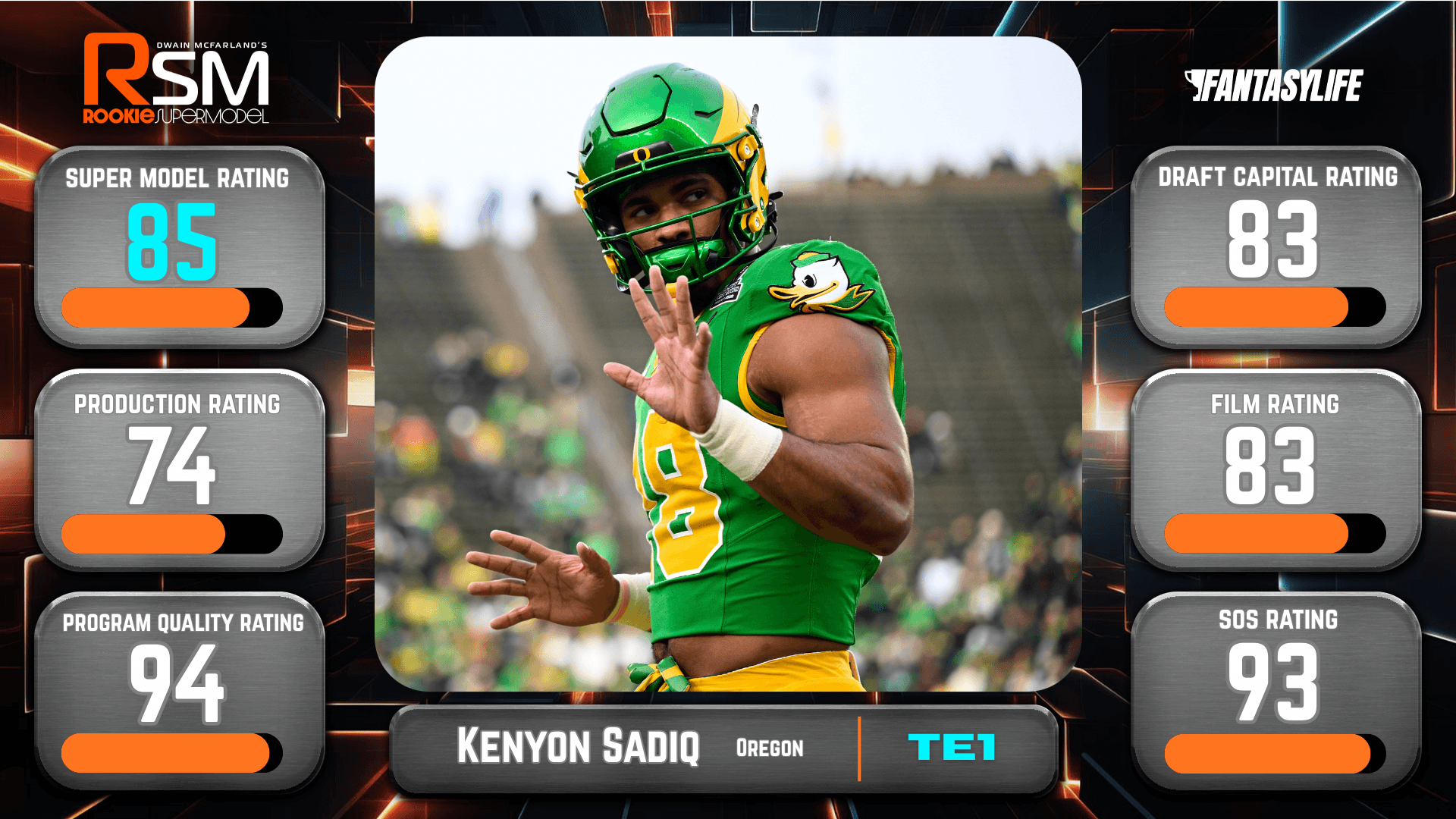
 6. Kenyon Sadiq | TE1 | Jets
- Rookie Super Model Rating: 84.9 (5th All-Time)
- NFL Draft Pick: 16
- 2026 Outlook: High-End TE2 with Upside
- Multi-Year Outlook: Low-End TE1 with High-End TE1 Upside
Sadiq never became the focal point of the Oregon offense, which is a red flag. Historically, top-16 picks had an 82 Production Rating. However, Sadiq was viewed as a consensus mid-Round 1 talent on big boards, and the Jets took the plunge.
He is a pure, unadulterated bet on athletic traits. The 21-year-old ran a 4.39 40-second 40-yard dash at 241 pounds. His 129.8 speed score ranks No. 1 all-time. The question is whether the Jets can unlock untapped target-earning potential. Sadiq's 9% career target share falls in the 25th percentile for prospects since 2018.
When given his opportunities, Sadiq's athleticism showed up in the data with a 137.9 career QB rating when targeted (89th percentile). His 6.6 YAC was +1.1 yards over expected after adjusting for his 6.2 average depth of target.
Some have concerns that Sadiq's size and blocking prowess will limit his playing time. That could certainly happen, but Brock Bowers and Harold Fannin Jr. were similar in size and career PFF Run Blocking grade.
Since 2018, 10 TEs have had a Rookie Super Model Rating between 75 and 95, with 60% achieving top-9 status by Year 3. They averaged 9.0 fantasy points over their first three seasons.
- Top-three: 30%
- Top-six: 30%
- Top-nine: 60%
- Top-12: 70%
The Jets spent a Round 2 pick last season on Mason Taylor, so there is some risk of a rotation, and the team also added Omar Cooper Jr. to play alongside Garrett Wilson. The Jets also have QB questions with Geno Smith as the starter for 2026. However, they have three first-rounders next season, which gives them the ammunition to make a move for their future franchise QB in the draft.
Bottom Line: Sadiq is my TE1 in rookie ranks and ranks as my No. 6 player overall—in line with Freedman. Sadiq is a boom-bust profile, but profiles as a mid-range TE1 with high-end upside in dynasty. For 2026, he projects as a high-end TE2 with upside.
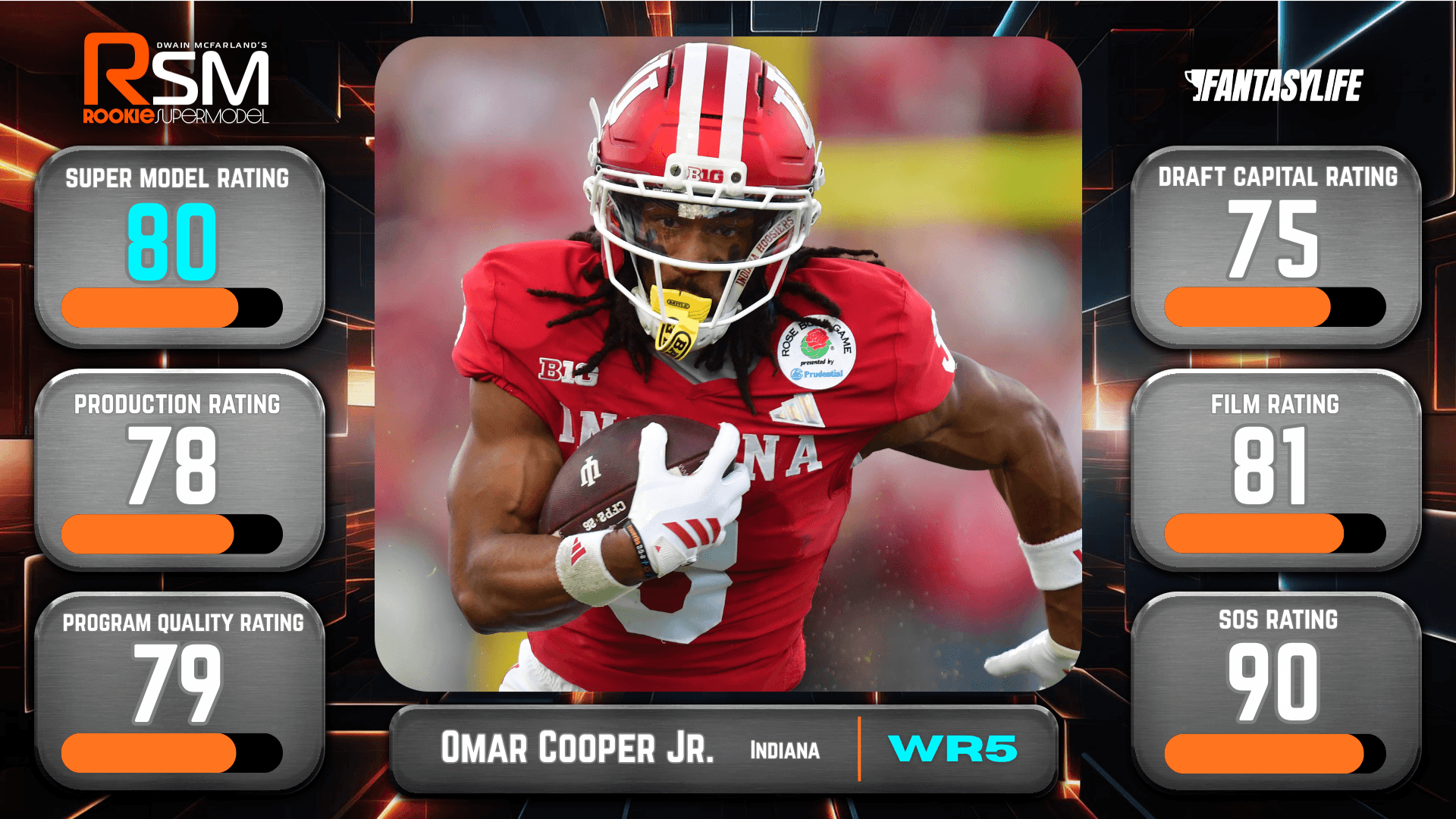
7. Omar Cooper Jr. | WR5 | Jets
- Rookie Super Model Rating: 79.6 (45th All-Time)
- NFL Draft Pick: 30
- 2026 Outlook: Borderline WR4
- Multi-Year Outlook: Low-End WR3 with WR2 Upside
Cooper erupted in his final season with a 2.43 RYPTPA after moving to the slot. However, the Rookie Super Model views Cooper as more of a Round 2 NFL Draft prospect. Each year of his career, he underperformed versus the average for Round 1 picks:
- Year 1: 0.00 (reshirt; Round 1 WR average: 0.91)
- Year 2: 0.99 (Round 1 WR average: 1.98)
- Year 3: 1.64 (Round 1 WR average: 2.74)
- Year 4: 2.43 (Round 1 WR average: 2.54)
With that said, Cooper did notch a 2.00 yards per route run (YPRR) all three seasons, including two playing primarily from the outside. Theoretically, that gives him schematic versatility, but he was at his best in the slot, where he could thrive as a plus YAC player. His career 6.6 YAC was +1.1 yards over expected after adjusting for his 12.5 aDOT.
The 22-year-old was a below-average target earner with a 17% share for his career (42nd percentile), but posted a 24% share in his best season in Year 4 (49th percentile). However, he made the most of his opportunities with a 130.7 QB rating when targeted (79th percentile).
Since 2018, 47 WR prospects have notched a Rookie Super Model between 75 and 85, with 47% securing a top-36 finish by Year 3. The cohort averaged 8.9 fantasy points over their first three years.
- Top-six: 4%
- Top-12: 11%
- Top-24: 34%
- Top-36: 47%
With the Jets, Cooper faces stiff target competition from Garrett Wilson, and the addition of Sadiq could further muddy the waters. Geno Smith has supported multiple fantasy weapons in the past but struggled in 2026, leaving considerable questions about the upside of this passing attack. Still, the Jets have three Round 1 picks in 2027, which could enable them to secure their long-term answer.
I expect Cooper to take over the WR2 role from Adonai Mitchell as a rookie, but the overall quality of the offense could limit his upside—especially in the TD department.
Bottom Line: Cooper is my WR5 in the rookie ranks, a view shared by Freedman. Long-term, he profiles as a low-end WR3 with WR2 upside. In 2026, he projects as a high-end WR5.
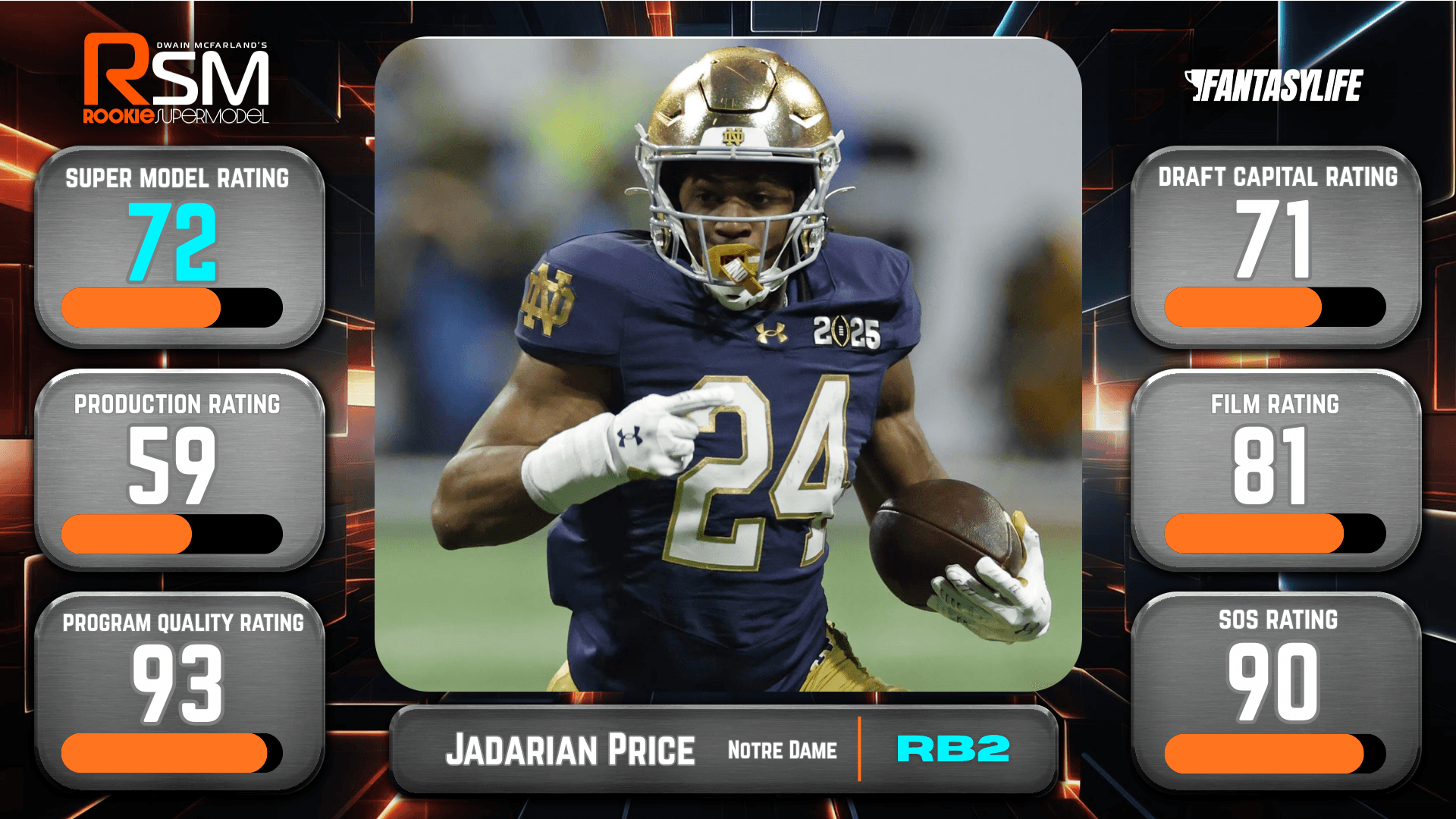
 8. Jadarian Price | RB | Seahawks
- Rookie Super Model Rating: 72.4 (45th All-Time)
- NFL Draft Pick: 32
- 2026 Outlook: Low-End RB2 until Zach Charbonnet returns
- Multi-Year Outlook: Low-End RB3 with RB2 Upside
Price shared the backfield with Love at Notre Dame, which severely limited his opportunities. However, he was a productive runner, posting solid underlying data points:
- Missed Tackles Forced: 25% (52nd percentile)
- Average Yards After Contact: 4.65 (76th percentile)
- 10-plus Yard Attempts: 19.2% (67th percentile)
Much of the scouting community praised Price as a potential plus early-down runner with natural vision, which aligns with his rushing data. The challenge with Price for fantasy purposes is his lackluster receiving profile.
- Targets Per Route Run: 9% (11th percentile)
- Yards Per Route Run: 0.80 (20th percentile)
His best RYPTPA season of 0.27 falls in the 27th percentile, and he struggled to handle blocking duties with a career PFF Pass Block Grade of 38.5 (30th percentile). That combination makes it hard to project him as a player who will become a significant part of a passing attack.
When you put it all together, Price is the most overrated Round 1 RB draft pick since 2017, according to the model. His draft pick ranks 14th, and his Rookie Super Model rating ranks 45th—a delta of 31. The two closest players: Clyde Edwards-Helaire (-11) and Sony Michel (-10).
Still, he should get his opportunities given that the Seahawks have a need with Charbonnet recovering from an ACL injury and Kenneth Walker gone. This draft capital suggests he will have an immediate role, which could provide value early in the 2026 season, but long-term, there are questions with his profile.
Since 2017, 67 RBs have posted a Super Model Rating between 67 and 77, averaging 8.1 points per game. Within that cohort, 49% have become top-36 RBs by Year 3.
- Top-six: 4%
- Top-12: 10%
- Top-24: 31%
- Top-36: 49%
Bottom Line: Price is the RB2 in my rookie ranks behind Love, but there is a considerable difference in my overall ranking and Freedman's. Freedman has Price as his No. 4 rookie, while I have him at No. 8 due to concerns about his receiving profile. I lean towards the Rookie Super Model, which sees price as a low-end RB3 in the long term. In 2026, Price projects as a borderline RB3, but could provide RB2 value until Charbonnet returns.
 9. Fernando Mendoza | QB1 | Raiders
- NFL Draft Pick: 1
- 2026 Outlook: Low-End QB2
- Multi-Year Outlook: Mid-Range QB2 with Low-End QB1 Upside
Mendoza was a prolific passer over his final two seasons. He averaged 273 yards in 2024 at Cal with 16 TDs. His yardage dropped 221 per game (9.3 yards per attempt) in his Championship season at Indiana, but he tossed 41 TDs.
He is a cerebral passer with good accuracy—his 68.1% completion rate was +7.1 over expected after adjusting for his 9.0 aDOT—which could lead to fantasy spike seasons if the Raiders can add more weapons beyond Brock Bowers.
The 22-year-old isn't a great runner, but he posted respectable numbers, rushing for 30.4 and 23.4 yards per game over his final two campaigns. He likely won't be part of the designed run-game plan, but he is willing to scramble (6.8% for his career).
Bottom Line: Mendoza is the No. 9 player in my rookie rankings and the No. 2 option in Superflex behind Love. To unlock his ceiling, the Raiders must add more high-quality weapons. For 2026, I have Mendoza projected as a low-end QB2 who might not start immediately.
Join Our Newsletter
Trusted by 400,000+ fantasy football players. Get access to Fantasy Life's free award winning newsletter and tools, all in one step.
By registering or logging in, you agree to our Terms of Use and Privacy Policy.