
Fantasy Football Takeaways From Week 6: Germie Bernard Leads Utilization Report
Welcome to the Utilization Report, where Dwain McFarland highlights his top fantasy football takeaways heading into Week 7.
Welcome to the Utilization Report, presented by Tenex.ai, where Dwain McFarland highlights his top fantasy football takeaways heading into Week 7.
The Top Fantasy Football Takeaways From Week 6
Let's follow the data to identify the top waiver wire options, trade targets, upgrades, and downgrades based on what we learned in Week 6.
If you love the sweet Utilization data below, you can access it all for yourself!
- Comparison tool
- Team-based views with game logs
- League-wide views for NFL leaders
- Customizable time periods and sample sizes
- Seasons: 2020 to 2026
Use the Utilization Report suite of tools to dominate your league, y'all!
 1. Germie Bernard flashes WR1 upside against Tampa Bay
Bernard was the priority waiver wire add last week in the Utilization Report, and he didn't disappoint in a tough matchup against the Buccaneers. The Round 2 NFL pick scored 25.7 points with an 83 Utilization Score.
Most importantly, we now have two games with Bernard in a full-time role. In those two contests, Bernard has a 28% target share, averaging 10 looks per game. That has fueled 20.1 PPG with an 86 Utilization Score.
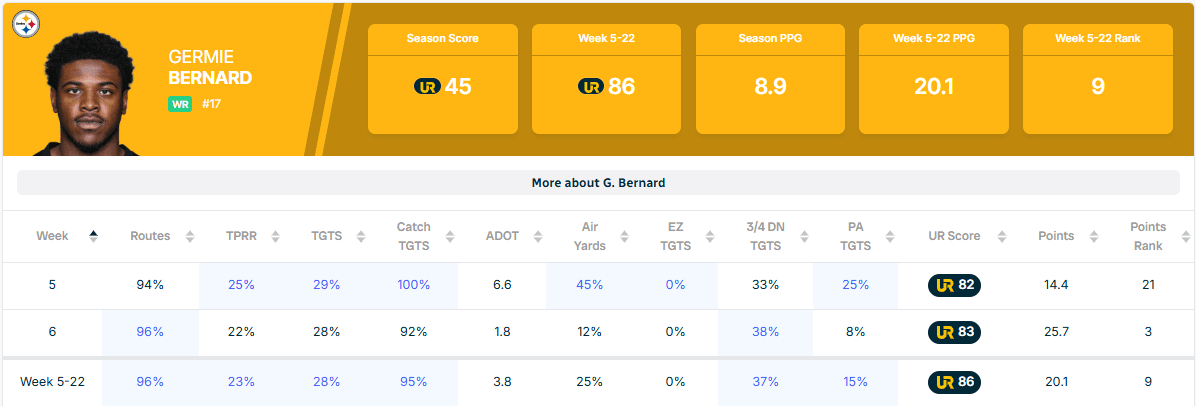
 Nerd Note: Bernard's Utilization Score over the last two games is higher than his weekly scores because the season and multi-game samples compare to historical seasons rather than weekly. The Utilization Score scale is higher on a one-week sample because it compares performance to every WR's weekly performance since 2020, where the tail end of outcomes is more spread out. The season-long view pushes his score up because the ranges tighten over a larger sample.
If there is a nitpick with Bernard, it is his low aDOT (3.8). His average route depth of 6.0 yards ranks 83rd out of 85 WRs with at least 100 routes this year. That is in the same range as names like Khalil Shakir (5.1), Deebo Samuel (5.4), Kendrick Bourne (6.6), and Makai Lemon (7.0).
But unlike those players, Bernard is in a full-time role, and Aaron Rodgers is peppering him with opportunities. While the underneath looks have historically made it hard to sustain high-end outcomes, Bernard is averaging 9.5 catchable targets in two starts—that goes a long way in PPR formats.
Bernard is averaging 5.1 yards after the catch, which is slightly below the average for his historical aDOT comps (6.0). Still, his ability with the ball in his hands matches his rookie scouting profile. And the Steelers are designing plays to protect and amplify the skillset of their new playmaker:
- Slot: 50%
- Screens: 19% of targets (9th out of WRs with at least 100 routes)
- Motion at snap: 16% (24th)
He can play inside or outside and handle more intermediate work. That makes him a strong bet to keep the starting role even after Michael Pittman Jr. (IR at least two more games) and Roman Wilson (IR at least three more games) return.
Pittman is a possession WR with similar route depth (6.9) this season. Bernard is simply the better option to feed opportunities because of his superior ability after the catch. Plus, Bernard is a second-round pick, and the Steelers can get out of Pittman's contract next season. Depending on timing, they could save $10-$19M in cap space.
Wilson also plays slot, but is best as a vertical threat. He is more of a rotational player, as we saw when he was healthy. Wilson's routes spiked in Week 2 with Pittman out at 91% but fell to 51% and 40% in Weeks 3-4.
Of course, we can never assume rational coaching. Bernard could return to a part-time role when Pittman and Wilson are healthy. But we want to lean into young talents flashing upside early in their career.
From 2015 to 2025, Round 2 WRs improved their fantasy PPG by 30% from Weeks 1-7 vs. Weeks 8-18. And they improved their snap shares by 22%.
In a nutshell: We want to bet the Steelers won't put this genie back in the bottle.
Using the Utilization Score (86) in a small sample can be dangerous. So let's look at two scenarios for Bernard's range of outcomes.
Scenario 1: Bernard remains in a full-time role, and his 2-week sample is accurate
In this runout, we would have an absolute fantasy stud on our hands. Since 2020, Bernard's historical comps averaged 17.9 PPG, with 97% reaching top-12 WR status.
- WR1-6 seasons: 54% (ceiling outcome)
- WR7-12: 43% (ceiling outcome)
- WR13-18: 4% (floor outcome)
I love Bernard, but even I am not this high on him. But it does paint a picture of how things could turn out if he is a stud.
Scenario 2: Bernard remains in a full-time role, and his 2-week sample is inflated
For this scenario, we will take a more sober-minded view of Bernard's outlook. To do this, I compared him to similar high-end target earners with low aDOTs who also weighed 200+ pounds: JuJu Smith-Schuster (2020), Robert Woods (2020), Deebo Samuel (2022-2023), Rashee Rice (2025).
That cohort had an average Utilization Score of 76. They averaged 14.5 PPG, with the majority (59%) posting WR2 seasons.
- WR7-12: 12% (outlier ceiling outcome → sell at this price)
- WR13-18: 29% (ceiling outcome → sell)
- WR19-24: 29% (median outcome → hold)
- WR25-30: 24% (floor outcome → hold/buy)
- WR31-36: 4% (outlier floor outcome → buy)
- WR37+: 2% (outlier floor outcome)
This better reflects Bernard's range of outcomes, assuming he retains the starting role.
The Steelers have the 10th-best schedule for WRs over the next five weeks.

The Eagles matchup is even better than the data above shows. They provide the No. 2 boost to slot WRs (+3.9 PPG).
They have the seventh-best WR schedule during the fantasy playoffs.

Bottom Line: Bernard UPGRADES to high-end WR3 status, leaving some room for me being wrong about holding onto a full-time role when Pittman and Wilson return. He offers realistic mid-range WR2 potential.
Bernard is still available in 50% of Yahoo leagues and is a MUST ADD if he is hanging out on the wire in your league.
 2. Carnell Tate is going to be a superstar
Tate was a buy-low after a down game against the Texans, then boomed against the Titans with 19 points in Week 6. The Utilization Score is really coming into its own on the buy-low, sell-high front, backed by six years of historical data.
Tate now owns a 27% target share (13th) and a 48% air-yards share (4th) over his first six contests as a pro. Over the last five games, he has reached a 25%-plus target share four times.
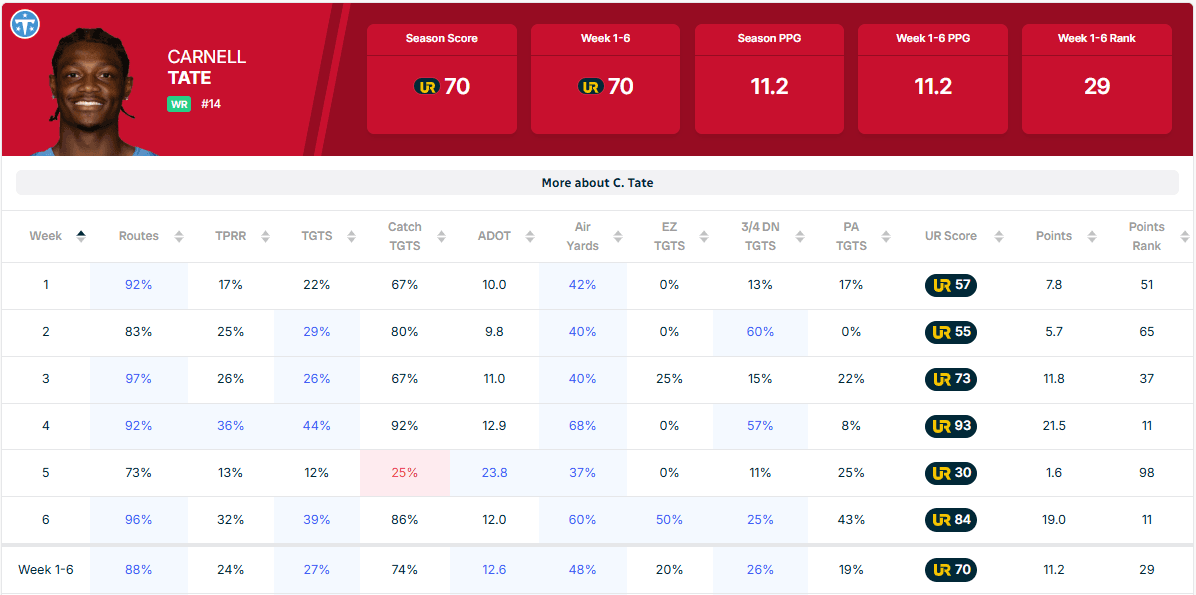
Tate is averaging 1.98 yards per route run (YPRR). That ranks 24th among WRs with at least 100 routes in 2026 and is an ELITE mark, considering Cam Ward averages 166 YPG, which ranks 30th among 32 QBs with at least 100 dropbacks.
And Tate is playing a diverse role rather than getting glued to the boundary as a vertical threat, as we saw at Ohio State in a loaded program. Tate's average route depth (9.2) is in the sweet spot for boom production, and he is playing from the slot on 27% of snaps. Only 15% of his routes have been go routes. His route distribution is very encouraging. He is running in-breaking routes 40% of the time:
- Crossing Routes: 5%
- Slant Routes: 14%
- In Routes: 14%
- Post Routes: 7%
The No. 4 overall pick will be a fantasy juggernaut at some point. The question is whether he can do that in 2026 in a terrible offense. The Titans are tied for 31st in scoring (14 PPG) and rank 32nd in regulation plays per game (53), thanks to the NFL's worst time of possession (24.12 minutes per game).
To put it into perspective: The Bears are on pace to run 340 more plays than the Titans. That is the equivalent of playing 5.7 fewer games than Chicago. Tennessee is on pace to run 111 fewer plays than the NFL average—the equivalent of a 1.8-game disadvantage.
While Tate's share data is fantastic, the Titans offense is weighing him down.
- Targets per game: 7.2 (28th)
- Catchable targets per game: 5.3 (26th)
- Air yards per game: 90.3 (23rd)
- Catchable air yards per game: 49.5 (28th)
But his Utilization Score (70) accounts for all of these factors. His historical comps have averaged 13.8 PPG—well above his 11.2 for the season. And the median outcome was a WR2 season:
- WR1-12: 5% (outlier ceiling outcome → sell)
- WR13-24: 46% (median outcome → hold but selling at a mid-range to high-end WR2 price)
- WR25-36: 25% (median/floor outcome → hold/buy)
- WR37-48: 15% (floor outcome → buy)
To put a well-known face to the floor outcome, think Drake London as a rookie. That season, London had a 22% target share with a 2.07 YPRR on a team that averaged 159 passing YPG. He finished as the WR42 with 10.9 PPG.
I love Tate's talent, but am slightly less bullish than the Utilization Score and am willing to upgrade him slowly, one step at a time.
Tate UPGRADES to high-end WR3 territory and offers WR2 potential the rest of the way—especially if the Titans offense can improve even modestly. He is a BUY candidate in dynasty.
 3. Bhayshul Tuten: The fantasy-points dam finally breaks
Tuten posted a season-high 24.7 points in Week 6 after a month-long build-up thanks to his efficiency and growing role.
But of course, nothing is ever clear-cut in fantasy football. Tuten's Utilization reversed course, hitting his lowest rush share (52%) of the 2026 campaign. The fantasy gods are really laughing at us.
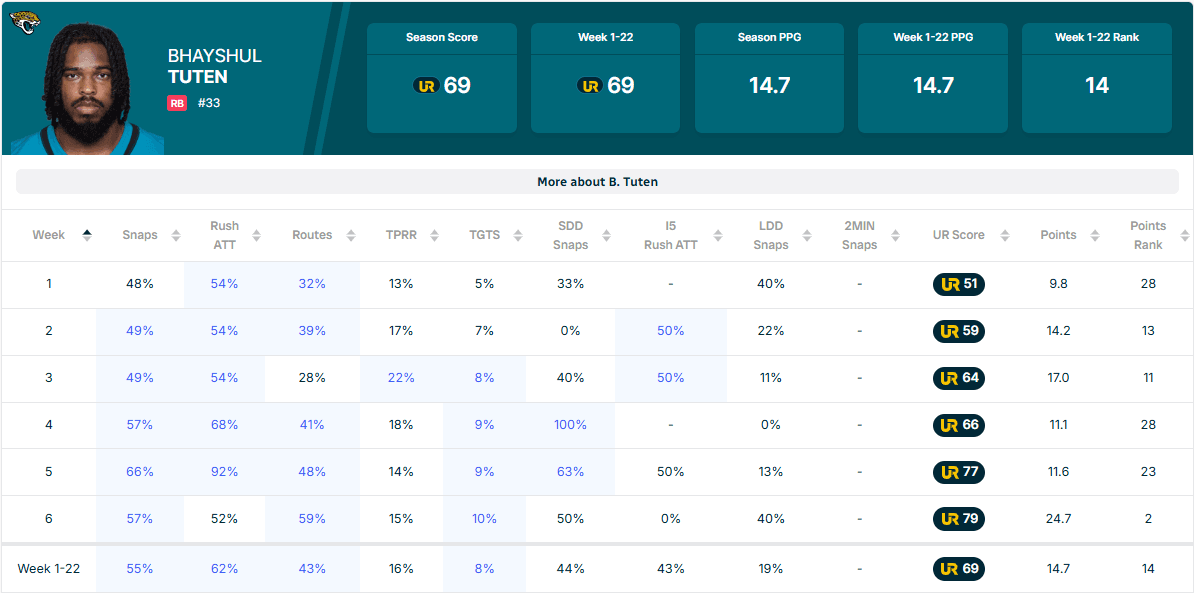
On a positive note, Tuten garnered his highest route share of the year (59%). His 10% target share was also his highest mark, and they are up over the last four games. While his two receiving TDs aren't sustainable on a 10% target share, some cool scheme things are happening in his favor.
In Week 6, they moved him around the formation and ran several alignments/route combinations designed to get him the ball in space—one of which led to a TD. Tuten was open for another receiving TD on a flat route inside the 10, but Trevor Lawrence went to the back of the end zone (Jakobi Meyers) and was intercepted.
Tuten also had his third rushing TD of the season called back—and this one was a ticky-tack call. The big takeaway: we see holding on nearly every play in the NFL. It just comes down to what is seen/called by the refs. Tuten is due to have some of these calls not go against him.
The Year 2 RB's efficiency has fallen over the last few games. He now ranks 15th out of 33 RBs with at least 50 attempts in yards per carry (YPC) at 4.1. But his underlying data remains strong.
- 10+ yard attempts: 11.7% (9th)
- Average yards after contact: 3.62 (6th)
- Missed tackles forced: 26.6% (5th)
Over the last four contests, Tuten has a 75 Utilization Score, averaging 16.1 PPG. Given his shifting role, I think this is a good sample to recalibrate with. It captures the highs but also doesn't ignore the issues in Week 3 (49% snap share) and Week 6 (52% rush share):
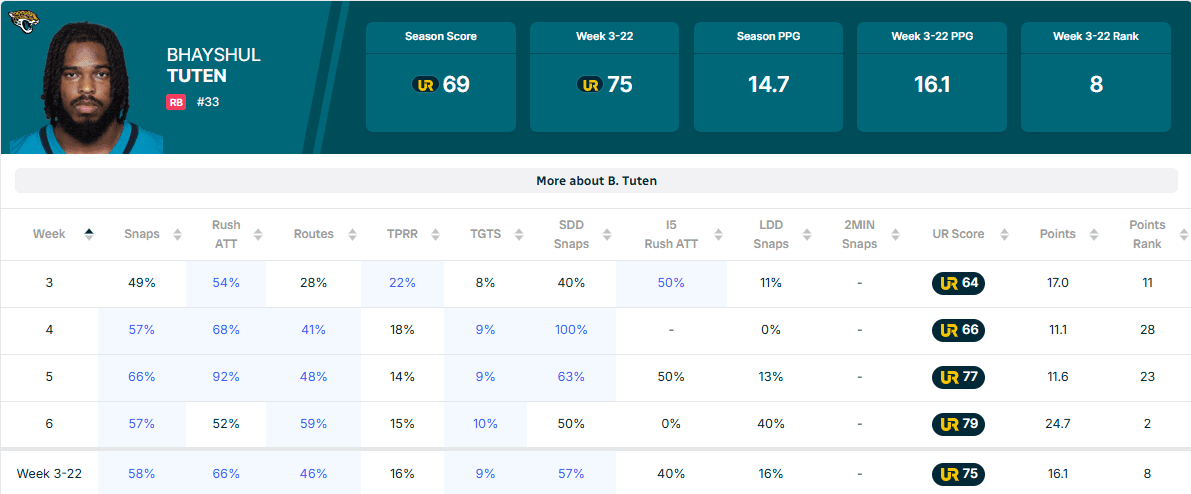
His historical comparisons averaged 14.4 PPG, with 29% reaching RB1 territory.
- RB1-6: 8% (outlier ceiling outcome → sell)
- RB7-12: 21% (ceiling outcome → sell/hold)
- RB13-18: 26% (median outcome → hold)
- RB19-24: 34% (low-end median outcome → hold/buy)
- RB25-30: 11% (buy)
Tuten UPGRADES to mid-range RB2 status and offers decent RB1 upside.
 4. Omar Cooper Jr. is a HIGH-PRIORITY waiver wire target
Cooper returned from IR in Week 6 and compiled 22.3 fantasy points with an 84 Utilization Score in his first NFL start. The Round 1 NFL pick led the team with a 24% target share on an 85% route participation rate, with Garrett Wilson dealing with Christian Gonzalez and Adonai Mitchell (finger) missing another game.
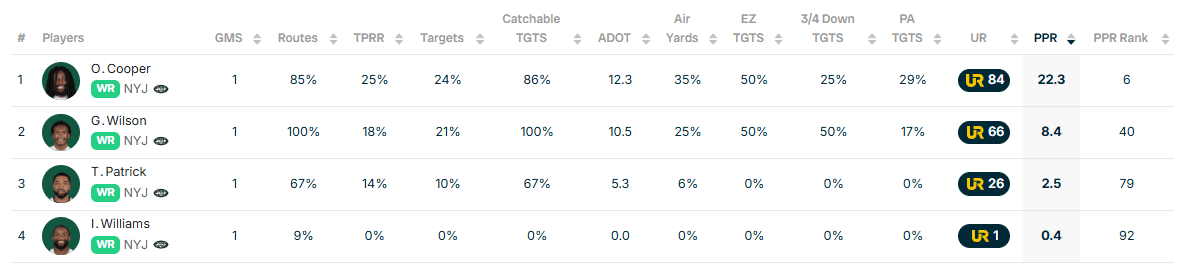
The rookie WR had another TD wiped out by an offensive pass interference against Tim Patrick that didn't affect the play. He finished the day with an endzone target and a red-zone target.
Cooper operated from the slot on 25% of snaps and was in motion on 18% of plays. His 8.1 average route depth was in the sweet spot, and juicy 29% of his targets came on play action.
We don't know what this offense will look like when Mitchell returns. We could see Cooper limited to slot-only work. But he played outside in college with a 2.00 YPRR over two seasons before switching to the slot in his final campaign. Cooper could be the WR2 and kick inside when Mitchell—who has a chance to return in Week 7—plays.
Cooper had a 75% route share in 12 personnel—second behind Wilson. So the team knows that he can play to the boundary. He led the team with a 43% target share in 12, catching three balls for 31 yards.
Despite the unknowns, I want to be in on Cooper. The reward outweighs the risk in a Jets offense that has been competent. Geno Smith is averaging 223 YPG (19th), leaving the door open for another viable passing-game asset behind Wilson.
Cooper UPGRADES to high-end WR4 status and offers WR2 upside if he locks down the WR2 role for New York.
He is a MUST-ADD waiver wire target in deep leagues, worthy of a 17.5% to 22.5% FAAB bid. In that range, I think you will win him roughly 50% of the time. So, if you really need WR help, you can go higher.
In smaller leagues, Cooper is a 7.5-12.5% FAAB option and is worthy of the No. 1 claim option if Bernard is gone.
Schedule Notes: No. 14 (+0.3 PPG) over the next five weeks. But things are tough in the playoffs from Weeks 14- 17: No. 30 (-2.4 PPG).
 5. Jalen Coker: Enters mid-range WR2 territory in fantasy
Coker is thriving in Brad Idzik's offense, leading the team with a 31% target share in his three healthy games. The third-year undrafted free agent operates from the slot on 44% of snaps, and a whopping 32% of his targets have come on play action.
Coker is pulling an Adam Thielen—emerging from UDFA status to NFL (and fantasy) stardom. He ranks 9th in YPRR (2.53). And the fantasy points are following. Coker has averaged 21.4 PPG.
We are now five games into the 2026 campaign, and Bryce Young still leads the league in passing YPG (310) and is tied for fourth in passing TDs per contest (2.2).
- Offensive points per game: 29.2 (4th)
- Regulation plays per game: 68.4 (2nd)
- Plays per minute: 2.2 (4th)
- Neutral play clock remaining: 9.56 seconds (10th)
- Play action: 32% (5th)
- Dropback rate over expected (DBOE): 5% (5th)
The Panthers are on pace to dropback to pass 153 times more than the average NFL team. That is the equivalent of playing an additional 4.4 games. Nice.
And we are dealing with a highly concentrated attack: Coker and Tetairoa McMillan have a combined 51% targets per route run (TPRR).
Coker's Utilization Score in three full games is 84. That puts him in similar territory to names like McMillan, Matthew Golden, Garrett Wilson, and Nico Collins. His historical comparisons have averaged 16.8 PPG, with the majority of comps finishing as low-end WR1s (53%).
- WR1-6: 23% (ceiling outcome → sell)
- WR7-12: 53% (median outcome → hold)
- WR13-18: 16% (floor outcome → buy)
- WR19-24: 5% (outlier floor outcome → buy)
- WR25+: 2%
Coker UPGRADES to mid-range WR2 territory and offers a strong chance for a low-end WR1 season. He is a BUY-LOW candidate who is significantly mispriced.
Based on FantasyCalc data, he is valued similarly to DJ Moore, Luther Burden, Jameson Williams, and Terry McLaurin. I would rather have Coker than all of these by a large margin. If you have RB depth, find an RB-needy team and make your move for Coker.
Schedule notes:
- Next five games: -0.7 PPG (22nd)
- Fantasy playoffs W14-17: -1.5 PPG (25th)
 6. Emeka Egbuka: Another rest-of-season rankings bump
I wrote up Egbuka in the Utilization Bytes last week, upgrading him to mid-range WR3 status after a 39% target share. Well, he just did it again. The former Round 1 pick hogged a 40% target share in Week 6 against the Steelers.
Egbuka, who dealt with a toe injury in the preseason, is rounding into form. He has scored 17.2 and 17.8 points with Jalon Daniels under center the last two weeks. Over that span, his Utilization Scores were 83 and 85.
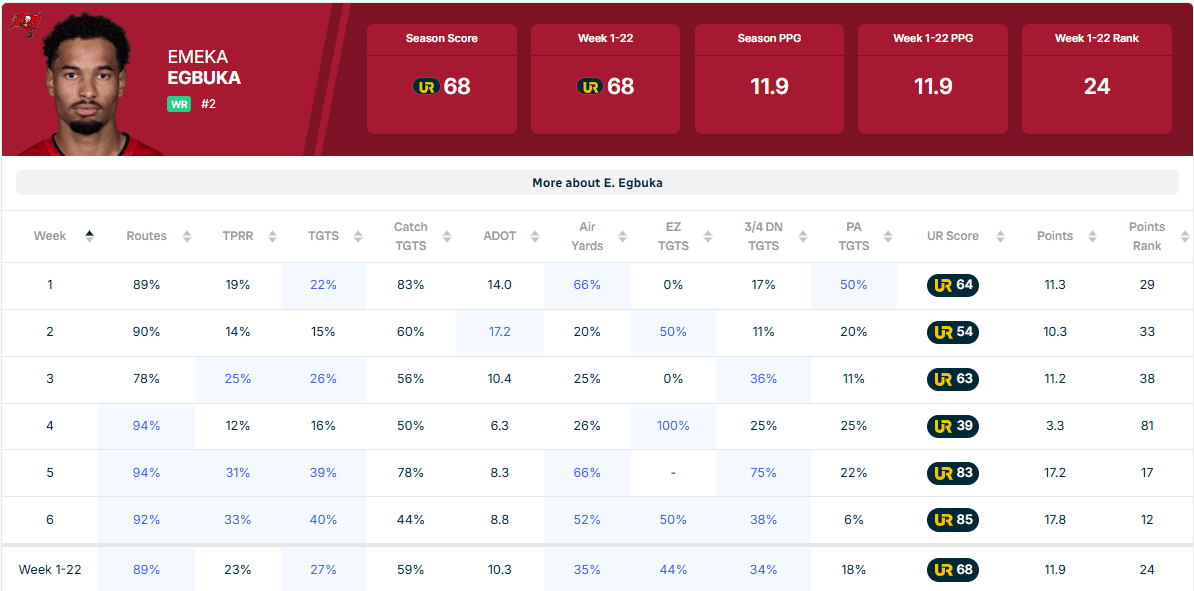
Egbuka's YPRR (1.12) ranks 93rd, but QB play significantly affects that data point. I am leaning into his Utilization Score, which is more predictive. Even if we use his 68 for the season—which probably isn't fair considering the injury—his historical comparisons averaged 13.1 PPG. That is above his 11.9 and would put him in the borderline WR2 range.
Baker Mayfield (thumb) will return to practice this week and should take the field in Week 7 or 8. Given that and the injury, I am willing to lean on Egbuka's score over the last three outings (73). His historical comps averaged 14.4 PPG, and most were WR2s (56%).
- WR7-12: 13% (outlier ceiling outcome → sell)
- WR13-18: 28% (ceiling outcome → hold/sell)
- WR19-24: 29% (median outcome → hold/buy)
- WR25-30: 21% (floor outcome → buy)
- WR31-36: 8% (outlier floor outcome → buy)
- WR36+: 3%
Egbuka UPGRADES to borderline WR2 territory and offers high-end WR2 upside.
Schedule Notes:
- Next five weeks: +1.1 PPG (8th); Bye: Week 10
- Fantasy playoffs: +0.7 PPG (14th)
7. Jaylen Warren: Retains large role with Rico Dowdle back
Warren scored only 9.8 points in a tough RB matchup against Tampa Bay. While his workload dropped compared with the last three games without Dowdle, no RB gets 90% snap share for a full season, so that wasn't realistic.
But Warren enjoyed a workload that historically associates with low-end RB1s to high-end RB2s: 74% share, 63% rush share, 55% route share. And his workload was significantly larger than in Week 1—the last time Dowdle was healthy.
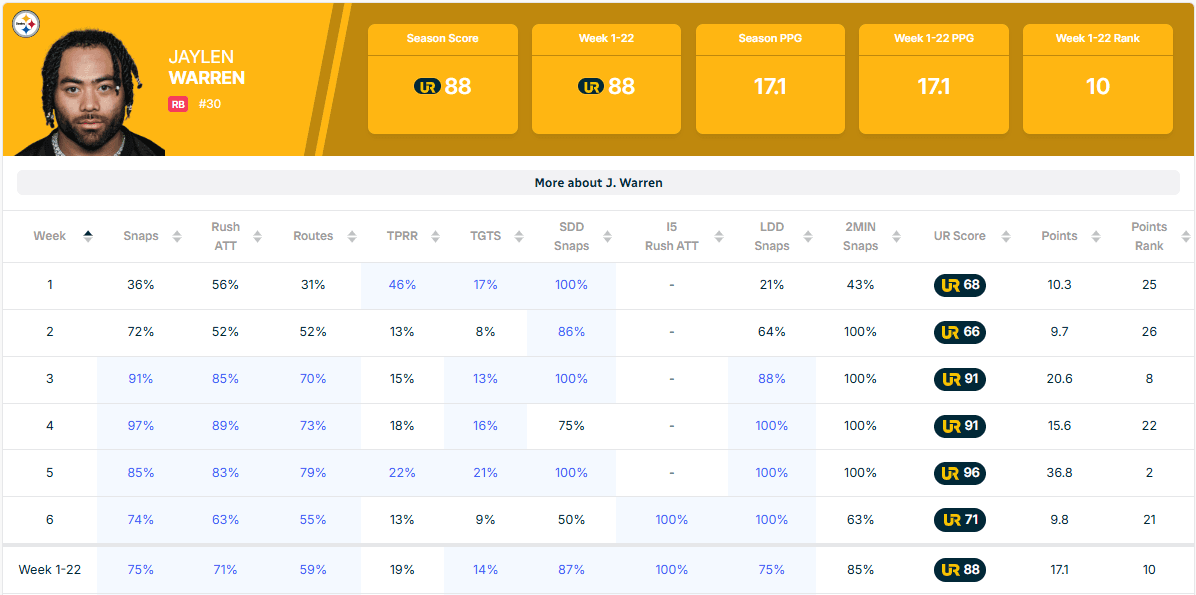
And the opportunities could have been much further apart. The issue with opportunity shares: they can rely heavily on who saw the longer drives. But the per-drive snap share data point to a significant lead for Warren. Essentially, Dowdle took the reins on only two drives. And we had a significant sample thanks to overtime.
Snap shares by drive:
- Drive 1: 100% (3 snaps)
- Drive 2: 100% (1 snap)
- Drive 3: 71% (5 snaps)
- Drive 4: 100% (3 snaps)
- Drive 5: 33% (2 snaps)
- Drive 6: 100% (3 snaps)
- Drive 7: 63% (5 snaps)
- Drive 8: 100% (3 snaps)
- Drive 9: 100% (3 snaps)
- Drive 10: 25% (2 snaps)
- Drive 11: 71% (5 snaps)
- Drive 12: 100% (8 snaps)
- Drive 13: 100% (3 snaps)
- Drive 14: 100% (1 snap)
- Drive 15: 75% (9 snaps)
We could see Dowdle's role grow as he returns to full health, but this data points to a pretty significant margin for error with Warren.
Warren is HOLDING STEADY as a mid-range RB2 with low-end RB1 upside.
8. Utilization Score Underperformers
The Utilization Score is made up of the fantasy data points that have historically correlated the most strongly with future fantasy success. It's similar to, but different from, expected fantasy points. How it differs:
- Accounts for snaps and routes in addition to attempts and targets.
- Accounts for catchable targets and catchable air yards.
- The underlying role accounts for ~75% of a player's Utilization Score.
- Uses fantasy points per game (PPG) as a proxy for talent (i.e., has the player done something with their opportunities). Fantasy PPG is worth ~25% of a player's Utilization Score.
 A.J. Brown | WR | Patriots
Fantasy managers waiting for Brown's return were disappointed by 5.7 points. But the underlying data was extremely encouraging. Brown monopolized a 34% target share with 10 opportunities against the Jets. He also led the team in air yards with 114.
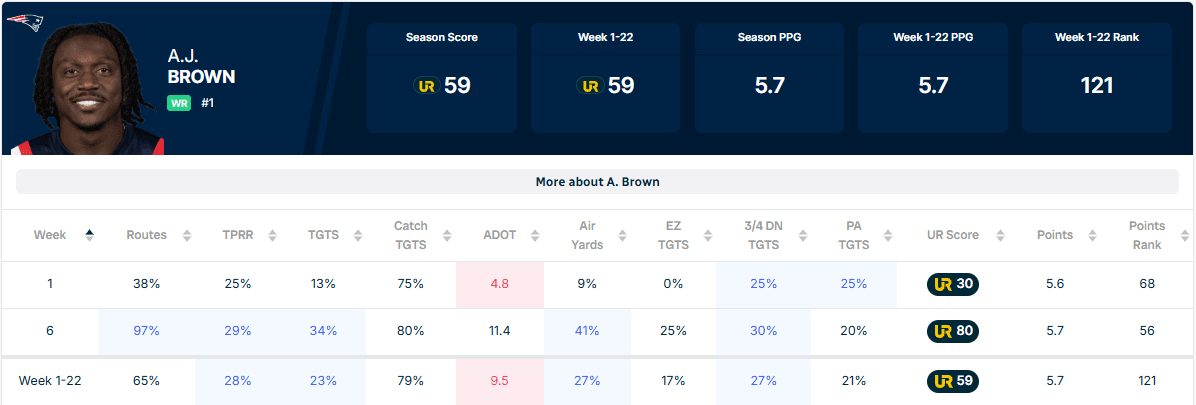
Ultimately, Brown fell flat, catching only 30% of his targets. He was credited with two drops, which isn't a meaningful stat in a one-game sample. How the rest of Brown's incompletions were charted:
- Batted pass
- Lost control
- Receiver error
- Short throw
- Defensive hit
Lost control is similar to a drop—he had it but didn't complete the catch process. The concern is batted passes and defensive hits. Brown could be entering a phase of his career where he can't create the separation he once did, which could lead to more contested situations.
But at the macro level, the Patriots don't have other options. Romeo Doubs, who was already bombing, is on IR for at least four games starting this week. And Drake Maye has found his groove. He now ranks 13th in YPG (244) and 9th in passing TDs per game (1.83).
If your local league manager is worried about the drops and the bad box score, now is the time to make an offer. The Patriots traded a first-round pick for Brown and are in win-now mode—he'll get plenty of opportunities to lead a prolific passing attack.
The only thing keeping me from moving Brown higher in the ROS rankings is his schedule. It is average over the next five weeks, but he has a tough schedule from Week 14-17, including tilts against the Vikings (-4.0 PPG), Chiefs (-3.3 PPG), Jets (-2.7 PPG), and Broncos (-5.0 PPG).
Schedule Notes:
- Next five weeks: -0.1 PPG (19th); Bye: Week 11
- Fantasy playoffs: -3.7 PPG (32nd)
Brown UPGRADES to high-end WR2 status and offers WR1 upside, but the schedule is brutal to end the year. He is a BUY-LOW option if someone values him as a mid-range WR2 or lower.
Note: For more buy-low options, check out the Utilization Bytes below.
9. Utilization Score: Overperformers SELL HIGH
 Ashton Jeanty | RB | Raiders
Jeanty is actually underperforming his Utilization Score (91) with 16.7 PPG. His historical comparisons have averaged 19.1 PPG. But I think now is the time to sell high because his name is still carrying high value. Per FantasyCalc, below are the players valued similarly to Jeanty:
- Javonte Williams
- Drake London
- Malik Nabers
- Nico Collins
- Christian Watson
- Chuba Hubbard
Honestly, I would prefer all of those names to Jeanty—especially Nabers, Hubbard, and Watson.
We are almost 1.5 years into this experiment, and Jeanty remains massively inefficient, averaging only 3.2 YPC (29th of 33 RBs with at least 50 attempts)—and the underlying data isn't better.
- 10-plus yard attempts: 5% (29th)
- Average yards after contact: 2.63 (24th)
- Missed tackles forced: 9% (30th)
Could this be partly because the Raiders offensive line ranked 28th in average yards before contact (0.75)? Sure. But do we expect that to change?
Could this be because of Jeanty dealing with injuries? Maybe. But it was similar last year.
The bottom line: If I can trade Jeanty for another superstar with proven upside, I am willing to do it. His Utilization has been trending down significantly over the last three games. If it isn't due to injuries, we could be stuck holding the bag on a player about to nose-dive down the rankings.
He has an 80 Utilization Score in Weeks 4-6, averaging 15 PPG.
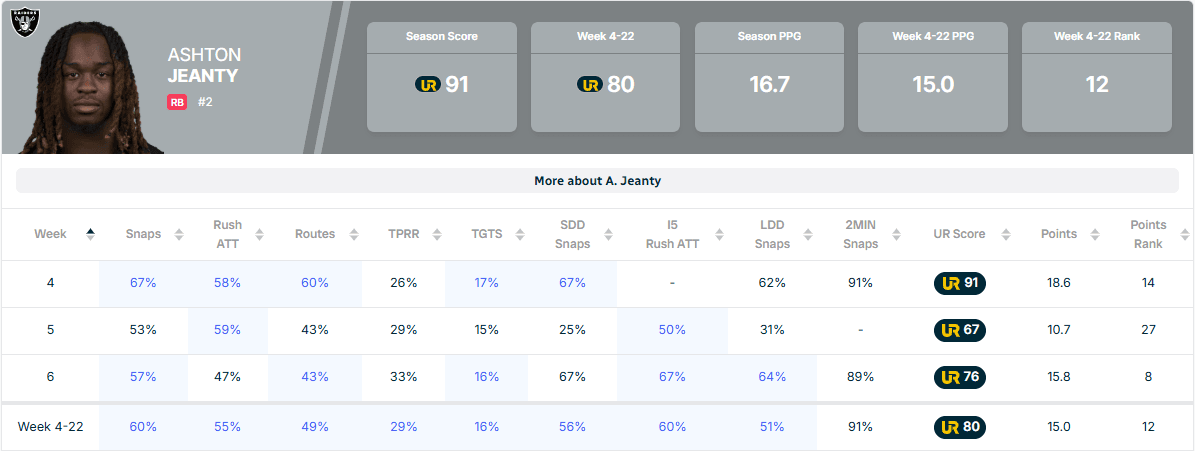
If that is his new role, his historical comparisons have averaged 15.5 PPG. And what is the downside of moving at this point? If Jeanty regains his early-season death grip on the backfield, that isn't anything new—we have already seen that movie.
To be clear: I don't want to give Jeanty away. He is a good receiver out of the backfield. His 17% target share ranks fourth this year. And it is holding at 16% in a smaller role over the last three outings.
But I think it's time to face the reality that he is probably not the prospect we thought he was. He doesn't have the same upside as Bijan Robinson and Jahmyr Gibbs, which was part of the allure to drafting him in fantasy. His profile looks more like prime Rachaad White from 2023.
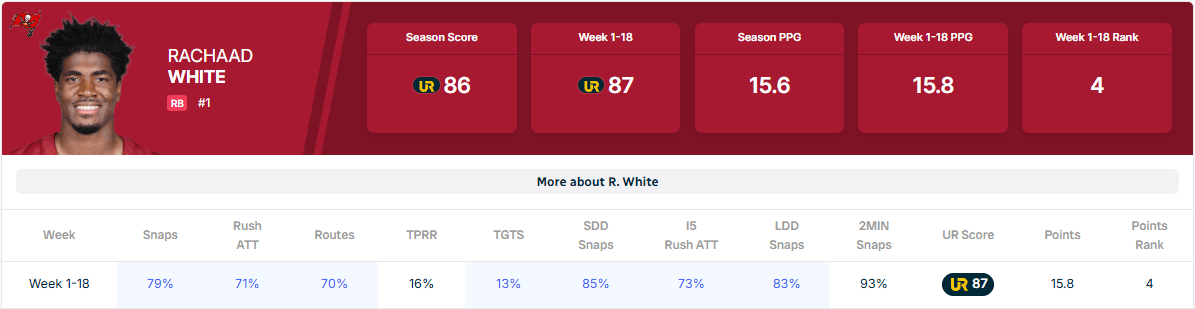
Jeanty DOWNGRADES to high-end RB2 status and is worth selling if someone wants to pay up, since he still offers high-end RB1 upside.
10. Waiver Wire Roundup
QB WAIVER WIRE OPTIONS FOR WEEK 7 IN FANTASY
- Kyler Murray | Vikings: Murray scored 18.3 points in Week 5. Over the last two games, he has thrown for 247 and 229 yards. And he notched a season-high scramble rate (18%) in Week 5. Murray scrambled 7 times for 54 yards. He could be gaining confidence in the scheme—which has plenty of playmakers—and his legs. That combination creates room for upside in fantasy football. Murray has the No. 1 QB schedule over the next three weeks: IND (+1.6), DET (+8.2), BUF (+4.3). Two of those offenses could push an elite defense like Minnesota into unknown territory. Murray is a low-end QB1 with upside over the next three weeks, AND he has the No. 1 QB schedule in the fantasy playoffs, including matchups against DET (+8.2) and WAS (+8.7). Murray is available in 49% of leagues after a bye, forcing many managers to cut bait.
- J.J. McCarthy | Giants: The Giants haven't named their starting QB for Week 7, but I lean toward McCarthy after a strong fourth-quarter performance (243 yards, 1 TD, 1 INT) following two more interceptions by Jameis Winston. McCarthy could be a complete flop, but stylistically he is much closer to Jaxson Dart than Winston. The team can use his mobility to threaten defenses in a way that Winston can't. McCarthy UPGRADES to low-end QB2 status but offers QB1 upside thanks to a potential dual-threat role. He is available in 99% of leagues.
RB WAIVER WIRE OPTIONS FOR WEEK 7 IN FANTASY
- Tyrone Tracy Jr. | Giants: Cam Skattebo played only 9% of the plays in Week 6 and didn't receive a carry or target. He was apparently demoted due to fumbling issues. I will be honest: I have no clue what the Giants will do with this backfield moving forward, but Tracy is my favorite player of the remaining options. He is the youngest and, theoretically, offers pass-catching upside because he played WR in college. With Skattebo out of the picture, the Giants used a committee in Week 6, but Tracy led the way with 18.5 points as the lead ball carrier (33% of snaps) and short-yardage option (43% of snaps). Tracy UPGRADES to RB4 status for now but could move up if New York rewards his play with more opportunities. He is available in 96% of leagues and has long-term potential.
- Kendre Miller | Saints: Miller has taken over the early-down role over the last two contests with a 57% rush share. He has a Utilization Score of 47 with 9.0 PPG, in a pass-first offense with run-blocking issues. So, he isn't a strong option. But with bye weeks in full effect, Miller offers short-term RB3 fill-in value. But a committee and Travis Etienne's eventual return severely cap his long-term upside. Miller is available in 66% of leagues.
- Roschon Johnson | Bears: Johnson has stepped into the RB2 role over the last two games with Kyle Monangai out, delivering 9.5 and 14.5 points. He could have scored another TD in Week 6, but slid down to drain the clock. Ben Johnson has a long history of tandem backfields, and Johnson has played a significant role in two games without Monangai. He could have contingent RB3 value if D'Andre Swift or Monangai miss time in a high-quality, run-oriented offense that leads the NFL in plays per game (73.2). Johnson is available in 95% of leagues.
- Dylan Sampson | Browns: Sampson offers short-term RB2 potential if he returns from IR this week and Quinshon Judkins is out. He is a plus receiving back, and Jaleel McLaughlin had a 17% target share last weekend. When Judkins is back, Sampson is an RB4-5 with contingent RB2 upside. He is available in 92% of leagues.
- Samaje Perine | Bengals: Perine remains one of the most underrated handcuffs in fantasy football. And he stepped into a larger role in Week 5 before the bye, handling 50% of the rushing attempts after a Chase Brown fumble. Perine is an RB5 handcuff stash but could carve out stand-alone value if Brown struggles. He is available in 95% of leagues.
- Jawhar Jordan | Texans: Jordan has looked better than Woody Marks when given the opportunities. He handled only 26% of attempts in Week 6, but scored on a 25-yard TD. Jordan is a SICKO league-type add who offers short-term RB3 potential with a sliver of long-term upside given how bad Marks and David Montgomery have looked. He is available in 99% of leagues.
- Bam Knight | Cardinals: Knight had a surprisingly large role with Jeremiyah Love out in Week 6. The veteran RB secured a 44% snap share and 44% rush share, forcing a near-even split with Tyler Allgeier. Knight scored 11.8 points and could operate as an RB4 with RB3 upside until Love returns. He is available in 99% of leagues.
- Should Return in Week 7: Josh Jacobs - Commissioners Exempt List (18% available), Jordan Mason - IR (33% available)
- Could Return in Week 7: Zach Charbonnet - IR (38% available) - the Seahawks must activate Charbonnet this week since his 21-day practice window ends Thursday. But we don't know if he will be active.
- Could Return in Week 8: Jadarian Price - IR (31% available)
- Tier 1 Handcuffs: Emmett Johnson (78%), Brian Robinson Jr. (57%), Kaelon Black (72%), Chris Rodriguez Jr. (73%)
- Tier 2 Handcuffs: Tyler Allgeier (32%), Rachaad White (44%), Ray Davis (94%), Kenny Gainwell (51%), Mike Washington Jr. (70%), Tyler Goodson (99%), Justice Hill (96%), Seth McGowan (98%), Tyjae Spears (78%), Kimani Vidal (81%), Jaylen Wright (95%)
- SICKO STASHES: Roschon Johnson (95%)
- Longview Players Your Leaguemates Could Cut: Emanuel Wilson was the second-most-cut RB in early waiver wire action. Charbonnet must be activated this week (the 21-day window is over), but we don't know if he is ready to play. And Jadarian Price is still on IR. That means we could still get another RB2 week out of Wilson in Week 7. Plus, Wilson has played well enough to stay in the mix.
- IR Stash: Jonathon Brooks (57%). Expected to return in early-to-mid November. Panthers' offense is much improved. Probably only a Tier 1 handcuff at this point, given how well Hubbard is playing.
WR WAIVER WIRE OPTIONS FOR WEEK 7 IN FANTASY
- Germie Bernard | Steelers: Available in 50% of leagues. See No. 1 above.
- Omar Cooper | Jets: Available in 96% of leagues. See No. 4 above.
- Jordyn Tyson | Saints: Tyson traveled with the team to Paris, leaving the door ajar for a return this weekend. His most likely return date remains Week 9, but now is the time to swoop if the Round 1 NFL pick is available in your league. He was a target monster in college and could quickly ascend to the WR2 role on a high-volume passing attack. Tyson is available in 52% of leagues and offers WR2 upside when 100%.
- Jaylin Noel | Texans: Noel makes the waiver wire section of this column in back-to-back weeks because he is still available in 93% of leagues. The second-year WR remains stuck in a part-time role (55% route share), but has made the most of his opportunities, ranking 10th in YPRR (2.53) among WRs with at least 100 routes. Should the team decide to move to more 3-WR looks as their primary mode of attack, Noel could ascend the ranks. He is a similar talent profile to Parker Washington. He can operate inside or outside and has the size (5'11", 201) to play an every-down role as an underneath or vertical threat and add yards after the catch. For now, Noel is a boom-bust WR4 averaging 10.8 PPG. But he offers WR2 upside if the role grows. He was the fourth-most-added WR in early waiver-wire activity.
- Keon Coleman | Bills: Coleman is on bye in Week 7, and DJ Moore could return in Week 8, which dampens the outlook. But he is a Year 3 WR who has flashed with two top-18 performances over the last three games. The WR2 role opposite Moore is open, with Khalil Shakir mostly playing from the slot. Coleman is a boom-bust WR5 option but offers contingent WR2 upside if Moore misses more time. He is available in 69% of leagues.
- Ja'kobi Lane | Ravens: Lane returned from IR in Week 7 and operated as the WR4 before Rashod Bateman left with a shoulder injury. After Bateman exited, Lane moved into the WR3 role behind DeVontez Walker. Lane notched a 23% TPRR and was targeted once in the red zone. The Round 2 pick has a decent chance to climb the depth chart and quickly wrestle the WR2 role. Lane is a WR5 but offers high-end WR3 upside if he can win the starting role. He is available in 88% of leagues.
- Travis Hunter | Jaguars: Hunter only played 16% of passing plays but showed high-end WR ability, scoring 15.9 points. As he gets more comfortable on defense, he could carve out a bigger role on offense. Hunter is a boom-bust WR6 but offers WR2 upside if a Jaguars starter misses time—especially if the team moves Brian Thomas ahead of the trade deadline. Hunter is available in 93% of leagues but is on bye in Week 7.
- Not Interested: Jahan Dotson.
- SICKO STASHES: Jalen Royals (99%), Antonio Williams (95%, on bye in Week 7), Caleb Douglas (93%)
- Longview Players Your Leaguemates Could Cut: Jakobi Meyers (53%), KC Concepcion (43%), Makai Lemon (76%), Brian Thomas Jr. (45% - trade candidate)
- IR Stashes: Alec Pierce (49%), Adonai Mitchell (85%)
TE WAIVER WIRE OPTIONS FOR WEEK 7 IN FANTASY
- Tyler Higbee | Rams: Higbee notched an 83% route share in Week 6 despite a healthy Colby Parkinson. The veteran has averaged 12.4 PPG in four games as the lead option. His strong performances may give him the edge as the Rams' TE1 for the rest of the season. With Davante Adams (knee) out for 6-10 games, the team will lean even more into their heavy TE packages. There is a world where Higbee is the No. 2 target in Sean McVay's high-powered scheme for the foreseeable future. Higbee UPGRADES to high-end TE2 territory for next week, but must hold off Terrance Ferguson upon his return (Week 8). Higbee is available in 65% of leagues.
- Michael Mayer | Raiders: Klint Kubiak is using 12 personnel on a league-leading 57% of snaps since Brock Bowers returned in Week 3. Over that span, Mayer has a 67% route share with a 15% target share, averaging 11.5 PPG. He is a mid-range TE2 and is available in 92% of leagues.
- Longview Players Your Leaguemates Could Cut: Kenyon Sadiq (77%)
- IR Stash: Terrance Ferguson (85%)
Utilization Bytes
Quarterbacks
- C.J. Stroud | Texans: Stroud is averaging 286 YPG (4th) and 1.5 TD tosses per contest (T-15th). With Nico Collins, Noel, and Harrison, this offense could abandon a lackluster run game without a feature back. They already rank 8th in DBOE (2%). Stroud UPGRADES to high-end QB2 status.
Running Back
- Braelon Allen | Jets: Allen has averaged 13.2 PPG with a 79 Utilization Score in three games without Breece Hall (quad). He has an 88% snap share, 80% rush share, and 10% target share in those games. Allen has run hard, averaging 3.58 yards after contact (7th), and 13.5% of his attempts have gone 10-plus yards (6th). Hall is a strong RB2 option in games without Hall and might have played well enough to create a tighter split upon Hall's return.
- Breece Hall | Jets: Hall (quad) remains week-to-week, but could return to a smaller workload when he is healthy. Allen has played well and complements Hall well, who has struggled to stay healthy. Hall DOWNGRADES to mid-range RB2 status and is a SELL-HIGH option ahead of his return.
- Cam Skattebo | Giants: Skattebo played only 9% of the snaps after a demotion ahead of the game due to fumble issues. His rest-of-season value is up in the air in a Giants backfield that could devolve into a full committee. Skattebo hasn't been explosive this year with 3.6 YPC (23rd of 33 RBs with at least 100 attempts) and only 6.2% of his attempts going for 10-plus yards (24th). He has also been average after contact, with 2.91 yards per attempt (16th). Given his loss of work in the passing game (13% TPRR), we don't have much to hang our hat on with Skattebo. He is my slight favorite to still lead this backfield in 2026, but my confidence isn't high. Skattebo DOWNGRADES to low-end RB3 territory until we see or get news about a return to a full-time role.
- Dameon Pierce | Eagles: It wasn't pretty, but Pierce scored 15 fantasy points thanks to a 97% snap share with Carson Steele knocked out of the game early. Pierce handled 92% of the attempts with a 13% target share. Saquon Barkley (hamstring) remains week-to-week, leaving the door open for another spot start for Pierce. He is a mid-range RB3 until Barkley returns.
- Kyren Williams | Rams: I have written extensively about Williams in the Utilization Report over the last two weeks and a potential dependence on shootout game scripts. In Week 6, in a low-scoring close loss to Arizona, Williams saw his lowest attempt share (50%) since Week 2. He finished with 9.7 points, with Blake Corum eating heavily into his workload. Williams did retain his passing-game role with a 17% target share—which is likely to persist with the loss of Adams for 6-10 weeks. Williams is HOLDING STEADY as a borderline RB1 with high-end RB1 upside in shootouts.
- Rhamondre Stevenson | Patriots: Woof. Every time we think we can trust this backfield, Josh McDaniels and Mike Vrabel pull the rug out from under us. TreVeyon Henderson fumbled in the second quarter, opening the door for a big boost for Stevenson, but Corey Kiner took most of those opportunities in the third and fourth quarters. Stevenson stumbled to a 3.6-point fantasy outing despite a 60% snap share. He managed only a 44% rush share and went untargeted. Stevenson DOWNGRADES to RB3 status.
- Tyler Allgeier | Cardinals: Allgeier continued to share the backfield in Week 6 even with Jeremiyah Love out. The veteran RB handled 56% of the snaps and 53% of the attempts. A surprise close game script allowed the low rush share to translate to 18 carries. Bam Knight saw 14 attempts and was the more effective runner. Allgeier DOWNGRADES from a Tier 1 handcuff to Tier 2 without a clear path to a 70%+ snap share when Love is out.
Wide Receiver
- Chris Olave | Saints: Olave has scored 8.6 and 14.3 points over the last two weeks, which could open the door for a buy-low opportunity. His underlying data has remained strong with 24% and 26% target shares. When Tyson returns, Olave could face stiffer target competition, but those targets could easily come at the expense of Devaughn Vele and Juwan Johnson, who don't have Olave's target pedigree. He has a 92 Utilization Score, and his historical comparisons average 20.6 PPG. Olave is HOLDING STEADY as a mid-range WR1.
- DeMario Douglas | Patriots: Romeo Doubs suffered a shoulder injury and will miss at least the next four games. In Week 6, with Mack Hollins also out, Douglas finished second on the team with a 28% target share. Over the last two games, he has posted 22.5 and 19.6 points in a banged-up WR room. He has a 78 Utilization Score over that span. Historically, Douglas has been a solid target earner but was mostly tethered to the line of scrimmage. That hasn't been the case this year, with a solid 7.7 average route depth. Hollins won't return until Week 9, so Douglas has short-term WR3 value while teams are on bye.
- Denzel Boston | Browns: Boston was the sell-high recommendation last week in the Utilization Report. It had less to do with Boston as a talent and more to do with the offense and his dependence on connecting on deep balls, which are highly volatile. In Week 6, that volatility caught up with Boston in the form of a 2.5-point dud. Boston is HOLDING STEADY as a borderline WR3.
- DeVonta Smith | Eagles: Smith returned to the lineup in Week 6 and saw his first action with Tanner McKee—the Eagles starter for the rest of the season with Jalen Hurts out due to blood clots. Smith briefly left the game with an injury scare, but dominated with a 30% target share, earning 12 looks. Only seven of his opportunities were catchable, so he and McKee will have to find their rhythm, but it was a positive first data point. Smith scored 20.5 points with a 90 Utilization Score. Smith is HOLDING STEADY as a borderline WR1.
- DK Metcalf | Steelers: Metcalf has rarely left the field in 2026 with a 98% route share and has reached a 24% target share in 4 of 6 games. Over the last three games, the veteran has heated up, averaging 14 PPG. He is playing a much more versatile role than in previous years, attacking the underneath and intermediate areas of the field. Metcalf has an average route depth of 6.8 with an aDOT of 9.8. And 35% of his routes are in-breaking. Metcalf now has a Utilization Score of 72. His comps averaged 13.8 PPG, well above his 11.5 for the season. Most were low-end WR2s or high-end WR3s. Metcalf UPGRADES to high-end WR3 status.
- Keenan Allen | Colts: The wily vet has bested Rome Odunze and Ladd McConkey over the last two years, and now he adds Josh Downs to the list. When the two have shared the field this season, Allen has a 33% target share vs. Downs's 24%. Allen's volatile route share makes him hard to trust in lineups, but when he's reached 75% or higher three times this year, he's averaged 14.6 PPG. Allen UPGRADES to mid-range WR4 territory with a 63 Utilization Score. His historical comps averaged 12.1 PPG.
- Luther Burden | Bears: Burden secured his second-best fantasy finish of the season with 17.5 points in Week 6. But he had a season-low 44% route share. I don't want to overreact because the Bears lead the NFL with 73 plays per game—12 more than the NFL average. To put that into perspective, that is the equivalent of 3.3 more games than the average NFL team if the pace holds. So, even in a smaller role, someone like Burden could thrive. But 44% is too low. A rotation with Kalif Raymond paired with an offense utilizing 12 and 13 personnel (52%) more than any other team often pushes Burden off the field. The second-year WR now has a 69% route share this year, but leads the team with a 23% target share. Burden is HOLDING STEADY as a high-end WR3, but we need more playing time next week to avoid a downgrade. On the flip side, Burden offers WR1 upside if Ben Johnson ever gives him a full-time role.
- Malik Nabers | Giants: Nabers has ramped up to a full-time role over the last three weeks, with a 94% route participation rate. Over that span, he has a 98 Utilization Score with 26.9 PPG. The third-year alpha is averaging 13.3 targets with 160 air yards. Nabers is clearly back to high-end WR1 territory as a talent. The question is whether the Giants will flip to J.J. McCarthy at QB. McCarthy looked good in one quarter of play last weekend, but last season he averaged only 168 in eight healthy games. And that caused Justin Jefferson's season to malfunction: 11.9 PPG. Many think Nabers is QB-proof. Maybe he is. But we thought that about Jefferson, too. Nabers is HOLDING STEADY as a mid-range WR1, but his floor falls to low-end WR2 status with McCarthy.
- Marvin Harrison Jr. | Texans: Harrison had an average route depth of 12.3 with 29% of his routes consisting of go routes with the Cardinals. He was a boundary X who wasn't running routes conducive to targets in today's NFL. In his first game with Houston, his average route depth came down to 9.9, and his go routes dipped to 22%. Harrison ran in-breaking routes 33% of the time and aligned from the slot 27% of the time. It was a small sample with only a 25% route share (16), but it was a step in the right direction. Harrison is HOLDING STEADY as a WR4, but he could move back into the WR3 conversation if his route tree translates in a game with a full-time role.
- Matthew Golden | Packers: Golden has the No. 7 Utilization Score (86) on the season, averaging 6.5 catchable targets (11th) and 77.3 catchable air yards (3rd) per game. He is averaging 16.8 PPG, and his historical comparisons notched 17.9 PPG. A whopping 97% of those comps were WR1s, with 54% securing top-6 seasons. Golden UPGRADES to borderline WR1 territory.
- Michael Wilson | Cardinals: Wilson posted another disappointing outing with 7.2 points in Week 6 against the Rams. Still, he is averaging nine targets and 101 air yards per game. He has a Utilization Score of 75. His historical comparisons averaged 14.8 PPG, well above his 11.9. And 55% finished as WR2s. Wilson is HOLDING STEADY as a low-end WR2 and still offers WR1 upside (22%).
- Parker Washington | Jaguars: Washington scored 10.4 points in Week 6, but had his second-most targets of the season (11). In wet conditions, he and Trevor Lawrence barely missed multiple connections, with only six of his targets charted as catchable. Washington will be fine—he is HOLDING STEADY as a high-end WR2.
- Xavier Worthy | Chiefs: Worthy scored a season-high 14.3 points against the Chargers. With Rashee Rice (hamstring) out, he has back-to-back 27% target shares. Worthy is playing a full-time role this year (89%) and offers WR3 potential in games without Rice.
Tight End
- Colston Loveland | Bears: Loveland notched his best outing of the year with a 94 Utilization Score and 18.5 points in Week 6. He has reached a 22% target share or higher in two of three games. In a Bears offense on pace to run 3.3 games' worth of additional plays vs. the NFL average, Loveland still offers massive upside. With all the 12 and 13 personnel, plus Odunze's deep role, he could easily become the target leader for the rest of the season. Loveland has an 80 Utilization Score over the last three games. If that is his new baseline, his historical comps averaged 12.3 PPG with 61% securing top-12 finishes. Loveland UPGRADES to low-end TE1 status and is back on the buy-low radar.
- Harold Fannin Jr. | Browns: Fannin's Utilization Score now sits at 65, averaging 8.9 points per game. The Browns offense ranks 28th in PPG (17.7) and ranks 24th in regulation plays per game (58.8). With Deshaun Watson averaging 196 YPG, this offense is too crowded. And KC Concepcion is attacking the same area of the field as Fannin—and getting more targets (20% TPRR vs. 15%). Fannin's historical comps averaged 9.4 PPG with 42% finishing inside the top 12. Fannin DOWNGRADES to high-end TE2 territory.
- Kenyon Sadiq | Jets: Sadiq played behind Mason Taylor in Week 6, handling a lowly 36% route share. The Round 1 pick still has mid-range TE1 upside if playing time reverses in his favor. But for now, he DOWNGRADES to low-end TE2 status.
- Kyle Pitts | Falcons: Pitts is averaging 11.9 PPG with a 64 Utilization Score in four games with Michael Penix this year. He has 13 targets over the last two games with season-highs in routes (29 and 29). Pitts is still rotating more than we want, but has reached a 73-74% route share in three of four contests. His historical comparisons averaged 9.3 PPG with 38% reaching top-12 status. Pitts UPGRADES to mid-range TE2 territory.
Team Trends To Monitor For Week 7
With six weeks of data for most teams, it's a good time to examine team-level trends that affect fantasy production. You can find the data across all 32 NFL teams in the Team Styles tab of the Utilization Report tools.
Redzone Drive Rate vs. Touchdown Drive Rate: Percentage of drives that reach the red zone versus how often the team is scoring a touchdown per drive. Large deltas indicate room for positive or negative regression. The average delta for the NFL is ~5-6%.
- Cardinals: 15% (33% v 18%)
- Bears: 13% (40% v 27%)
- Texans: 12% (35% v 23%)
Dropback Over Expected (DBOE): How often teams pass the ball compared to their peers when considering the score differential over the last six weeks:
- Packers: 8%
- Cowboys: 6%
- Bengals: 6%
- Steelers: 5%
- Panthers: 5%
—
- Chargers: -5%
- Dolphins: -9%
- Falcons: -9%
Neutral Playclock: Teams that are leaving more or less time on the play clock when the score is within three points (neutral situations) over the last five weeks. The NFL average is 8.3 seconds.
- Browns: 11.57
- Cowboys: 11.45
- Chargers: 11.06
- Patriots: 10.92
- Chiefs: 10.55
—
- Steelers: 6.87
- Dolphins: 6.66
- Giants: 6.66
- Commanders: 6.63 (Pre MNF)
- Titans: 6.54
Play action pass rate: Teams that are utilizing play action the most per dropback over the last five weeks, which adds value to WRs and TEs on a per-route basis in fantasy:
- Bills: 38%
- Chiefs: 34%
- Lions: 33%
- Bears: 33%
- Panthers: 32%
—
- Cardinals: 19%
- Browns: 19%
- Steelers: 19%
- Saints: 19%
- Bengals: 19%
- Eagles: 16%
Personnel: When teams deploy more heavy personnel, with extra TEs and RBs on the field, the pass-catchers who remain on the field face less target competition. For example: WRs saw a 29% boost in PPR points per route with two WRs on the field vs. three WRs over the last three seasons. This is year-to-date data through Week 7, when we flip to the last six. Game scripts can impact this data over small samples.
21 Personnel (2 RB, 1 TE, 2 WR) – large boost
- 49ers: 33% (Pre MNF)
- Chargers: 27%
- Dolphins: 26%
22 Personnel (2 RB, 2 TE, 1 WR) – large boost
- Giants: 16% (21 + 22 = 31%)
- Raiders: 15% (21 + 22 = 30%)
- Vikings: 9% (21 + 22 = 25%)
- Chargers: 8% (21 + 22 = 35%)
11 Personnel (1 RB, 1 TE, 3 WR) – negative boost
- Eagles: 77%
- Titans: 75%
- Cowboys: 73%
- Browns: 71%
- Buccaneers: 70%
12 Personnel (1 RB, 2 TE, 2 WR) – small boost
- Bengals: 46%
- Raiders: 44%
- Bears: 34%
- Chiefs: 30%
- Falcons: 30%
- Ravens: 29%
13 Personnel (1 RB, 3 TE, 1 WR) – large boost
- Rams: 31% (12 + 13 = 41%)
- Bills: 29% (12 + 13 = 49%)
- Cardinals: 26% (12 + 13 = 33%)
- Bears: 19% (12 + 13 = 52%)
- Ravens: 16% (12 + 13 = 46%)
Offensive Lines: Pressure rates are huge for QBs. Most signal callers who are constantly harassed will struggle to find consistent fantasy value. QBs partially own pressures, so it isn't all an offensive line issue. The NFL average pressure rate is 36% over the last three seasons. Yards before contact matters for RBs. Backs who get better blocking have a better chance to thrive in fantasy. The NFL average yards before contact on RB attempts is 1.28 over the last three years. It is important to remove QBs since scrambles often come with defenders' backs turned and can inflate these numbers.
Pressure Rate Allowed:
- 3-Year NFL Average: 36%
- 2026 NFL Average: 37%
- Cardinals: 26%
- Bengals: 30%
- Falcons: 31%
- Jaguars: 31%
—-
- Patriots: 42%
- Eagles: 43%
- Browns: 43%
- Seahawks: 45%
- Panthers: 45%
- Chargers: 45%
- Dolphins: 45%
Average Yards Before Contact Rushing
- 3-Year NFL Average: 1.28
- 2026 NFL Average: 1.13
- Bills: 2.37
- Rams: 1.89
- Lions: 1.72
- Chiefs: 1.66
- 49ers: 1.66 (Pre MNF)
—
- Packers: 0.79
- Giants: 0.77
- Raiders: 0.75
- Eagles: 0.72
- Jaguars: 0.67
- Seahawks: 0.65
- Browns: 0.52
- Defensive Tendencies
Pressure Rate: Defenses with high pressure rates can dramatically impact QB performance. Under pressure, QB statistics become much more unstable and decline at the macro level.
- 3-Year NFL Average: 36%
- Vikings: 46%
- Seahawks: 44%
- Falcons: 44%
- Broncos: 42%
- Browns: 41%
- Bears: 40%
—
- Cardinals: 30%
- Titans: 29%
- Saints: 29%
- Colts: 28%
- Buccaneers: 28%
- Giants: 26%
Pass Blitz Rate: Defenses that blitz often can impact how often TEs and RBs run routes. Against heavy blitz teams, they can remain in to block more often.
- 3-Year NFL Average: 26%
- 2026 NFL Average: 30%
- Vikings: 66%
- Commanders: 43% (Pre MNF)
- Buccaneers: 43% (low pressure rate = big plays available)
- Jets: 39%
- Panthers: 38%
- Patriots: 38%
- Bears: 38%
—
- Falcons: 22% (high pressure rate)
- Raiders: 22%
- Colts: 21% (low pressure rate)
- Seahawks: 21% (high pressure rate)
- Texans: 21% (strong pressure rate of 37%)
- Bengals: 17% (strong pressure rate of 39%)
Man Coverage: Targets skew toward the top WR options against man coverage, while TE and RB opportunities decline at the macro level. Of course, there are exceptions for elite TEs. Also, many teams that utilize man concepts have a shut-down corner, which can be problematic for WRs—especially if the CB shadows.
Scrambling QBs also benefit from man coverage. When defenders turn their backs, QBs can tuck the ball and run. And it can take defenders longer to realize it is happening (i.e., Jayden Daniels vs. the Giants in Week 5).
- NFL Average in 2026: 23%
- Browns: 41% (Denzel Ward. Doesn't always shadow.)
- WR units: +0.5 PPG boost (13th-best matchup)
- Giants: 35%
- WR Units: -2.2 PPG (24th)
- Patriots: 31% (Christian Gonzalez. Will shadow.)
- WR Units: -1.5 PPG (19th)
- Jets: 30%
- WR Units: -2.7 PPG (26th)
- Lions: 30% (Bad corners + man = great for opposing WRs)
- WR units: +6.1 PPG (2nd)
- Steelers: 29%
- WR Units: -1.5 PPG (20th)
- WR Units: -1.5 PPG (20th)
Zone Coverage: Targets spread out against heavy zone teams. RBs and TEs get more involved, while WR targets tend to take a bit of a hit. There are exceptions. Underneath, WRs can benefit from zone.
- NFL Average in 2026: 71%
- Seahawks: 81%
- Adding up the tendencies: High pressure, low blitz, heavy zone →
- RBs: +1.4 boost to receiving PPG
- WRs: -4.4 PPG
- TEs: -3.9 PPG
- Panthers: 81%
- Saints: 80%
- Packers: 78%
- Titans: 77%
- Raiders: 77%
- Vikings: 77%
- Adding up the tendencies: High pressure, high blitz, high zone →
- RBs: -6.4 boost overall; -2.7 receiving boost (staying into block + zone bad for RB targets)
- WRs: -4.9 boost
- Falcons: 74%
- Adding up the tendencies: High pressure, low blitz, high zone →
- RBs: +1.4 boost to receiving PPG
Players Mentioned in this Article
Presented by

Published Updated