Fantasy Football Wide Receiver Rankings For 2026: Ja'Marr Chase, Malik Nabers and More
We've ranked the top 12 wide receivers for the 2026 fantasy football season. Let's break down each of the prospective WR1s and what they bring to the table for fantasy football.
To me, the wide receiver position is probably the most exciting in all of fantasy. Every year, multiple players break out, making the position even deeper. However, that does make ranking the wide receivers a lot more difficult.
Lucky for me, that’s not my job today.
Instead, I’ll be taking a look at Fantasy Life's fantasy football rankings and breaking down the top-12 players. Of course, it’s still only May, which means these rankings can (and probably will) change, so be sure to keep tabs throughout the summer.
Let’s go.

Unlock Our Tools!
Stop hitting the paywall. FL+ gives you access to our premium in-depth content, expert rankings & projections, mock draft simulator, and all the tools you need – all personalized to your league.
The Top 12 Wide Receiver Rankings For 2026 Fantasy Football
 1.) Ja’Marr Chase | CIN
Since 2024, no player in football has seen more targets (360) or run more routes (1,335) than Chase, who has been a top-five fantasy wideout in five of six NFL seasons. The only exception? 2023, when Joe Burrow only played 10 games. And even that season, Chase still hauled in 100 passes for 1,216 yards and seven touchdowns. It’s pretty simple. When Burrow is out, Chase is a very good fantasy wide receiver.
But when Burrow is under center, Chase is arguably the best.
Since 2021, Chase has averaged 9.9 targets, 6.7 receptions, 90.7 receiving yards and 20.4 PPR PPG. For what it’s worth, 90.7 receiving yards per game would be the second-best for a career in NFL history. Of course, Burrow has missed plenty of time as of late. And in 15 career games with Burrow sidelined, Chase’s numbers, though still strong, wouldn’t put him among fantasy’s elite:
- 9.3 targets
- 6.3 receptions
- 71.9 receiving yards
- 0.3 TDs
- 15.5 PPG
Entering 2026, we should once again expect the Bengals to air it out, which has helped propel Chase’s absurd volume. Cincinnati has ranked sixth, third, second and second in dropback rate over the past four seasons, and although they’ve made some improvements to the defense, this still projects as one of the more pass-heavy teams in football. Chase headlines our fantasy football projections with a league-best 165 targets for 2026 and as long as his quarterback is healthy, I’d expect him to also pace the receiver position in fantasy points.
 2.) Puka Nacua | LAR
Following a WR1 finish (23.4 PPG), Nacua checks in as our consensus WR2 for 2026.
One of the most efficient players in football, Nacua comfortably leads the league in yards per route run since entering the NFL in 2023 (3.20), while also ranking first in fantasy points per route over the last two years (0.79). The efficiency is, of course, extremely impressive. But it’s even more impressive when you consider how insane the volume has been.
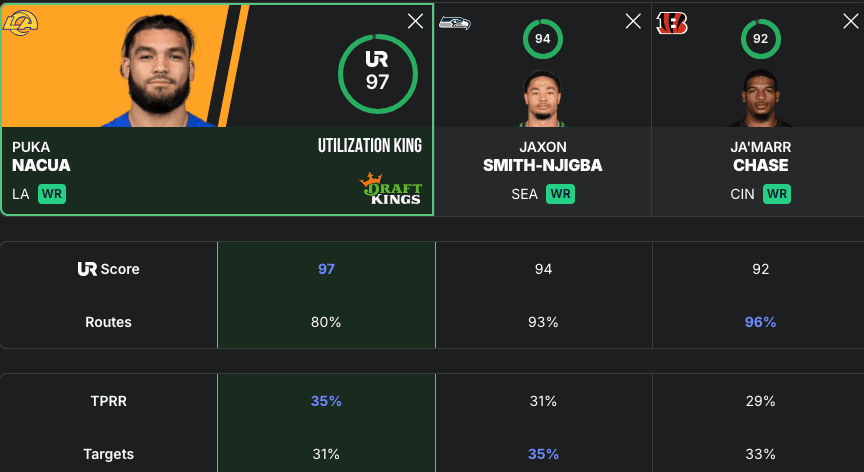
Nacua has led the league in TPRR each of the past two seasons (35%), and even as a fifth-round rookie back in 2023, he emerged, finishing fifth at 27%. He’s an awesome player and is the perfect fit for the style of offense Sean McVay wants to run. The latest craze around the NFL is the expected spike in 12 and 13 personnel, which McVay kicked off this past season. Los Angeles deployed 13 personnel on nearly 31% of their plays last year, easily the highest rate in football. Nacua wasn’t always the lone receiver on the field in those sets, but when he was and the Rams passed, you could bet he was getting the football. Nacua ran the second-most routes in three tight end sets (55), sporting an absurd 38% TPRR. Look for Nacua to continue to benefit from seeing so little target competition when the Rams run heavy personnel, which will only solidify his already elite target volume.
Great player, great offense, elite usage? Sign me up.
 3.) Jaxon Smith-Njigba | SEA
JSN found his stride towards the end of his sophomore season in 2024, and he built on that momentum in his third year. Smith-Njigba truly broke out last season, hauling in 119 passes for 1,793 yards and 10 touchdowns. His 21.2 PPR points per game were good for the second-most among all wideouts, while also ranking top-five in both fantasy points per route and target.
Seattle’s passing attack ran through JSN, as his 35% target share paced the entire NFL. In fact, Smith-Njigba had at least a 30% target share in 14 different games last season. And despite the massive boost in usage, he remained efficient, averaging 3.7 YPRR, trailing only Puka Nacua, while also ranking sixth in yards per target (11.0) and first in yards per team pass attempt (3.73). He won at all three levels of the field, and although he saw a massive drop in slot usage, JSN still crushed on the perimeter, leading the league in YPRR (3.8), receiving yards (1,378) and receptions (88) when out wide.
Entering the 2026 campaign, Seattle has a new offensive coordinator, but it is difficult to imagine the Seahawks’ passing game not funneling through their star wide receiver once again.
 4.) Amon-Ra St. Brown | DET
You want consistency? Look no further than St. Brown, who has finished as the WR4 in fantasy each of the past three seasons.
So, yeah. A WR4 ranking feels … appropriate.
St. Brown has averaged 159.3 targets, 1,393 yards and 11 touchdowns over the last three years. He’s coming off a career-high 172 targets, though that number is likely to drop significantly entering 2026. Though not as much as Jameson Williams, St. Brown did benefit from the absence of Sam LaPorta, averaging 11.3 targets and 89.5 receiving yards per game in eight outings with LaPorta sidelined. Assuming LaPorta stays healthy, St. Brown will likely slide into the 145-150 targets, which is obviously still elite.
The Lions will once again have a new playcaller in Drew Petzing, but the passing game will continue to run through St. Brown. Since 2023, no player has had more third-down targets than Amon-Ra’s 134, while his 32.4% third down target share during that span is the second-highest in football. When push comes to shove, we know where Jared Goff is going with the football.
 5.) CeeDee Lamb | DAL
An ankle injury and some poor touchdown luck limited Lamb to 14.4 PPG, the worst mark since his rookie season. He still eclipsed 1,000 yards on 75 catches thanks to a career-best 14.4 yards per reception. But overall, it was a strange season for Lamb, who didn’t help himself with eight drops (2nd-most).
The addition of George Pickens did cut into Lamb’s volume a bit, as his target share 23% and TPRR (25%) dropped by four and three percent, respectively. Fortunately, Dallas’ pace and play volume can help make up for added target competition. Since Brian Schottenheimer joined the Cowboys in 2022, the Cowboys have been one of the most fantasy-friendly offenses in the league:
| Year | No-Huddle Rate | Pass Attempts/Gm |
|---|---|---|
| 2022 | 13.80% | 329 |
| 2023 | 5.10% | 37.4 |
| 2024 | 9.00% | 37.5 |
| 2025 | 9.20% | 36.7 |
Expect a bounce-back season from Lamb in 2026, who remains the 1A of a high-powered Cowboys offense.
 6.) Justin Jefferson | MIN
Poor quarterback play limited Jefferson to just 11.9 PPR PPG (28th) and two (!) receiving touchdowns. His 67.4% catchable target rate ranked 63rd among wideouts, while over 21% of McCarthy’s attempts were deemed bad throws, the second-highest rate among qualified signal callers. But when he actually had serviceable quarterback play, Jefferson did Justin Jefferson things.
In five games with Wentz under center, Jefferson averaged 10 targets, 6.8 receptions, 95.4 receiving yards and 16.3 PPR points per game. And the fantasy production is even more impressive when you consider Jefferson didn’t score a single touchdown during those games. Jefferson should benefit from the addition of Kyler Murray, who helped DeAndre Hopkins haul in 15 passes for 1,407 yards back in 2021.
Arguably still the best receiver in football, as long as Murray is average, Jefferson should be viewed as one of the easiest bounce back candidates in all of fantasy.
 7.) Rashee Rice | KC
Rice’s NFL career thus far has resembled a season preview of your favorite television show. The flashes and highlights over a small stretch are fun and exciting, but you’re really anticipating what it’ll look like when it all comes together.
Season 4 should be Rice’s best.
After playing 16 games as a rookie in 2023, Rice has logged just 12 games over the last two years combined. We’ve seen consecutive seasons where Rice has hinted at elite fantasy production.
2024 Weeks 1-3:
- 33% TPRR (1st)
- 34% target share (2nd)
- 21.6 PPG (2nd)
2025 Weeks 7-15:
- 29% TPRR (5th)
- 29% target share (10th)
- 18.0 PPG (8th)
That sample size has everyone expecting a top-seven season if he can play close to a full season. And it makes sense. The Kansas City passing game funnels through Rice, especially the older Travis Kelce gets. All of the designed and schemed touches go towards Rice. Over the last two seasons (again, 12 games), Rice is averaging 2.25 targets per game when in motion (3rd), while being targeted on 58% of such routes. During that same span, Rice ranks 11th in wide receiver screens with 25, despite the rest of the wideouts playing more than double the games. This usage gives Rice such a safe weekly floor, while the upside, as long as Patrick Mahomes is under center, remains quite high, too.
If Rice’s eight-game stretch from last year is the trailer, we should be getting quite the season in 2026.
 8.) Drake London | ATL
London got off to a slow start last year, averaging just 5.3 receptions, 53 yards and 10.6 PPR PPG. But from then on, he wasn’t just good.
London was the best receiver in all of fantasy.
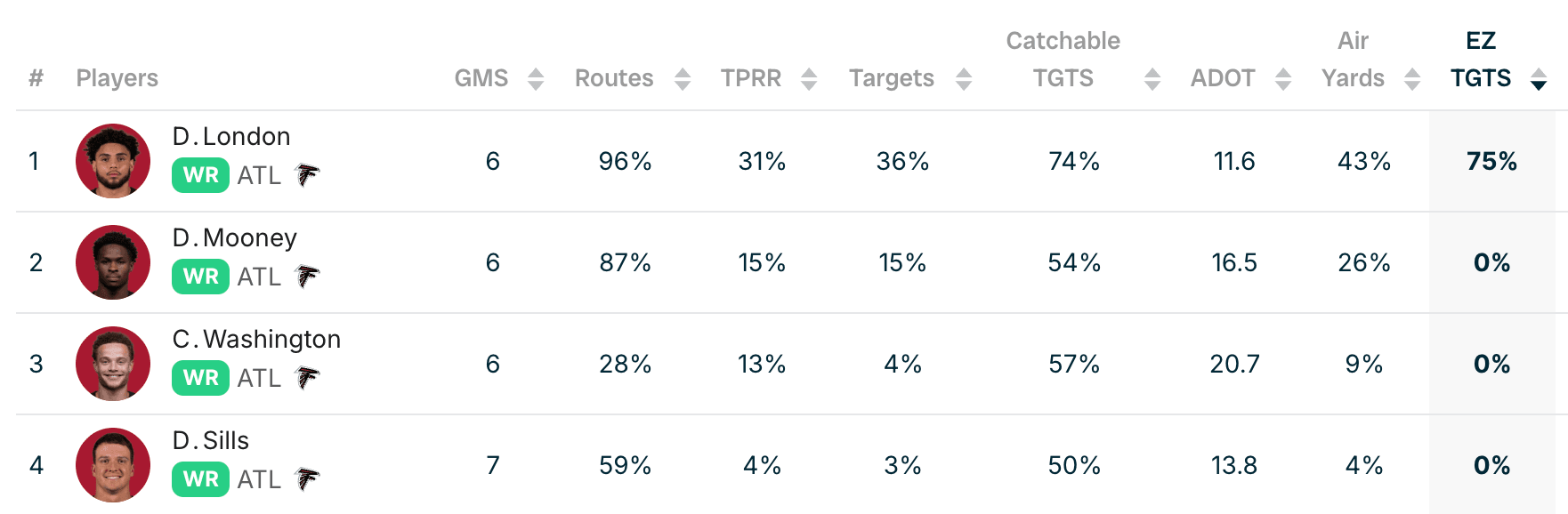
From Weeks 4-11, London averaged 11.2 targets, 7.3 receptions, 108.5 yards and 24.2 PPR PPG. He was fantasy’s WR1, while recording five 100-yard games over that stretch. London was easily on pace for a career year, but a PCL sprain derailed his season, costing him four games. And when he finally returned in Week 16, he clearly wasn’t the same player, averaging just 8.3 points per game during the final three weeks.
London’s midseason stretch illustrates the upside he possesses. During that span, he ranked second in TPRR (31%) and first in target share (36%), while accounting for a whopping 75% of Atlanta’s end zone targets. Entering 2026, London remains the clear alpha in Atlanta.
We’ll see if Michael Penix is ready for Week 1, but even if he’s not or once again misses time, the addition of Tua Tagovailoa guarantees that London will have a quarterback who can at least support great fantasy receiver seasons.
 9.) Nico Collins | HOU
Collins broke out in 2023 and, since then, has emerged as one of the 10 best talents at the wide receiver position. From a fantasy perspective, his target volume isn’t quite the same as that of other players around him, which has capped his upside a bit. Since 2023, Collins’ 24% target share is good, not great. Of course, Collins makes up for it with stellar efficiency, trailing only Nacua in YPRR during that span (2.75). And despite C.J. Stroud’s decline since his rookie year, Collins has still posted fantasy finishes of WR9 and WR8 over the last two seasons.
Volume and injury (he’s yet to play more than 15 games) could keep Collins towards the low-end WR1 status, especially if the Texans continue to rely on their elite defense to win games. But on a per-target basis, he’ll be as good as most wideouts in football.
 10.) Malik Nabers | NYG
Perhaps no player in fantasy will have their training camp status scrutinized more than Nabers, who is coming off not only an ACL tear, but meniscus damage as well. His Week 1 availability is in question, but if we get positive updates regarding his Week 1 availability, wheels all the way up. Because when he’s on the field, Nabers isn’t just good.
He’s elite.
As a rookie in 2024, Nabers posted an absurd 35% target share, averaging just over 18 PPR PPG. Drafted sixth overall, the Giants made sure that Nabers was getting the football early and often:
- 35% target share (1st)
- 31% TPRR (2nd)
- 11.3 targets per game (1st)
- 9.1 first-read targets per game (1st)
Nabers’ target-earning ability is even more impressive when you consider 23.6% of his routes during that season were go routes, while just over 13% were slants or in-breaking routes. Through the first three weeks of his sophomore season, Nabers was once again dominating targets, sporting a 29% target share and 22% TPRR, while accounting for 55% of the Giants’ air yards. Of course, his season unfortunately ended after running just 10 routes in Week 4, robbing us of seeing really any connection between him and Jaxson Dart.
His ADP has fallen a bit as of late, and given the injury concerns, yes, there is some early-season risk. But the upside is absolutely massive.
 11.) A.J. Brown | PHI/NE (potentially ... eventually ...)
Though his 2025 campaign may be viewed as a disappointment, Brown still impressed in plenty of metrics. Last season, the veteran ranked sixth in target share (29.5%), 10th in TPRR (25%), 10th in PPG (14.7) and 16th in YPRR (2.1). Brown was also once again very productive against man coverage, ranking 5th in TPRR (33%), 10th in YPRR (2.7), 5th in target share (34.4%) and 6th in fantasy points per target (2.06) when facing man. Many thought Brown may have been washed after watching him this past season, but I strongly disagree. And the numbers back it up.
As for the fit with New England, assuming the long-rumored trade crosses the finish line, it’s fine. You won’t see a ton of RPO pass attempts from the Patriots, which is something that has helped get Brown so many easy, pre-determined targets over the middle of the field. But the Patriots are likely to be a bit more pass-heavy than the offenses we’ve seen in Philadelphia, while the route concepts may be more suited for Brown’s skill set. This past season, just 7.7% of Brown’s routes were crossers, while Diggs was at 16.5%. Get him the ball over the middle of the field, let him beat press-man coverage, and let him make plays after the catch.
12.) George Pickens | DAL
Pickens rounds out the top-12 wideouts, and a lot of the arguments used for Lamb can be applied to Pickens, too. The Cowboys play fast, throw the ball a lot and have a great quarterback, all things we love for our wide receivers. It was a nice change of pace for Pickens, who was stuck in a stale, stationary role during his time with the Steelers.
Dallas clearly understood the assignment.
During his final season in Pittsburgh, just 23% of Pickens’ targets were off in-breaking routes, while sporting a 22.4% target rate. But in his first season in Dallas, 43% of Pickens’ targets came off in-breakers to go along with a 27.3% target rate. No longer just a boundary option, Pickens transformed into a matchup nightmare en route to a career-best season (93/1,429/9 TD). In fact, Pickens’ production was right there with Lamb’s when the two played together. Pickens averaged 7.8 targets, 5.3 catches, 77.1 yards and 14.9 PPR points per game alongside Lamb, while the latter averaged 15.4 PPG in the split. Playing in Dallas’ pass-heavy offense, there is enough for both Pickens and Lamb to shine.

Join Our Newsletter
Trusted by 400,000+ fantasy football players. Get access to Fantasy Life's free award winning newsletter and tools, all in one step.
By registering or logging in, you agree to our Terms of Use and Privacy Policy.
Players Mentioned in this Article



Published Updated