
How to Identify Late-Round TE Targets In Fantasy Football 2026: Will Dalton Kincaid Deliver?
Ian Hartitz provides a historical study on late-round tight ends who deliver big seasons, and offers targets for 2026.
Brock Bowers and Trey McBride are great and all, but what if you're too cool to draft early-round tight ends? What if you can't be bothered to spend such a premium pick on such a peculiar position? What if you are so f*cking ahead of the game that you wait to spend a late-round pick on the position—and get a ton of production back anyway?
Presenting: A look at this year's top late-round tight end bets! We'll first take a moment to look back on common factors among the position's more surprising late-round booms over the years before utilizing Fantasy Life Projections and Fantasy Life Rankings to identify the top candidates ahead of 2026.
As always: It's a great day to be great.

Join Our Newsletter
Trusted by 400,000+ fantasy football players. Get access to Fantasy Life's free award winning newsletter and tools, all in one step.
By registering or logging in, you agree to our Terms of Use and Privacy Policy.
The History of Stud Late-Round TEs
Key word: Stud. Last season the difference between TE7 and TE16 was just 1.5 PPR points per game. We're not looking for average borderline TE1 options—those types are often readily available and replaceable on the ole waiver wire—but instead the sorts of talents that will get the kids barking about league-winning potential.
With this in mind: I found the 18 tight ends who managed to score 12+ PPR points per game (minimum 8 games) AND were drafted as the TE10 or later in fantasy drafts. ADP is from ESPN leagues since 2017 (as far back as I can find).
The results:
- New offense, new me: 5 of the 18 tight ends (28%) were in a new situation, whether that be a veteran joining a new team (2024 Jonnu Smith, 2018 Eric Ebron), a talented rookie (2023 Sam LaPorta, 2024 Brock Bowers) or in one strange case: Darren Waller changing positions to tight end after his initial season with the Raiders.
- High-scoring offense not required: The average scoring rank of the group's offense: 16. Median: 17.5. This lines up with previous research I've done that indicates high-end fantasy wide receivers and tight ends are far less reliant on being in a high-scoring offense than quarterbacks and running backs.
- Less competition, the better: Almost none of these guys had much WR pass-game competition to worry about. And if they did, it was usually just one high-end receiver. The only real exceptions were 2021 Gronk (Evans, Godwin, AB), 2019 Austin Hooper (Julio, Ridley), 2025 Dallas Goedert (AJB, DeVonta), 2024 Jonnu Smith (Tyreek, Waddle), and 2021 Dalton Schultz (CeeDee, Cooper).
- No country for old men: The average age: 26.7. Median: 25. This is the age range where we usually see the most top-performing fantasy tight ends, independent of this study. 2024 Taysom Hill (34), 2021 Gronk (32), 2018 Jared Cook (31) and 2025 Goedert (30) were the only 30-plus-year-olds to qualify.
- The outliers: The only four tight ends who weren't in a new offense AND had ample pass-game competition: 2019 Hooper, 2021 Schultz, 2021 Gronk and 2025 Goedert. The former three benefited from playing with immensely productive passing games led by longtime stud QBs, while the latter literally had some of the wildest fantasy-friendly goal-line usage that I've ever seen. I mean, look at this shit.
As with most things in life: There's not a singular one-size-fits-all rule here, but I do like the idea of focusing on the following factors when looking ahead to 2026:
- Must have demonstrated at least some level of receiving upside in their career, or be a fairly lauded draft prospect.
- Don't shy away from tight ends in new offenses.
- We don't need a super high-end scoring offense *IF* there isn't a lot of extra target competition.
- Ideally the tight end isn't too old. If they are, let's at least target ones who haven't shown decline in the YAC and efficiency departments in recent seasons.
The latter bullet excludes guys like Travis Kelce and Mark Andrews from consideration—they're also barely late-round tight ends considering their TE10 and TE12 ADP. I'm also going to eliminate 31-year-old Dallas Goedert, who failed to clear 10 yards per reception for the first time in his career and only somewhat boomed in 2025 because of his aforementioned borderline asinine goal-line usage.
Additionally, there's probably a bit too much target competition in meh-to-good offenses to feel too good about the upside scenario for guys like Oronde Gadsden, Kenyon Sadiq, Juwan Johnson, T.J. Hockenson, AJ Barner, Dalton Schultz, Cade Otton, Pat Freiermuth and Brenton Strange, among others. This isn't to suggest these dudes can't supply top-12 numbers—that'd make them pretty solid values at cost!--but again, we're big-game hunting today. Johnson (86), Schultz (82) and Sadiq (82) are the only members of that group projected for more than 80 targets, while Gadsden and Strange are the only two options in passing games that profile as strong contenders to REALLY go crazy.
This leaves us with seven tight ends presently going outside the top 10 rounds in fantasy drafts who have demonstrated some level of receiving upside during their career, aren't too old, and either have a path to a high-end target total OR function in the sort of high-octane passing game where they could make the most out of limited opportunities. In order of their present ADP …
- Cowboys TE Jake Ferguson (TE11 ADP, pick 125.9)
- Bills TE Dalton Kincaid (TE13, 130.8)
- Giants TE Isaiah Likely (TE14, 133.4)
- Patriots TE Hunter Henry (TE18, 150)
- Commanders TE Chig Okonkwo (TE19, 152.4)
- Titans TE Gunnar Helm (TE25, 179.9)
- Dolphins TE Greg Dulcich (TE32, 209.6)
Let's break down the contenders with a bull (good) case, bear (bad) case, and an ultimate verdict on how hard in the paint we want to go in drafts to acquire their services ahead of 2026.
 Cowboys TE Jake Ferguson
- 2025 finish: 11.1 PPR points per game (TE11)
- Bull case: ASAP Ferg reaches triple-digit targets with a healthy Dak Prescott under center for the third time in as many tries, but this year he scores double-digit touchdowns inside an offense that very realistically could lead the NFL in scoring.
- Bear case: CeeDee Lamb and George Pickens stay healthy, leading to far more good than great days for Fergy, whose 2025 efficiency numbers were ROUGH.
Verdict: The numbers with and without Lamb in the lineup last year are just a bit too damning to fully believe in Ferguson ahead of 2026: The man averaged 18.6 PPR points per game in four games without Lamb compared to just 9.4 with. Throw in an atrocious 5.9 yards per target (51st among 55 qualified tight ends last season), and it's tough to see a non-injury-contigent path into the position's top 6 for this offense's No. 3 (at best) pass-game option.
 Bills TE Dalton Kincaid
- 2025 finish: 10.5 PPR points per game (TE14)
- Bull case: The Bills feel better than ever about Kincaid's health and fully lean into his standing as the best receiving threat on this offense. This leads to No. 1 pass-game treatment from Josh f*cking Allen.
- Bear case: The Bills … do what they've always done with Kincaid: Split his reps far too much and render him as nothing more than a usage-based TE2 in fantasy land.
Verdict: Dalton Kincaid never surpassed a 55% snap rate at any point last season, but still managed to finish right around where he's being drafted thanks to easily being the league's most efficient player at the position on a per-route basis. Hell, even including wide receivers, only Jaxon Smith-Njigba and Puka Nacua averaged more yards per route run than Kincaid last year!
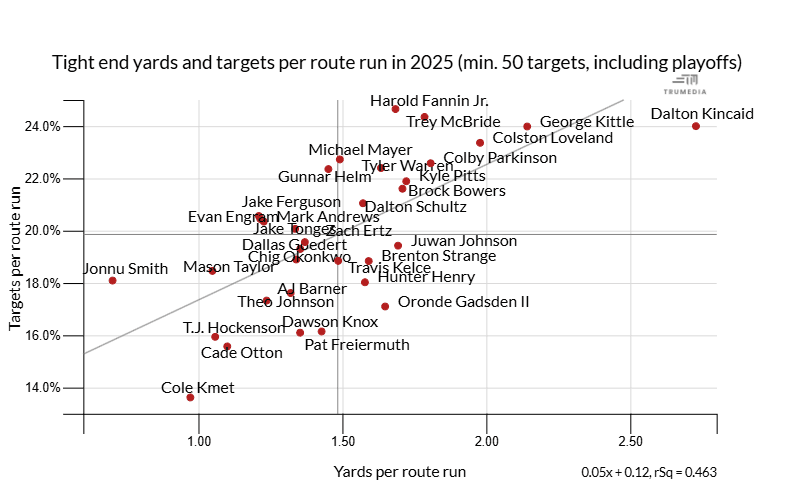
HC Joe Brady already hinted back in March that more load management could be on the table ahead of next season. Still, Brady had good things to say about Kincaid more recently in May, a sentiment that was echoed by Kincaid himself, who noted this is "probably the best I've ever felt" entering 2026. Learned doctors believe there's reason for optimism here.
You know what? I'm buying in here. Kincaid is a talented, potential target hog in maybe the league's highest-scoring offense. Yes, you need to be on the football field in order to score fantasy points. Also yes, it sure sounds like the Bills WANT that to be the case … if Kincaid is healthy enough to handle it … and at least for now it sounds like he is! We could be ranking Kincaid as high as the TE5 in the Week 2 ranks if we get a route rate of even 70% in Week 1. This is the definition of a player priced far closer to their floor than ceiling. Kincaid is a priority target for me in Round 11 and is my No. 1 late-round tight end pick among this group.
 Giants TE Isaiah Likely
- 2025 finish: 4.4 PPR points per game (TE43)
- Bull case: John Harbaugh unleashes his longtime No. 2 TE as THE clear-cut No. 2 pass-game option of a wide-open passing game that isn't even guaranteed to have No. 1 WR Malik Nabers during the early portions of the season.
- Bear case: More natural inline options Theo Johnson and Chris Manhertz prevent Isaiah Likely from securing a true full-time role, and Jaxson Dart doesn't take a step forward in an offense that winds up running the ball at a near league-high rate.
Verdict: Aside from Kincaid, Likely is my favorite late-round tight end bet of 2026. A broken foot in August sabotaged his 2025 campaign, but when healthy, Likely has the sort of YAC ability to make the most out of any low-aDOT/screen targets thrown his way, and his penchant for getting open during the scramble drill could mesh pretty damn great with Dart. Throw in the high-priced contract (one of only six tight ends making $40M+) and utter lack of target competition at TE and WR alike, and I have Likely ranked ahead of older, more expensive, and lamer options like Kelce, Ferguson and Andrews.
 Patriots TE Hunter Henry
- 2025 finish: 10.5 PPR points per game (TE13)
- Bull case: Flirts with double-digit touchdowns as the go-to red zone option from MVP runner-up Drake Maye *and* is more involved between the 20s as an intermediate threat without Stefon Diggs around.
- Bear case: Age (32 in December) catches up to the veteran, and A.J. Brown winds up soaking up all of Diggs' leftover targets—and more.
Verdict: It sure felt like 2025 went about as well as possible for Hunter Henry … and he still couldn't quite finish inside the position's top-12 options. Now, the ADP distance between Henry and guys like Andrews and Ferguson is probably far too wide, but it sure feels like if we were ever going to get an elite top-5 season from the veteran—it would have already happened by now. I'll reassess things if the long-anticipated AJB trade doesn't come to fruition.
 Commanders TE Chig Okonkwo
- 2025 finish: 7.3 PPR points per game (TE27)
- Bull case: The fun YAC beast works as Jayden Daniels' No. 2 pass-game option in an offense with basically nothing of substance behind soon-to-be 31-year-old WR1 Terry McLaurin.
- Bear case: More traditional inline options John Bates and Ben Sinnott hinder Chiggy's full-time role, and he winds up as one of many complementary pieces in a passing game that frankly wasn't very good in 2025.
Verdict: Chig Okonkwo had an absurdly efficient rookie season in a part-time role and has continued to flash afterward. The man is a legit YAC threat out there.
Of course, Okonkwo is cheaper than every other option we've discussed so far, and does seem to profile as similar commodity as Likely: Fun player in a new, fairly wide-open offense with a young QB we like alongside a potential newfound every-down role given the solid free agency investment. Now, Chig's financial investment (3 years, $27 million) isn't quite on the same level as Likely, but still: There is a clear, rational path to Okonkwo smashing his current ADP. He's my third favorite option of this group.
 Titans TE Gunnar Helm
- 2025 finish: 5.7 PPR points per game (TE35)
- Bull case: Helm builds on his enticing rookie season per-route efficiency numbers and winds up working as Cam Ward's primary red-zone threat.
- Bear case: Brian Daboll's BFF Daniel Bellinger limits Helm's full-time role, leading to him working as the No. 4 pass-game option in a passing game that (again) isn't very good.
Verdict: We're talking LATE-round tight ends at this point—Helm is currently going at the Round 15-16 turn in early drafts—but the Texas product does deserve credit for making the most out of his opportunities in Year 1. This is some good company!
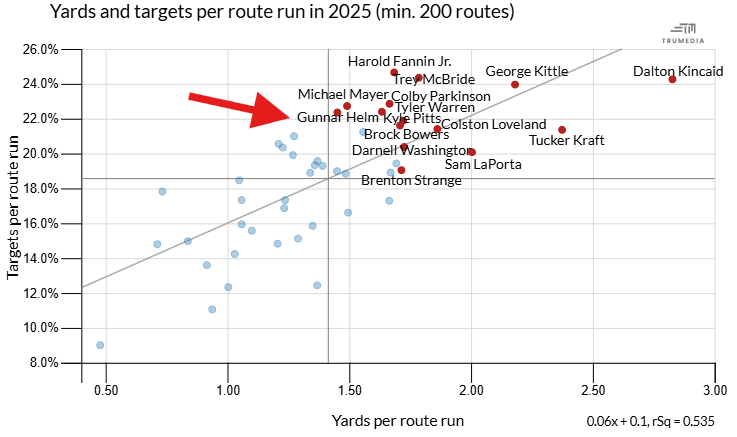
And yet, a full-time role is far from guaranteed in a new offense that also figures to predominantly flow through its top-3 receivers in Carnell Tate, Wan'Dale Robinson and Calvin Ridley. I appreciate Cam Ward's occasional off-script magic and limitless arm talent as much as the next football nerd, but it's tough to really paint the picture of a top-6-level breakout here.
 Dolphins TE Greg Dulcich
- 2025 finish: 6.3 PPR points per game (TE33)
- Bull case: The 26-year-old talent builds on his solid second half of 2026 and emerges as Malik Willis' go-to option inside an offense with the league's single-worst wide receiver room.
- Bear case: Dulcich struggles to separate from Day 2 rookie Will Kacmarek (a more traditional inline option), rendering him as one of many complementary options inside the league's single-least productive passing attack.
Verdict: Similar to Helm: You can find some quality Dulcich propaganda in terms of per-route efficiency if you move the sample size down low enough. Also similar to Helm, it's just tough to picture Dulcich going too crazy inside an offense fully expected to, you know, suck. Now, dominating target share in a bad offense could still produce quality fantasy results for the rising fifth-year veteran; just realize Dulcich already failed to land a full-time role LAST season in an offense that had new OC Bobby Slowik on the staff. Simply subtracting Jaylen Waddle from the equation isn't quite enough for me to believe in Duclich supplying true high-end heights, but hey, if you need one last tight end in the literal final round of best ball drafts—he's your guy!
TLDR: My top-3 favorite late-round tight ends ahead of 2026
Hell yeah, brother.

Go FantasyLife+
Your league is unique. Your advice should be too. Get personalized tools, rankings, and projections tailored to your fantasy football league settings.
Players Mentioned in this Article




Published Updated