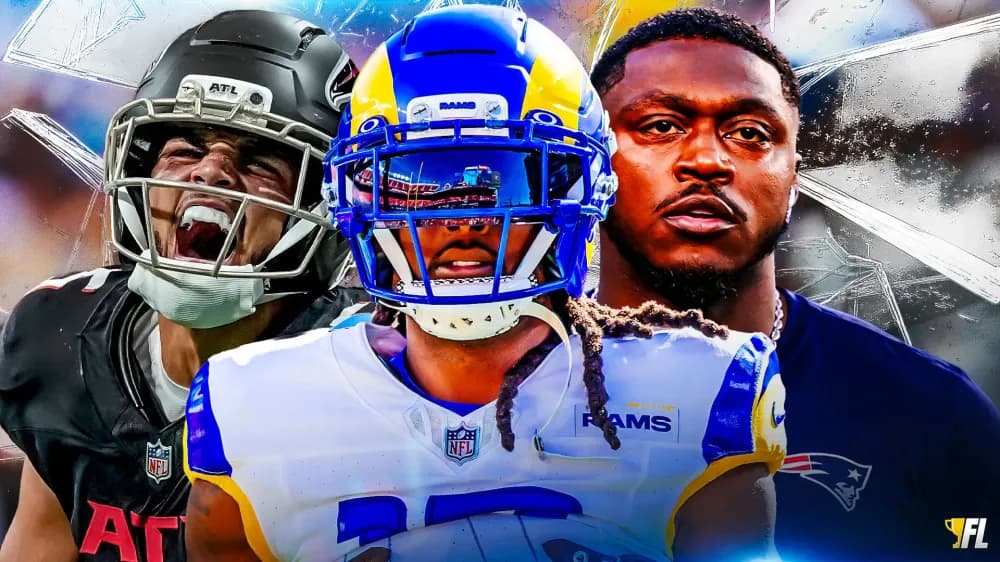
Fantasy Football Bounceback Candidates For 2026: Christian Watson, Drake London and More
Dwain McFarland highlights a dozen players who saw their 2025 performance significantly impacted by non-season-ending injuries and are in line for a bounceback 2026 fantasy football season.
When it comes to analyzing the previous year's injuries for fantasy football purposes, most fantasy players have a good understanding of players who were knocked out for the season. Because we have a clear-cut point, we can easily see whether the player is good or bad before their injury. For example, Cam Skattebo averaged 18.8 fantasy points from Week 2 through Week 7 before a Week 8 injury ended his 2025 rookie campaign.
That is helpful information to know. However, most NFL injuries are not season-ending. Often, players are managing lingering injuries to avoid or limit missed playing time. It is the dreaded high-ankle sprains and soft-tissue injuries that quietly bleed a player's fantasy value week after week—and rarely get the attention they deserve.
Identifying these nagging, multi-week injuries requires more legwork, digging into game-level injury status data and practice participation reports. But by doing this analysis, with per-game production splits, we can isolate the performances that could mask a player's true fantasy potential.

Join Our Newsletter
Trusted by 400,000+ fantasy football players. Get access to Fantasy Life's free award winning newsletter and tools, all in one step.
By registering or logging in, you agree to our Terms of Use and Privacy Policy.
2026 Fantasy Football Bounceback Candidates After Injuries In 2025
A recurring theme across these profiles: the injury story is rarely the whole story. In almost every case, a second variable clouds the picture. That complexity can suppress a player's average draft position (ADP) heading into draft season.
In this article, that is our primary focus: identifying players who battled multi-week injuries but performed significantly better when healthy in 2025 and could be undervalued in 2026 fantasy football drafts.
 Drake London | WR | ATL
The Injury
London suffered a Posterior Cruciate Ligament (PCL) injury in Week 11 that caused him to miss four games and possibly limited his effectiveness in Weeks 16 and 17.
- Week 12-15: Out
- Week 16: PCL - LP, LP, LP; Questionable
- Week 17: PCL - LP, LP, LP; Questionable
- Week 18: PCL - LP, LP, LP; Questionable
How to read the data above: For each week, the injury is listed first, followed by the daily practice participation and the final injury status for that week. DNP = did not participate; LP = limited participation; FP = full participation.
Performance Impact
Before the PCL injury, London was the WR6 in fantasy, averaging 19.4 points. Over that time frame, he monopolized 32% of the Falcons' targets on a 94% route participation rate.
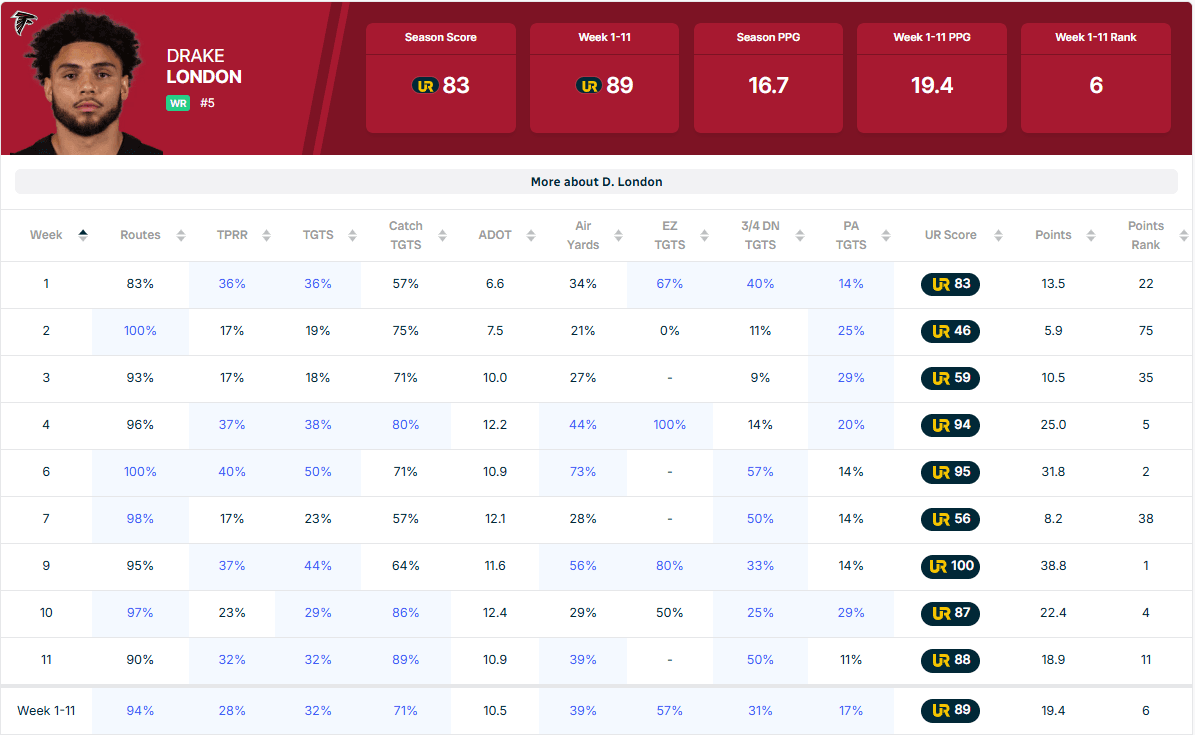
He fell flat over the final three weeks—leaving fantasy managers hurting during the playoffs. We saw 57% of London's fantasy points evaporate, with only 8.3 per game, and his target share declined nine percentage points to 23%.
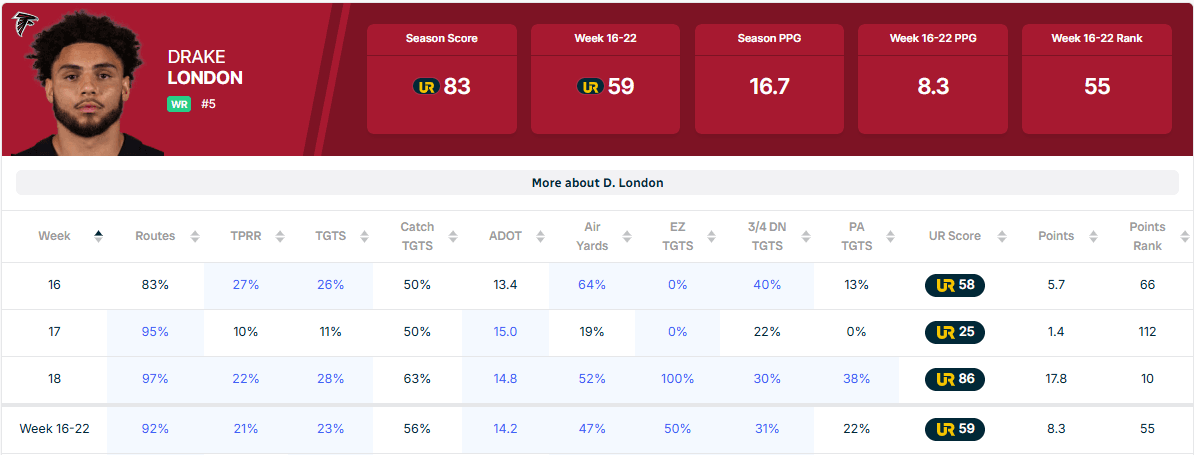
Of course, nothing is ever straightforward in a sport with so many interdependent variables. London's stats in the last three games in 2025 also coincided with him playing with Kirk Cousins. Over the last two years, in games where London has handled at least an 80% route participation rate with a healthy Michael Penix, he has been a high-end WR1, but a mid-range WR2 without Penix.
| Starting QB (75%+ snaps) | Games | Fantasy Points Per Game |
|---|---|---|
| Michael Penix Jr. | 10 | 21.6 |
| Not Michael Penix Jr. | 17 | 14.4 |
Penix is recovering from a November ACL injury, which typically takes 9 to 12 months for recovery. He has a shot to start Week 1, but that is a tight timeline. Currently, we have Tua Tagovailoa projected as the starter to begin the 2026 season. Despite Tagovailoa's recent downfall, I still consider him a better option than any other QB London has played with outside of Penix.
2026 Fantasy Outlook For Drake London
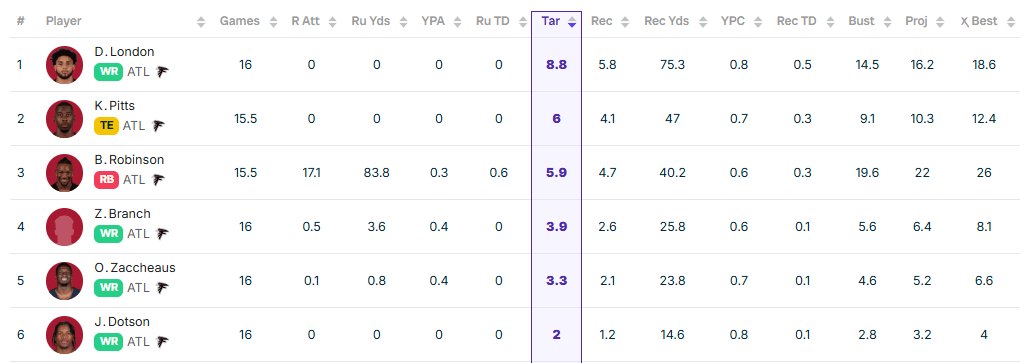
London projects as the clear-cut WR1 on a team with significant uncertainty behind him at the WR2 and WR3 spots. He is the WR7 in our projection model and offers high-end WR1 upside.
Key Stat: London averaged 19.4 fantasy points per game before his PCL injury, compared to just 8.3 in his final three games—a 57% decline in production.
Bottom Line: London is a strong Round 2 pick, worth consideration over some of the RB options in PPR leagues. In half-PPR, he is a mid-to-late Round 2 option with top-six upside.
 Davante Adams | WR | LAR
The Injuries
Adams had a couple of brief encounters with the injury report over the first 11 weeks, but became a mainstay from Week 14 through the Wild Card round of the NFL Playoffs.
- Week 4: Hamstring - DNP, DNP, LP; Questionable
- Week 11: Oblique - DNP, LP, LP; Questionable
- Week 14: Hamstring - DNP, LP, FP; Not listed
- Week 15: Hamstring - DNP, DNP, LP; Questionable
- Week 16: Hamstring, Knee - DNP, DNP, DNP; Out
- Week 17: Hamstring - DNP, DNP, DNP; Out
- Week 18: Hamstring - DNP, LP, LP; Out
- Wild Card: Hamstring - FP, FP, FP; Not listed
- Divisional: No limitations reported
- Championship: No limitations reported
Performance Impact
The veteran was the WR6 over the first 12 contests, averaging 17.1 fantasy points, collecting six top-12 finishes. He notched an 86% route participation rate and was the clear-cut No. 2 receiving option on the team behind Puka Nacua with a 26% target share.
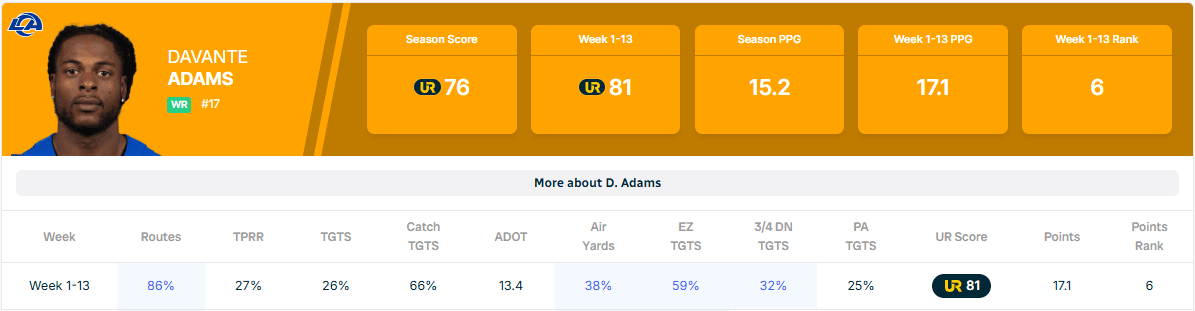
After his second hamstring injury, Adams' fantasy production per game dropped 37% to 10.7 points per game. His route participation fell to 75%, and his target share dipped to 21%.
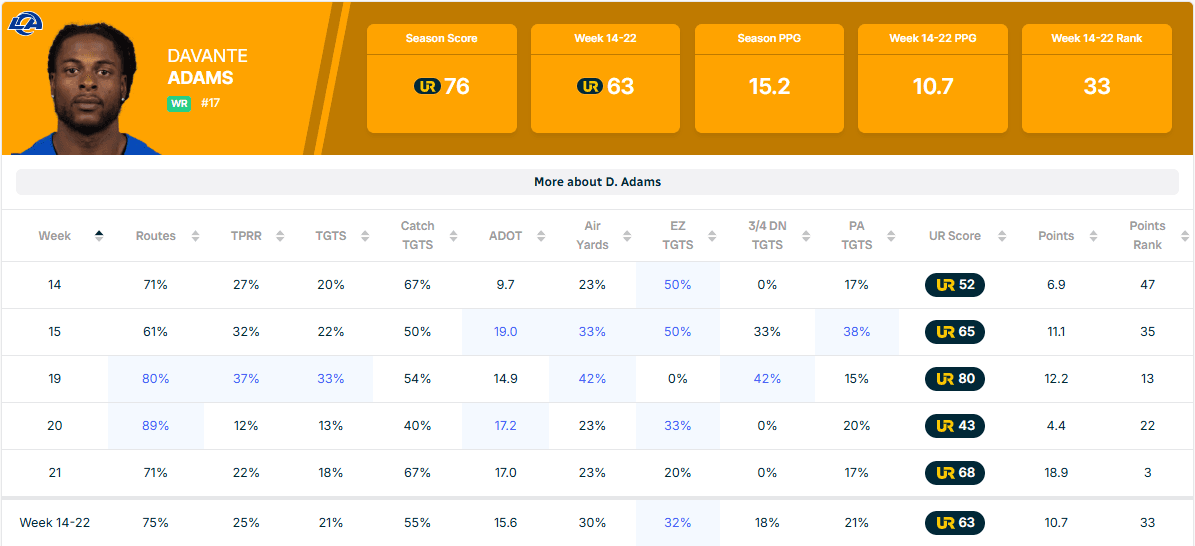
Analyzing this data, it is almost impossible to say that Adams wasn't significantly affected by injuries late in the season. Still, another factor adds some uncertainty: the Rams' adoption of 13 personnel.
| Personnel | Weeks 1-13 | Weeks 14-21 |
|---|---|---|
| 11 (1 TE, 2 WRs) | 69% | 37% |
| 12 (2 TEs, 2 WRs) | 11% | 7% |
| 13 (3 TEs, 1 WR) | 18% | 56% |
On the one hand, Sean McVay may have embraced three-TE groupings to offset a less-than-100% Adams. On the other hand, it worked, AND the Rams reinforced that commitment in the 2026 NFL Draft, selecting TE Max Klare in Round 2—a signal that heavy TE groupings probably aren't going away.
In games where Adams and Nacua were healthy, Adams posted a 31% route participation rate when the Rams utilized 13 personnel. That is a small sample, so it is hard to say how this would play out over a full season, but it adds risk to Adams' outlook in 2026 even though he was highly efficient with a 4.41 YPRR out of 13 personnel in 2025.
2026 Fantasy Outlook For Davante Adams
I have taken a conservative-leaning approach with Adams (83% routes) in our projections, assuming the Rams use more 13-personnel than they did early last year in his 12th season, when he was dominant. Still, he projects as a borderline WR2, with low-end WR1 upside.
Key Stat: Adams averaged 17.1 fantasy points over his first 12 games before hamstring issues, compared to 10.7 afterward—a 37% decline.
Bottom Line: Adams was on pace for a top-12 finish before injuries derailed his first season with the Rams. If we are overpenalizing Adams for the heavy TE utilization and age, he could pay significant dividends as a Round 5 fantasy pick.
 A.J. Brown | WR | NE
The Injury
Brown picked up a hamstring injury at training camp, which caused him to miss a large portion of summer practices. He returned by late August and was not on the injury report ahead of Week 1, but started the season slowly and suffered a setback in Week 8.
- Training Camp 8/1: Hamstring - missed multiple practices
- Training Camp 8/10: Hamstring - missed multiple practices
- Week 8: Hamstring - DNP, DNP, DNP; Out
- Week 9: Bye Week
- Week 10: Hamstring - FP, FP, FP; Not listed
Performance Impact
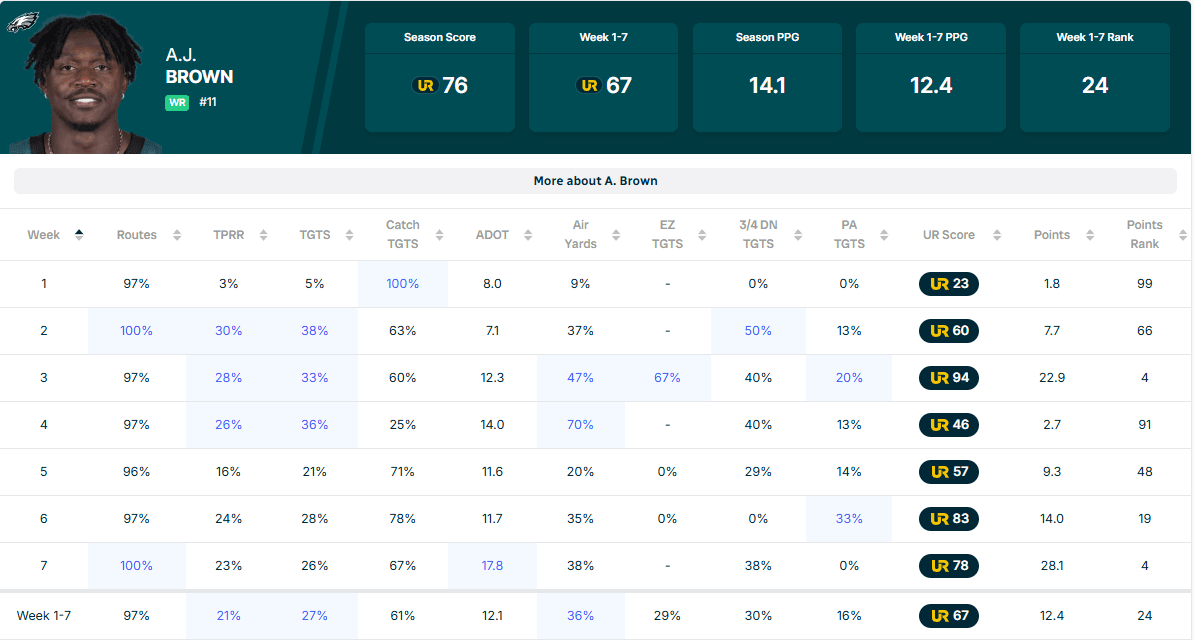
While Brown avoided the injury report until Week 8, his production was curiously low despite a strong target share over the first seven games. He averaged only 12.4 fantasy points as the WR24. Brown was earning targets (27%), but was ineffective with his opportunities.
After resting in Weeks 8 and 9, Brown looked much more like the alpha WR we have come to know, averaging 15.5 PPG—a 25% improvement. He was the WR7 in PPG from Week 10 through the Wild Card Game. That is an impressive performance in a stagnant passing attack that averaged only 202 yards per game over that span.
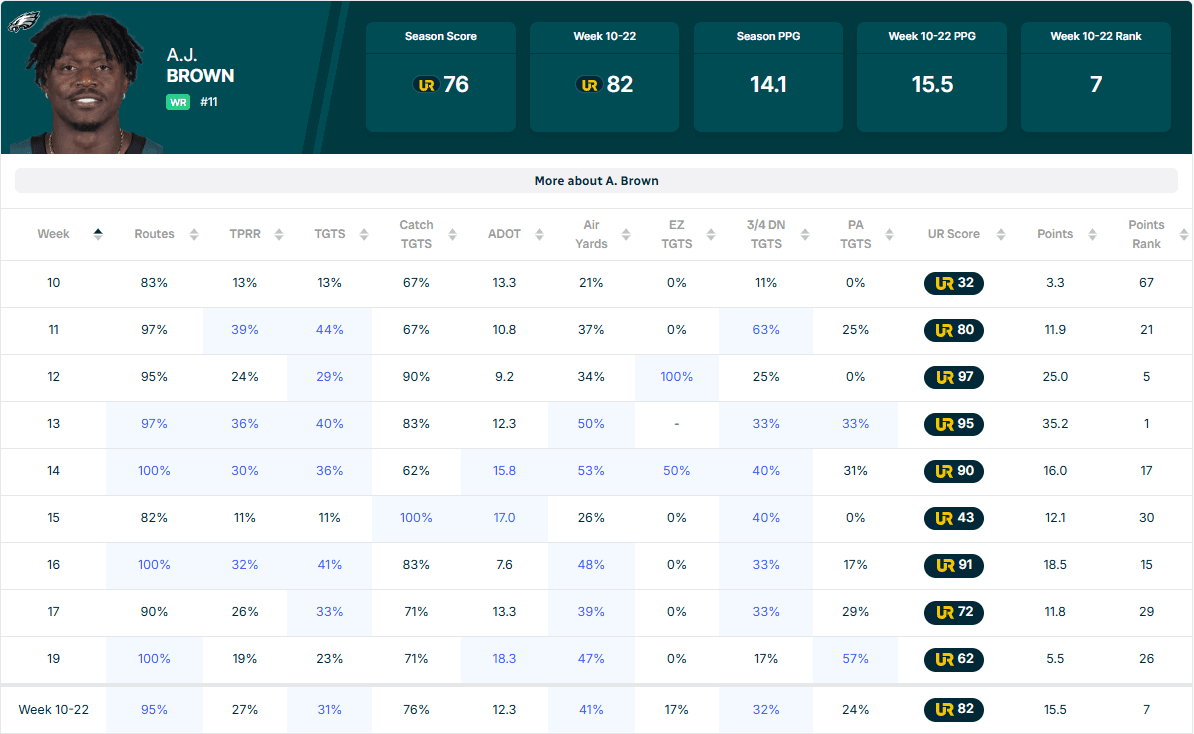
Admittedly, I am not 100% confident that Brown's early-season woes were purely a product of the lingering hamstring injury, given his absence on practice reports. But there is some variability in how teams report injuries, and the setback later makes plausibility reasonable.
A separate layer of concern is Brown's degenerative knee condition. The Patriots' General Manager, Eliot Wolf, acknowledged the condition, but the medical staff felt comfortable enough to sign off on the trade. It's a flag worth keeping in mind over the long term, but I am not overly concerned about 2026.
2026 Fantasy Outlook For A.J. Brown
Brown projects as the WR9, leaning into his two prior seasons (16.7 and 17.3 PPG) plus the strong finish to 2025. At 29, he's still in a range where elite target earners have historically remained productive. The long-term implications for his knee are concerning, but the move to New England brings a meaningful boost in passing yardage expectations.
Passing yards per game in 2025 (including playoffs):
- Drake Maye: 249
- Jalen Hurts: 199
That gap is the most important aspect of Brown's 2026 outlook. Even if he's a slightly diminished version of his former self, it's hard to imagine him failing in a thin receiving room. With the Eagles, he shared a low-passing-yardage offense with DeVonta Smith and Dallas Goedert. In New England, his competition for targets is headlined by Romeo Doubs—a solid receiver, but never a consistent high-end target earner.
Key Stat: Brown averaged just 12.4 fantasy points over his first seven games before his Week 8 hamstring setback, compared to 15.5 PPG after his return—a 25% improvement following rest.
Bottom Line: Brown offers top-six WR upside in the Patriots offense as a late Round 2 pick. His floor sits in mid-range WR2 territory if his skills decline faster than expected. In dynasty formats, the calculus is less favorable—the long-term knee concerns make this a sell-high window if you're not contending in 2026.
 Rome Odunze | WR | CHI
The Injuries
Odunze first showed up on the injury report in Week 9 and became a frequent flyer on practice reports before missing Weeks 14 to 18.
- Week 9: Heel - DNP, LP, FP; Not listed on final injury report
- Week 10: Ankle, Heel - DNP, LP, FP; Not listed
- Week 11: Ankle - DNP, LP, FP; Not listed
- Week 12: No limitations reported
- Week 13: No limitations reported
- Week 14: Foot - DNP, DNP, DNP; Out
- Week 15: Foot - LP, LP, LP; Out
- Week 16: Foot - DNP, DNP, DNP; Out
- Week 17: Foot - DNP, DNP, DNP; Out
- Week 18: Foot - DNP, DNP, LP; Out
- Wild Card: Foot - LP, LP, FP; Not listed
- Divisional: Foot - LP, LP, FP; Questionable
Performance Impact
Over the first eight games, before showing up on the injury report, Odunze averaged 15.5 fantasy points per game. He rarely left the field, collecting a 93% route participation rate, which is high-end WR1 territory. Over that span, he led the Bears with a 26% target share and notched a 1.99 yards per route run (YPRR). Historically, those align with WR1s and WR2s, respectively.
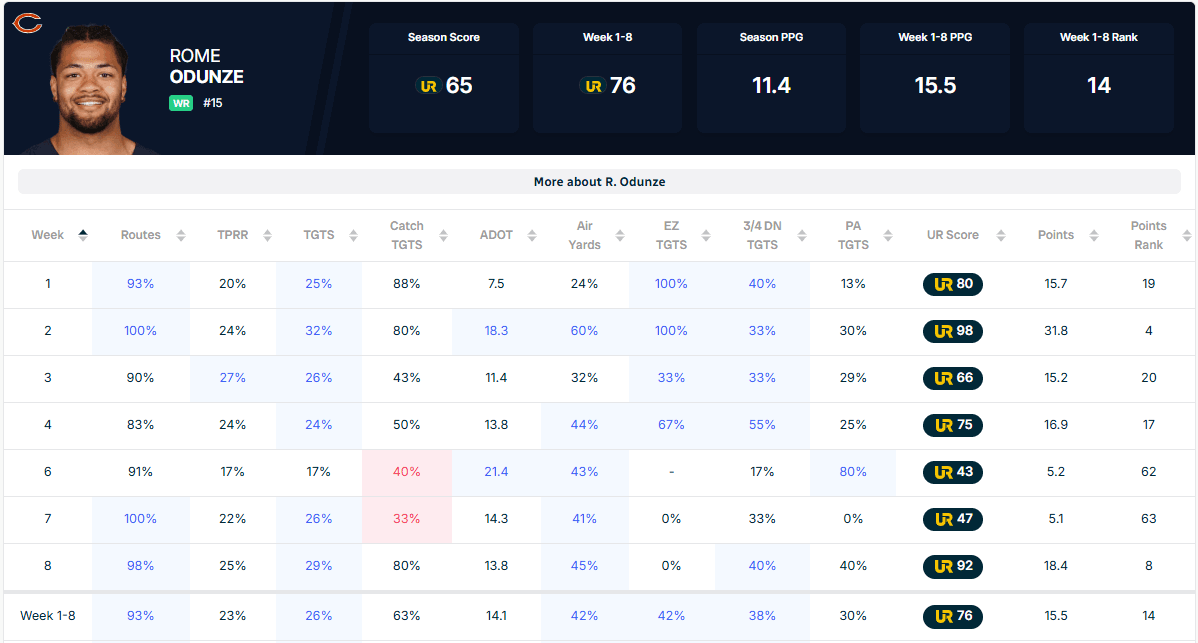
After appearing on the injury report, Odunze's route participation rate plummeted to 83%, and his target share fell to 19%. Over his final seven games, including the NFL Playoffs, he averaged only 7.2 fantasy points, representing a 54% reduction.
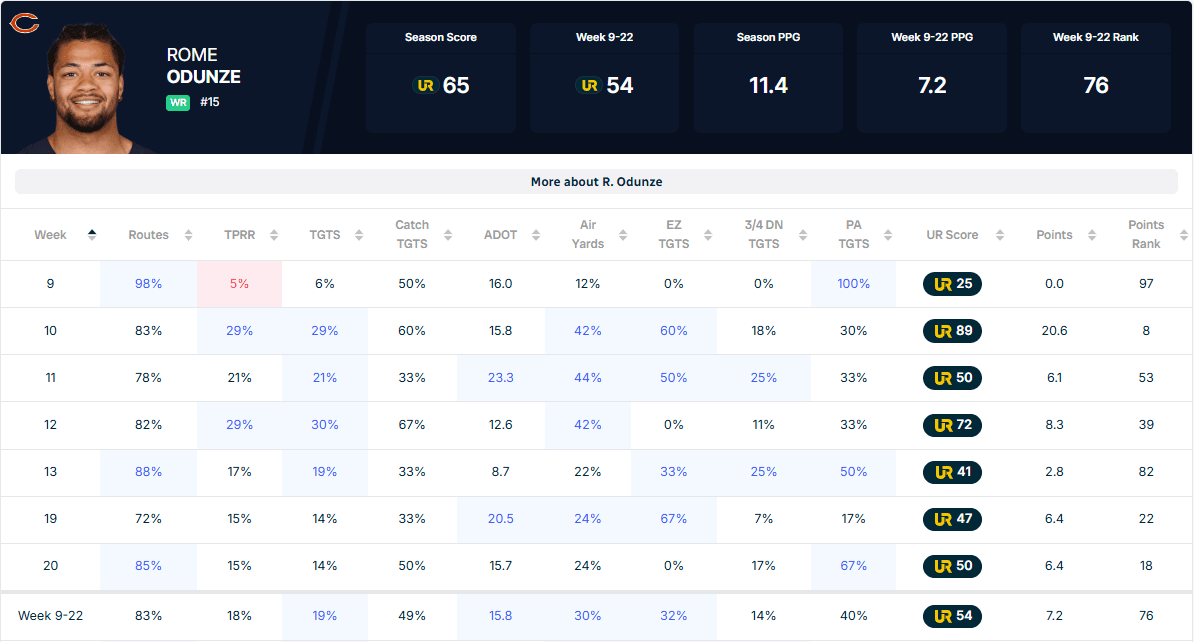
Odunze was clearly a different player after injuries took their toll in 2025. However, there are two tricky components to the equation.
First, Odunze made some concerning comments about his foot during OTA interviews:
"This is my new normal. And it’s not from a standpoint that I’m always in pain but the way my foot broke there’s callouses in there that create a different type of foot structure with those bones—different types of things that kind of shift things around. So my new normal is kind of what I am going into."
"So my new normal was kind of what I am going into. And I don't think that's anything that's going to prohibit me from making plays, but I feel like with the break it's just like when you tear your AC it's never really back to normal."
While these aren't the type of comments you want to hear, Odunze is fully practicing, getting heavily targeted, and even hauled in a 67-yard TD from Caleb Williams. I think it is important to note that the medical community isn't united on what this means for Odunze moving forward. It is a tricky situation. Additionally, we don't often get this sort of candor from a player on their injury. These types of things probably happen more often than we think. Football is a violent game.
It will be interesting to see how the market reacts to this news. I slightly reduced Odunze's route participation and docked him an additional half game in the projection model.
Second, when Odunze was thriving early in the season, Loveland and Burden were playing significantly less:
| Player | Routes Weeks 1-8 | Routes Weeks 9-20 |
|---|---|---|
| Loveland | 52% | 71% |
| Burden | 24% | 60% |
This doesn't mean we should dismiss Odunze's pre-injury splits—but we do need to acknowledge that Loveland and Burden's expanded roles may have suppressed his numbers upon return. That said, you can flip this argument: what if Odunze's absence was a catalyst for their emergence rather than the other way around? That's entirely plausible, and the sample size for Burden and Loveland in larger roles is small.
2026 Fantasy Outlook For Rome Odunze
I have Odunze ranked behind Loveland and Burden as a mid-range WR3, though their projections are tight—even after the minor playing time reduction tied to the foot comments, which could ultimately prove unwarranted. The medical community isn't united on what a "new normal" foot actually means for on-field performance.

The question worth sitting with: what if Odunze's breakout production had come in the second half of Year 2 rather than the first? In that scenario, the market would be far more bullish, drawing easy comparisons to Jaxon Smith-Njigba's Year 2 second-half surge. Instead, we're left discounting a promising sample due to injury and uncertainty.
Key Stat: Odunze averaged 15.5 fantasy points per game before injuries, compared to just 7.2 after—a 54% decline in production.
Bottom Line: Odunze was on track for a Year 2 breakout before injuries took their toll, and he is the cheapest receiving option on an explosive offense. If Loveland and Burden are stars, Odunze could still pay off a WR3 price tag. If one of them falters, finishing as the team's top option is well within Odunze's range of outcomes.
 Emeka Egbuka | WR | TB
The Injuries
Egbuka appeared on the injury report three times in his rookie campaign. His playing time was limited in two of the three contests.
- Week 3: Hip, Groin - DNP, DNP, LP; Questionable → 64% routes
- Week 7: Hamstring - DNP, DNP, LP; Questionable → 81% routes
- Week 8: Hamstring - DNP, LP, FP; Not listed → 96% routes
Performance Impact
The Year 1 WR gutted out a 14.5-point performance in Week 3 despite the injury. Over the first five games, he was phenomenal, averaging 20.1 fantasy points as the WR3. He was the No. 1 target for the Bucs with a 23% target share and demonstrated an ability to attack downfield with a 14.1 average depth of target (aDOT), which is something he didn't do often at Ohio State.
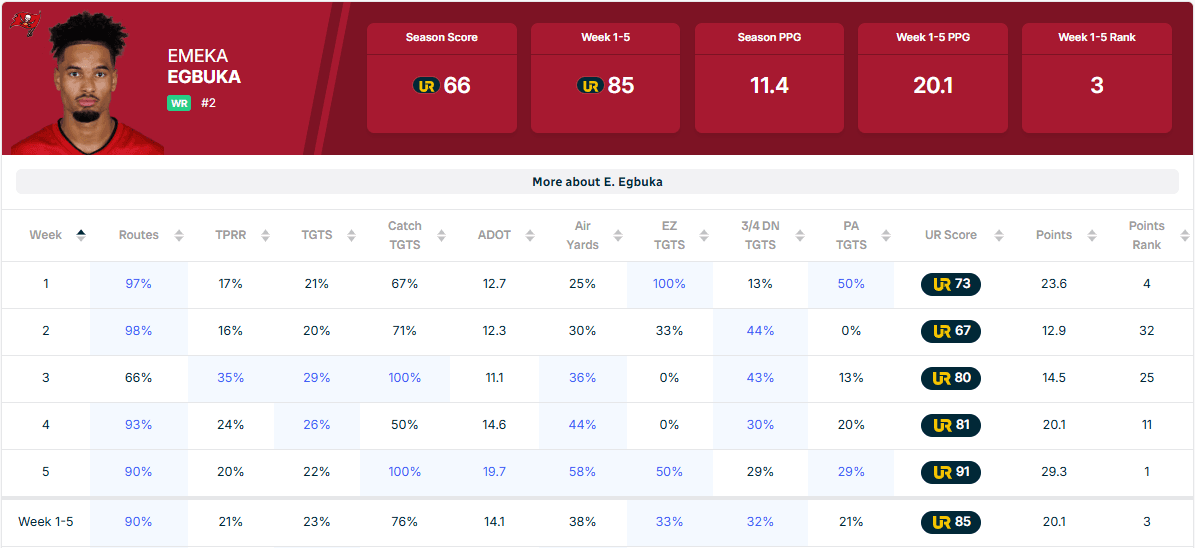
But Egbuka picked up a hamstring issue in Week 6, when he played only 64% of the pass plays, which bled into Week 7 (81%). Ultimately, he wasn't the same player after the injury—even in contests with strong route participation in Weeks 8 through 14.
Eventually, as Tampa Bay got healthy at WR, the rookie finished the season in a rotational role. Egbuka's fantasy production tumbled 61% to 7.8 PPG.
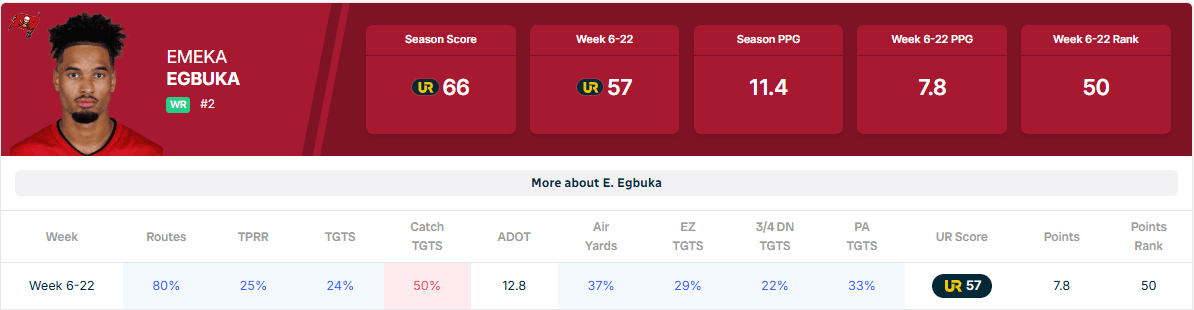
Jalen McMillan returned to the lineup in Week 15, and Mike Evans reclaimed a near full-time role that week as well. That is notable because it coincided with Egbuka's lowest route participation rates of the season: 63%, 50%, 54%, and 64%.
Was the Round 1 NFL Draft pick still less than 100%? Or did the coaching staff simply view the other options as the better players? I don't have an answer for you. But what we do know: Mike Evans is gone, and it is in Tampa Bay's best interests to see Egbuka succeed in 2026.
As with other players in this piece, the injury story isn't the only variable. But with Egbuka, there is a third dynamic to consider: Baker Mayfield dealt with knee, oblique, shoulder, core and ankle injuries over the second half of the season. His passing yards per game deteriorated from 244 in Weeks 1-10 to 188 in Weeks 11-18.
Note: For a full breakdown on Mayfield, read on, y'all!
2026 Fantasy Outlook For Emeka Egbuka
In the projection model, Egbuka isn't getting the 90%-plus route shares we saw from early last season. But we also aren't tanking him to the 50-60% range we saw late. We have him at 86%, with a strong target share in light of Evans's departure. Egbuka projects as the No. 1 receiver for Tampa Bay as a borderline WR2 with low-end WR1 upside.
Key Stat: Egbuka averaged 20.1 fantasy points over his first five games before hamstring issues, compared to just 7.8 PPG after—a 61% decline in production.
Bottom Line: Egbuka offers significant upside as a Round 4 selection in fantasy drafts. If he regains his early-season form in a less crowded attack with a healthy Mayfield, WR1 upside is on the table.
Baker Mayfield | QB | TB
The Injuries
Mayfield was only questionable for two games in 2025, but was listed with an injury on practice reports 11 times. Interpreting this data requires some caution. Todd Bowles is notorious for wild injury reporting.
Is he overreporting weeks with the FPs? Or were the FP weeks when listed actually Baker being less than a FP? Hard to say, but my guess is that it all evens out. Mayfield was probably taking most of the practice reps because it's difficult to install a game plan without your QB practicing. However, Mayfield was probably not at 100%, which is reflected in the list below.
- Week 3: Foot, Toe - FP, FP, FP; Not listed
- Week 4: Right Biceps - LP, LP, LP; Questionable
- Week 5: Knee, Right Biceps - DNP, FP, FP; Not listed
- Week 6: No limitations reported
- Week 7: No limitations reported
- Week 8: Knee, Oblique - LP, FP, LP; Not listed
- Week 9: Bye
- Week 10: Knee, Oblique - FP, FP, FP; Not listed
- Week 11: No limitations reported
- Week 12: Illness - FP, FP, FP; Not listed
- Week 13: Left Shoulder - DNP, LP, FP; Questionable
- Week 14: Left Shoulder - LP, FP, FP; Not listed
- Week 15: Left Shoulder - FP, FP, FP; Not listed
- Week 16: No limitations reported
- Week 17: No limitations reported
- Week 18: Right Shoulder, Knee - LP, FP, FP; Not listed
I think we can also agree that Mayfield is one tough SOB.
Performance Impact
Mayfield didn't seem to be impacted until the knee and oblique injuries popped up. He picked up the knee issue in Week 7. He played less than 100% of the snaps in four of five games, although some of that was due to game conditions.
That makes this one a little tricky, and our sample selection may be biased. But if we assume Week 7 as the time when injuries truly started to impact Mayfield's production, we get a stark contrast in performance:
- Weeks 1-6: 19.4 PPG
- Weeks 7-18: 15.5 PPG
Mayfield's fantasy production was 25% higher before Week 7.
What makes Mayfield's 2025 performance even more difficult to assess is the wave of injuries to his receiving corps. We already covered Egbuka above, but Mike Evans only registered a 70%+ route share in seven games. Chris Godwin reached that number six times. Jalen McMillan didn't play until the final four games.
With Evans gone to San Francisco, maybe some of this argument is moot, but a healthier Mayfield with three healthy WRs leaves the door open for a bounce-back season.
2026 Fantasy Outlook For Baker Mayfield
Mayfield projects as a mid-range QB2 with low-end QB1 upside. But that isn't a knock on him. It is just difficult to rank QBs mostly reliant on their passing production too high—primarily due to passing TD volatility. He is among the last QBs drafted with a realistic TD-spike upside. He has scrambled on 7% of dropbacks over the last two years, registering 22 rushing yards per game each season—well above his previous high of 10.
Key Stat: Mayfield averaged 19.4 fantasy points per game in Weeks 1–6 before knee and oblique injuries emerged along with a cascade of later-season injuries, compared to 15.5 PPG over Weeks 7–18—a 25% decline.
Bottom Line: If you are drafting one QB, don't build your strategy around waiting for Mayfield. However, he is in play if you are drafting two later. In bestball formats, he is a strong QB2-QB3 option.
 Javonte Williams | RB | DAL
The Injury
Williams suffered a neck/stinger injury in Week 15 that massively impacted his final three outings of the season.
- Week 16: Neck - LP, LP, FP; Not listed
- Week 17: Neck - LP, LP, FP; Not listed
- Week 18: Neck, Shoulder - FP, DNP, DNP; Out
Performance Impact
Before the neck injury in Week 15, Williams averaged 16.2 PPG with a 77% snap share. He was the RB7 in fantasy over the first 14 weeks, operating as the clear-cut RB1 for the Cowboys.
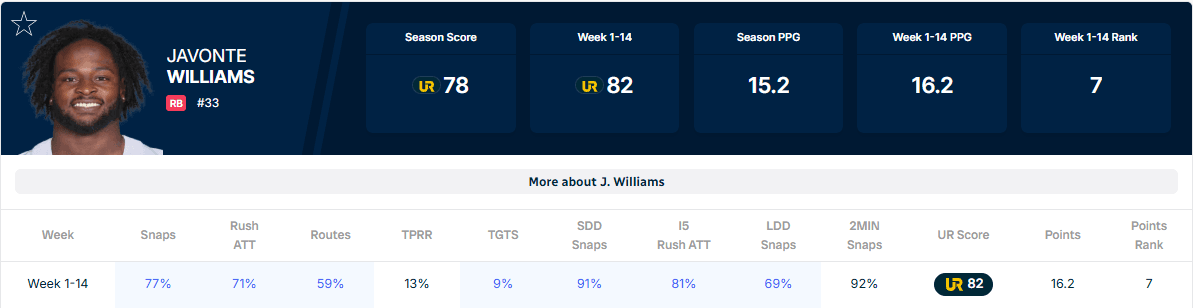
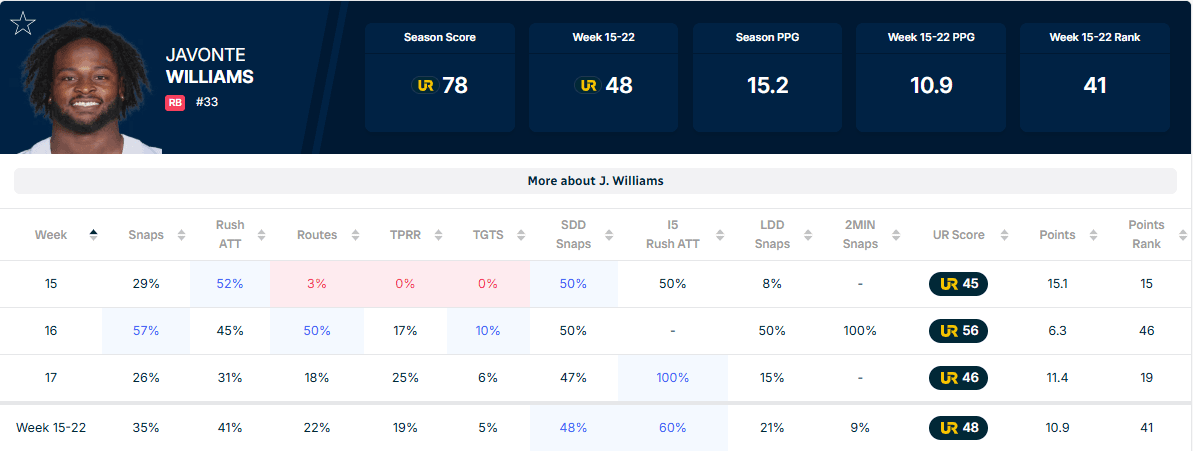
Williams is a great example of why digging into practice reports matters. If we were to just go by injury designation, Williams wouldn't show up for Week 16 or 17. Despite being removed from the injury report, he was severely limited, with snap shares of 57% and 26%. His fantasy production fell to 10.9 PPG over his final three outings, representing a 33% drop vs. his first 13 contests.
Of all the players we have covered so far, Williams has the least encumbered path to reclaiming a massive role. The Cowboys' depth chart is very weak behind him, and the team committed to a three-year, $24M contract.
2026 Fantasy Outlook For Javonte Williams
Williams draws skepticism in some circles as a potential trap pick. He is not a priority passing-game option on a team loaded with weapons. However, he has a legit path to a 70% snap share and offers double-digit TD upside on a strong offense. He projects as a borderline RB1.
Key Stat: Williams averaged 16.2 fantasy points per game over his first 14 games as the RB7 in fantasy, compared to just 10.9 PPG after his neck injury—a 33% decline that only shows up in practice participation data, not the official injury report.
Bottom Line: Williams is a late-Round 3 pick in best ball drafts who sometimes slides into Round 4 at the RB17. Honestly, you can argue there isn't much difference between him and Omarion Hampton, who goes a full round sooner. Williams offers mid-range RB1 upside with a mid-range RB2 floor.
 Omarion Hampton | RB | LAC
The Injury
Hampton fractured his left ankle in Week 5 and didn't return to action until Week 14. He reaggravated the injury in Week 17, handling a full workload with Kimani Vidal out.
- Week 6-12: Injured Reserve (IR)
- Week 13: Ankle - LP, LP, LP; Out
- Week 14: Ankle - LP, FP, FP; Questionable
- Week 15-17: No limitations reported
- Week 18: Ankle - DNP, DNP, DNP; Out
- Wild Card: Ankle - DNP, DNP, LP; Questionable
Performance Impact
Ultimately, we saw Hampton handle 50% or more of the snaps in only 7 contests during his rookie season. In those games, he averaged 15.9 fantasy points. Historically, that is low-end RB1 territory. In games below 50% of the snaps, the Round 1 NFL Draft pick averaged 7.4, which was mostly pulled down by his 3% snap outing on Wild Card Weekend. He was 114% more productive in his healthiest outings.
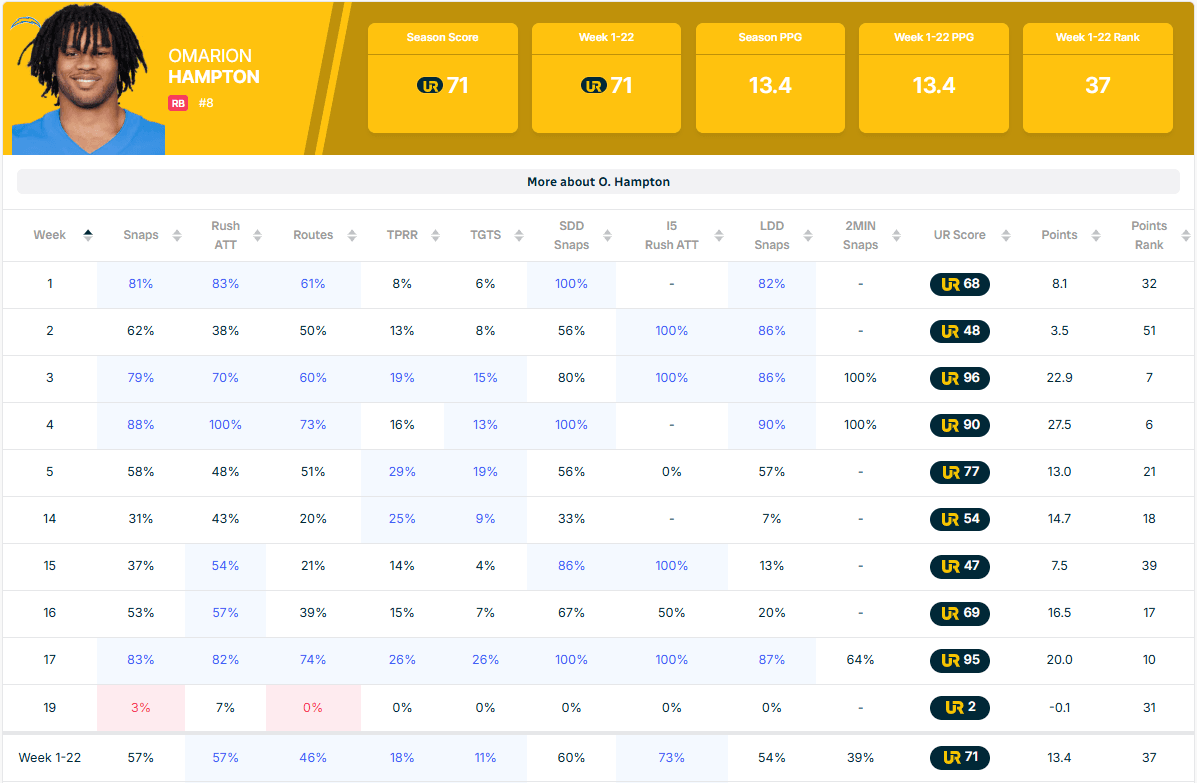
The tricky part with Hampton is the fact that he never regained the lead role until Vidal missed Week 17. Additionally, after a lackluster Week 1, Najee Harris cut into his opportunities in Week 2. But Harris suffered a torn Achilles tendon, ending his year.
With Vidal back in the fold and Keaton Mitchell also joining the backfield, concerns about a committee backfield in Year 2 remain legitimate. Still, in four games where the Chargers went all-in on Hampton, giving him a 70%+ snap share, he was incredible, averaging 19.7 points.
2026 Fantasy Outlook For Omarion Hampton
Hampton projects as a borderline RB1. He should be the No. 1 RB in Mike McDaniel's offense, which has the ingredients to be one of the most-improved offenses in 2026, but we acknowledge some risk of a timeshare.
Key Stat: Hampton averaged 19.7 fantasy points in games with a 70%+ snap share in 2025—high-end RB1 production that suggests elite upside when fully healthy and featured.
Bottom Line: Hampton is a strong bet to deliver a top-12 RB season in 2026, with top-six upside if the Chargers commit to him as an every-down workhorse. The floor is a high-end RB2 if McDaniel opts for a timeshare.
D'Andre Swift | RB | CHI
The Injuries
Swift battled multiple injuries in 2025, appearing on practice reports nine times. He was out or questionable in seven total contests.
- Week 3: Quadricep - LP, LP, LP; Questionable
- Week 4: Hip - LP, LP, LP; Questionable
- Week 7: Groin - FP, LP, LP; Questionable
- Week 8: Groin - DNP, LP, LP, Questionable
- Week 9: Groin - DNP, DNP, DNP; Out
- Week 10: Groin, Personal - LP, FP, DNP; Questionable
- Week 11: Hip - LP, FP, FP; Not listed
- Week 12: Hip - LP, FP, FP; Not listed
- Week 16: Groin - FP, LP, LP; Questionable
Performance Impact
In nine games where Swift didn't have any practice limitations, he averaged 14.5 fantasy points versus 12.2 when he was listed. He was 19% better in healthy contests.
The most interesting part about Swift is that Kyle Monangai's role expansion occurred once the groin injury flared up. Given the Week 16 reaggravation, there is a chance the team was managing Swift even in weeks where the injury didn't register on practice reports.
While I don't think Monangai is going away—he fits the one-two punch Ben Johnson has a history with, and Swift has an injury history—there is a world where Swift plays a slightly larger role as the better all-around back.
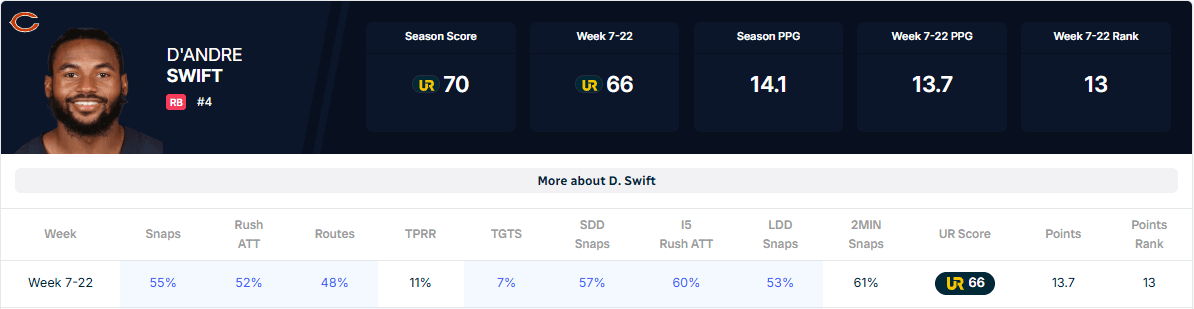
Swift enjoyed a 65% snap share in five games before the groin injury, averaging 15.1 PPG.
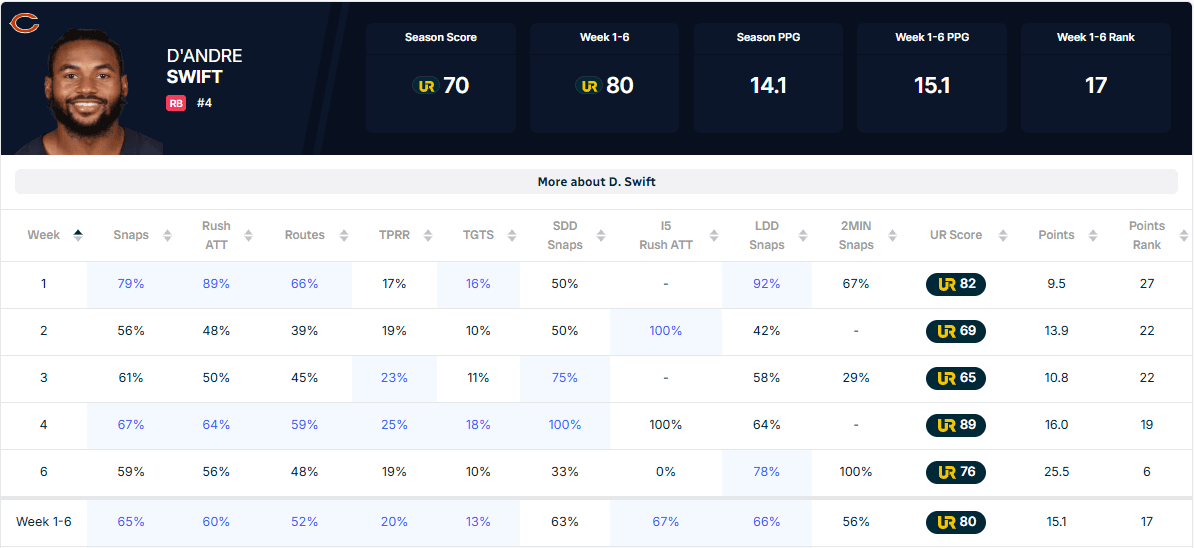
Those numbers fell to 55% and 13.7 PPG from Week 7 through the Divisional Playoff game.
2026 Fantasy Outlook For D'Andre Swift
Swift isn't the headliner in this article, but he is the most straightforward high-floor RB with sneaky upside in a high-scoring offense—and he's available in Round 5 or later. He projects as a borderline RB2. A one-two punch with Monangai is likely to continue, but Swift could play a slightly larger role as the better all-around back if fully healthy.
Key Stat: Swift averaged 15.1 fantasy points per game with a 65% snap share before his groin injury, compared to 13.7 PPG and a 55% snap share after—suggesting the injury may have quietly suppressed both his role and production.
Bottom Line: Swift isn't a priority target in drafts, but I am far more willing to click his name after doing this research—there is some upside I wasn't considering before.
 Christian Watson | WR | GB
The Injuries
Watson started 2025 on the PUP, recovering from a season-ending ACL injury that occurred in the final week of the 2024 season. He returned to action in Week 8 and ramped up to a full-time role in Week 10. However, chest and shoulder injuries hampered him late in 2025.
- Week 9: Knee - LP, LP, LP; Not listed
- Week 10: Knee - LP, LP, LP; Not listed
- Week 11: Knee, Hamstring - FP, LP, LP; Not listed
- Week 12: Knee - LP, LP, FP; Not listed
- Week 13: Knee - FP, FP, FP; Not listed
- Week 14: No limitations reported
- Week 15: No limitations reported
- Week 16: Chest, Shoulder - DNP, LP, LP; Questionable
- Week 17: Shoulder, Illness - FP, FP, DNP; Questionable
- Week 18: Out (starters rested for the playoffs)
- Wild Card: No limitations reported
Performance Impact
Ultimately, we saw Watson reach 80%+ route participation in only six contests, with injuries limiting his role in the other five. In six healthy games, he averaged 15.2 fantasy points with a 23% target share. That was 46% higher than the 10.4 he averaged when ramping up from the ACL and battling shoulder and chest issues.
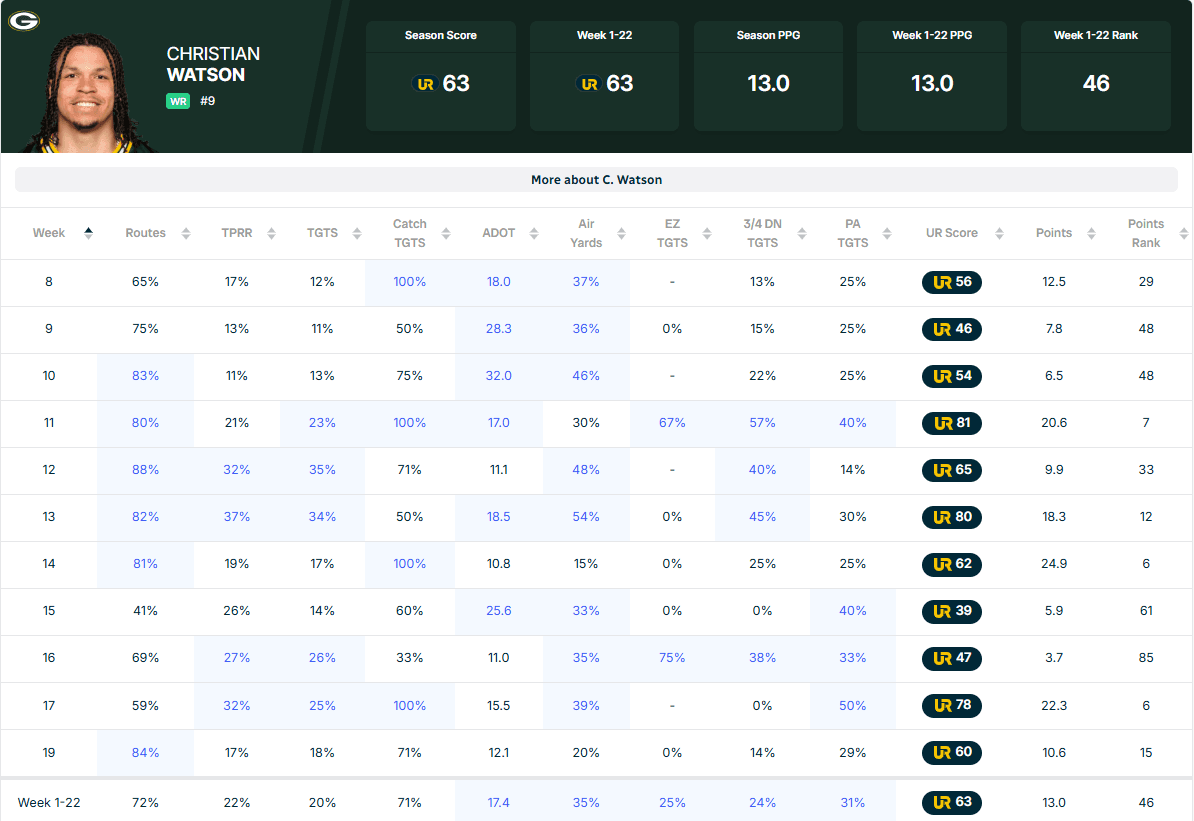
As with most of the injury splits, there is a caveat with Watson: his teammates were in and out of the lineup.
Teammates missing from the lineup by week:
- Jayden Reed: 8, 9, 10, 11, 12, 13
- Matthew Golden: 10, 12, 13, 14
- Dontayvion Wicks: 8, 9, 17 (injured in game), 19
In other words, Watson rarely had a full complement of teammates when at his best. One or more of his teammates were missing in his four biggest outings in Weeks 11, 13, 14 and 17. Additionally, his lowest route-participation weeks (15-17) coincided not only with his injury but also with the WR room being at its healthiest.
But how much do we really care? Romeo Doubs signed with the Patriots, and Dontayvion Wicks was traded to the Eagles. And the Packers are telling us how much they value Watson by giving him a four-year $110M contract extension with a $31M signing bonus.
2026 Fantasy Outlook For Christian Watson
Watson projects as a WR3 with upside in 2026. The Year 5 WR has posted a 2.20+ YPRR in three of four seasons, which aligns with historical high-end WR2s. And that is what we saw from Watson when healthy in 2025.
Of all the players in this piece, Watson may have the cleanest path forward. Two big variables clouding his 2025 splits—Doubs and Wicks—have walked out the door.
Key Stat: Watson averaged 15.2 fantasy points in his six healthiest games in 2025, compared to 10.4 when managing injuries—a 46% production improvement.
Bottom Line: Watson has a long history of injuries, but the talent and situation are aligned for the most productive season of his career in 2026. He is a priority target in Rounds 5 and 6 of fantasy drafts as a WR3 with a high-end WR2 ceiling.
 Brock Bowers | TE | LV
The Injury
Bowers suffered a PCL injury in Week 1 that he tried to play through before ultimately shutting it down for three games and returning after the bye. He continued to be listed on practice reports for the next two games despite full practices and no official injury designation by game time.
- Week 2: PCL - DNP, DNP, LP; Questionable
- Week 3: PCL - LP, LP, LP; Not listed
- Week 4: PCL - FP, FP, FP; Not listed
- Week 5: PCL - LP, DNP, DNP; Out
- Week 6: PCL - DNP, DNP, DNP; Out
- Week 7: PCL - DNP, DNP, LP; Out
- Week 8: Bye
- Week 9: PCL - FP, FP, FP; Not listed
- Week 10: Toe - FP, FP, FP; Not listed
- Week 11-16: No limitations reported
- Week 17-18: IR (no setback, but the Raiders were out of playoff contention)
Performance Impact
Bowers scored 15.3 fantasy points in Week 1, but his production dropped dramatically in Weeks 2-4, averaging 8.7 PPG.
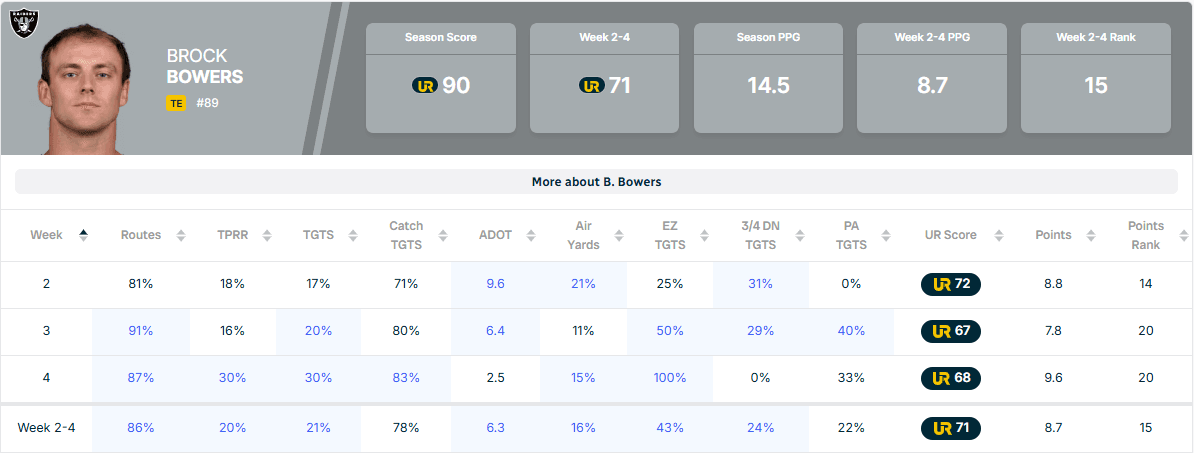
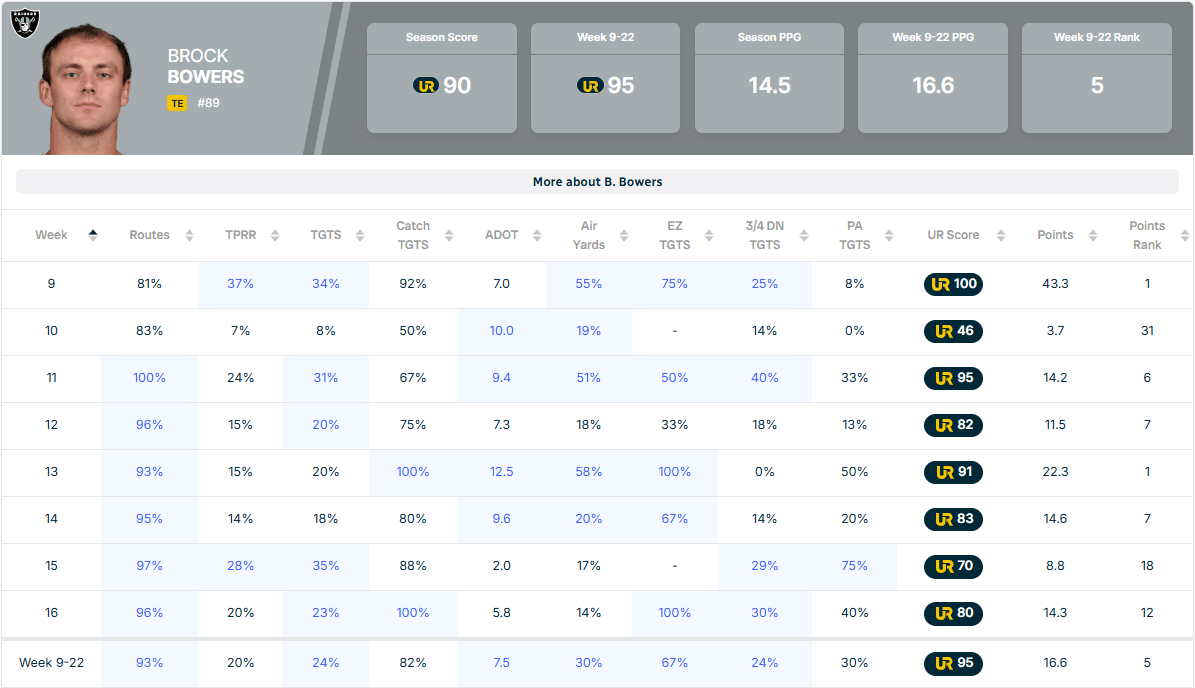
The Year 2 TE averaged 16.6 PPG after returning from injury in Week 9 and practicing in full all week. That figure is somewhat elevated by a 43.3-point outburst in Week 9, but he secured a top-12 TE finish in six of eight games after returning. Put simply, Bowers was 91% more productive after returning than in the three games he tried to play through his PCL injury.
The Raiders' receiving corps remains thin behind Bowers, leaving him as the clear primary option for the second consecutive season.
2026 Fantasy Outlook For Brock Bowers
Considering Bowers was an elite prospect who averaged 15.5 PPG as a rookie, I am leaning into his 16.6 PPG Year 2 healthy splits from 2025. He projects as a high-end TE1 who should dominate opportunities in Las Vegas.
Key Stat: Bowers averaged just 8.7 fantasy points per game in Weeks 2–4 while playing through his PCL injury, compared to 16.6 PPG after returning—a 91% production improvement.
Bottom Line: Bowers is a TE whose upside compares more closely to mid-range WR1s — a significant advantage at a position where low-end TE1s average 9.5–10.5 PPG. He ranks as my TE1 and is worthy of a Round 2 fantasy selection.
 Dalton Kincaid | TE | BUF
The Injury
Kincaid was nursing a torn PCL in his left knee from the 2024 season, which flared up early in the first week of training camp. The former first-rounder tried to play through the issue rather than having surgery. He also dealt with additional injuries, compounding the impact on playing time and fantasy output.
- Training Camp: PCL - Limited
- Week 6: Oblique - LP, LP, LP; Out
- Week 7: Bye
- Week 8: Oblique - LP, LP, LP; Questionable
- Week 9-10: No limitations reported
- Week 11: Hamstring - DNP, DNP, DNP; Out
- Week 12: Hamstring - DNP, DNP, DNP; Out
- Week 13: Hamstring - DNP, LP, LP; Questionable
- Week 14: Hamstring, PCL - LP, LP, LP; Questionable
- Week 15: PCL - FP, FP, FP; Not listed
- Week 16: PCL - DNP, DNP, FP; Not listed
- Week 17: PCL - DNP, DNP, LP; Questionable
- Week 18: PCL - LP, LP, LP; Questionable
- Wild Card: PCL - LP, LP, FP; Not listed
- Divisional: PCL, Calf - LP, LP, LP; Not listed
Performance Impact
Managing Kincaid's workload in camp paid early dividends. Over the first five games, he averaged 12.9 fantasy points as the TE3. He was still playing a part-time role with a 60% route participation rate, but was effective, earning a target on 22% of his routes.
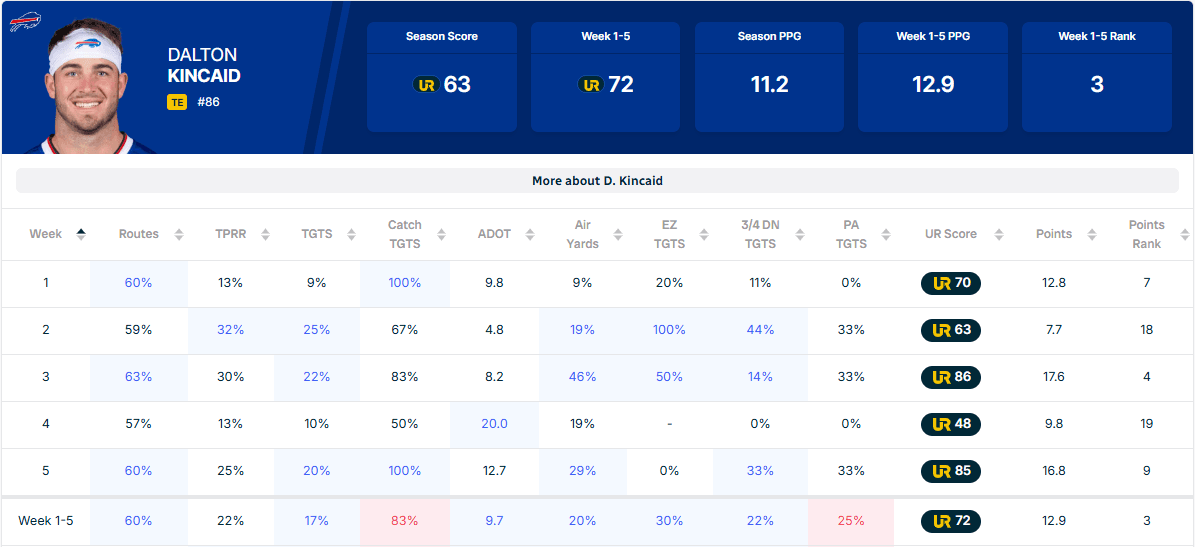
Over the final nine games, including Wild Card and Divisional games, Kincaid's route participation fell to 46%. His fantasy points followed, averaging 10.2, and falling outside the top 18 in five of nine contests. That represents a 21% decrease in fantasy output.
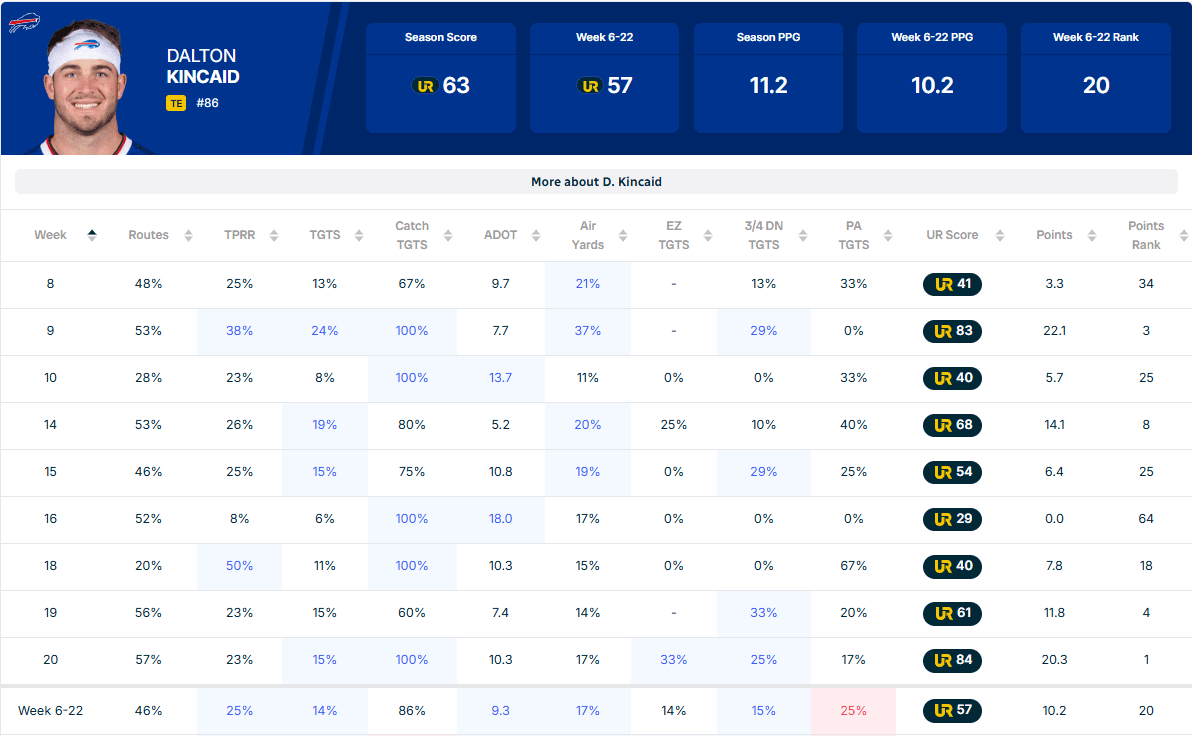
Isolating the games where he had zero limitations on practice reports tells an even stronger story. In those games, Kincaid averaged 13.5 PPG with a 24% TPRR and an elite 3.08 YPRR. He averaged 9.1 in games where he was listed on practice reports—a 48% delta. Over the last two seasons, the former Round 1 NFL Draft pick ranks second in YPRR (2.04) out of all TEs with at least 250 routes, behind only George Kittle (2.44).
The lingering question isn't talent—it's his role. Will Joe Brady finally give Kincaid a full-time workload? Brady was the offensive coordinator over the last two years and will call plays again in 2026 as the new head coach. So far, he hasn't given Kincaid that opportunity, but the injuries muddy the picture.
2026 Fantasy Outlook For Dalton Kincaid
Kincaid has the talent to offer much more in fantasy football. He is reportedly healthy heading into the season, with no restrictions, and Brady has hinted at a larger role in 2026 without PCL restrictions.
I have Kincaid projected for 65% of the routes, which makes him a high-end TE2. But if I plug in 75%, which isn't unreasonable, he jumps into the mid-range TE1 conversation. At 80%, he would push for high-end TE1 results.
Key Stat: In games with no practice limitations, Kincaid averaged 13.5 fantasy points—a 48% boost over games where he was listed on practice reports.
Bottom Line: Kincaid is one of the stronger upside TE bets in fantasy football, especially if you miss out on the high-end TE1s. If his playing time spikes, he is one of the few TEs who could push for high-end TE1 status. If his route participation rate remains low, you can cut him and find a streamer.
Honorable mentions:
- Josh Jacobs, RB, Green Bay Packers: Jacobs battled knee issues from Week 11 through the Wild Card game. Before the injury, he averaged 19.5 PPG with a 68% snap share. Post-knee injury, he handled 48% of the snaps and averaged 9.3 PPG. Jacobs was originally slated for a full write-up, but off-field concerns create too much uncertainty to evaluate on injury splits alone. If he avoids suspension and falls in drafts, the production gap makes him a significant value.
- Chuba Hubbard, RB, Carolina Panthers: Hubbard appeared on the injury report in Week 4 with a calf injury, which he tried to play through. He then sat out Weeks 5-6 before returning to full practice participation and game action in Week 7. Before the injury, he averaged 15.4 PPG with a 69% snap share, which dropped to 7.6 PPG and 43% snap share, respectively, from Week 8 through the season's end. Hubbard played behind Rico Dowdle for the majority of games, leading the backfield only two more times in Week 13 and the Wild Card game, scoring 20.4 and 19.9 fantasy points. On the one hand, we can see that Hubbard offers significant fantasy value when in a full-time role—he averaged 17.3 points in five games with 55%+ snap shares. On the other hand, he fell victim to a hot-hand approach in the season after signing a $33M contract extension. The Panthers are willing to do anything here. That could mean feeding Hubbard, but it could also turn into an eventual Jonathon Brooks takeover. Hubbard goes in the "we don't know what will happen, but there is some evidence it could be good" range of drafts in Rounds 6-7 alongside Brian Thomas, Parker Washington, Rhamondre Stevenson and Alec Pierce. Depending on your build, Hubbard is in play, but it is also a great time to grab an elite QB or Tyler Warren if you need a TE.
Why don't I see other players who played with injuries?
The criteria for making the list are two-fold: playing through injuries for multiple games AND performing significantly better in healthier games. Below are a few examples of players who played with injuries but weren't significantly better in non-injury games, so they didn't get write-ups:
- Saquon Barkley, RB, Philadelphia Eagles
- Breece Hall, RB, New York Jets
- Mike Evans, WR, San Francisco 49ers
- Brian Thomas, WR, Jacksonville Jaguars
- Khalil Shakir, WR, Buffalo Bills
There are likely some players I missed, but I tried to focus primarily on fantasy options going in the top 100 picks of fantasy drafts.
Join Our Newsletter
Trusted by 400,000+ fantasy football players. Get access to Fantasy Life's free award winning newsletter and tools, all in one step.
By registering or logging in, you agree to our Terms of Use and Privacy Policy.
Players Mentioned in this Article


Published Updated